Occasional solo compote maker
You mainly use one saucepan for seasonal batches and want to avoid committing permanent worktop space to a fitted hob. A portable cooker still needs suitable placement and a pan its cooking zone can detect.


For occasional one-person batches of plum compote, a portable induction cooker is a sensible starting point if you can give it a suitable surface and use an induction-compatible saucepan. Choose a compact built-in hob if you want a permanent fitting and a second zone; consider a wider hob if you regularly cook with several pans. Whichever format you choose, check that your small pan suits the cooking zone and plan to lower the heat, stir and stay nearby rather than relying on a boil sensor to cook the fruit.
How often you make compote matters less than whether the hob also needs to serve the rest of your cooking.
You mainly use one saucepan for seasonal batches and want to avoid committing permanent worktop space to a fitted hob. A portable cooker still needs suitable placement and a pan its cooking zone can detect.
You want induction built into a compact kitchen but usually cook for one. A narrow two-zone layout gives you a second pan position without choosing a four-zone format; its cut-out and electrical requirements still need checking.
You make compote alongside other dishes or work with several pans. A wider layout and a timer may be useful, but an assisted boiling feature should not be treated as a programme for unattended fruit cooking.
For one-person plum compote, decide how you will reduce the heat after boiling, whether you need a fitted hob, and whether your saucepan will work on the chosen zone.
Choose when: You make occasional batches and want to cook without altering the worktop.
Trade-off: It occupies a suitable surface while in use and offers less room for simultaneous cooking.
Choose when: You want a permanent fitting and sometimes need a second pan alongside the compote.
Trade-off: A two-zone layout limits how many pans you can use at once and requires installation planning.
Choose when: Compote is one part of regular multi-pan cooking.
Trade-off: It needs more worktop width; a boil-to-simmer feature may be intended for water rather than fruit mixtures.
| Concern | What to check | Who this matters to |
|---|---|---|
| Gentle simmer control | Look for selectable lower power levels and check what any timer or boil sensor actually does. AEG describes SenseBoil use with water or water with potatoes, not plum compote. | Once the fruit boils, I want to turn it down and keep an eye on the saucepan rather than assume a sensor will manage it. Around 42% of consumers put simmer control first. |
| Space and installation | Compare the exact worktop cut-out and clearances with your kitchen; confirm the model’s electrical connection before ordering a built-in hob. | In a small permanent kitchen, I want room to prepare food as well as space for the hob. Roughly 33% of consumers put installation fit first. |
| Cookware and placement | Check that your saucepan is induction-compatible and meets the model’s pan-base requirements. For a portable cooker, follow its surface and ventilation instructions. | If I use a small saucepan for one portion, I need to know the zone will detect it and that I can position the cooker safely. About 25% of consumers make cookware and setup their primary concern. |
Induction needs compatible cookware, and a pan base that is too small for a particular zone may not be detected. This matters when you make only a saucepan-sized batch.
Check the chosen model’s pan-base requirements against your saucepan before committing to the hob.
If your existing saucepan is unsuitable, you may need another pan.
AEG’s guidance describes SenseBoil use for water or water with potatoes. That stated use does not establish how it will handle fruit and sugar.
Follow the feature instructions, then adjust the heat yourself, stir the compote and stay nearby.
Overall hob width is not the worktop opening, and electrical connections differ between models. AEG specifies a hardwired connection for the IAX64411CB.
Compare your worktop and cabinet with the exact installation drawing, then confirm the electrical installation route.
Fitting may involve worktop alterations and an electrician.
A portable hob still needs a stable, heat-resistant position and unobstructed ventilation while it is operating.
Follow the model’s placement instructions, keep vents clear and do not leave simmering compote unattended.
These examples illustrate different built-in layouts and controls; the suitability of any feature depends on the exact model and how you cook beyond compote.
Consider the IAX64411CB if you want a four-zone built-in layout with a minute minder and boiling assistance for its stated uses.
Consider the HDMI32401DT where a narrow, permanent two-zone layout suits a small kitchen.
The PUE611BB5E is a conventional built-in option for someone who also cooks with several pans.
The T66FHE4L0 is relevant if flexible-zone and connected features matter to your wider cooking routine.
These choices cover portable cooking for occasional batches and a compact two-zone hob for a fitted kitchen. Compare their stated controls with your saucepan and setup; the list is not a substitute for checking the instructions for the exact model.
 No image available
A portable choice if you make occasional one-pan batches and do not want a built-in installation.
The product name lists eight power levels, 60–270°C temperature control, a three-hour timer, a child safety lock and suitable cookware measuring 12–26 cm. Check your saucepan against that stated range and follow the supplied placement instructions.
Adjust the heat and stir the compote yourself; the named cooking functions do not establish an automatic compote programme.
 No image available
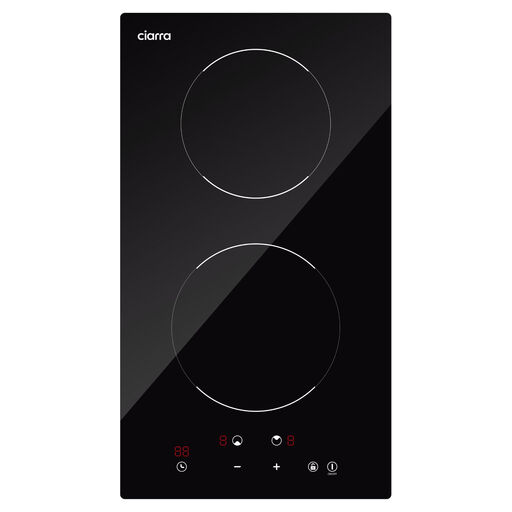
A built-in choice if you want a permanent, narrow hob and an occasional second pan position.
The product name specifies two zones, 2900 W, touch controls, nine power levels, a timer and a child safety lock. Check the installation drawing, electrical connection and pan requirements for this model before ordering.
Its heat settings and timer do not replace watching, stirring and adjusting a fruit mixture.
 No image available
A portable option for occasional compote when you can provide a suitable place to use and store the cooker.
The product name lists touch controls, ten power settings, six functions and a safety lock. Check the model instructions for your small saucepan’s minimum suitable base size and for any timer you need.
Use the settings to adjust heat manually, and stay nearby to stir and check the fruit.
It will work only if it is induction-compatible and its base suits the chosen zone. Compare the saucepan with the exact model’s pan-base requirements, particularly if you make small one-person batches.
Do not rely on SenseBoil to cook plum compote automatically. AEG describes the sensor for boiling water or water with potatoes; follow the model instructions and monitor, stir and adjust fruit mixtures yourself.
A narrow two-zone hob can suit one saucepan of compote and an occasional second pan. Beko’s HDMI32401DT illustrates the format at 29 cm wide, but any built-in model still needs a suitable cut-out and electrical installation.
Check the model’s installation drawing and electrical connection against your kitchen before ordering. GOV.UK’s Approved Document P covers electrical safety in dwellings in England; ask a competent installer about the requirements for your property’s location rather than assuming the same rules apply throughout the UK.
Use it only where its instructions permit stable, heat-resistant placement and clear ventilation. Keep it away from water and flammable materials, and stay nearby while the compote simmers.