What to check before buying
For creamy leeks in a shared kitchen, settle the fixed-versus-portable installation question, then check the household’s pans and the controls needed for a gentle simmer.
Built-in induction
Consider it when: A fixed hob is suitable and the shared pans work on induction.
Trade-off: It needs magnetic cookware, and the electrical connection varies by model.
Built-in ceramic
Consider it when: Keeping non-magnetic pans is the household’s priority.
Trade-off: The cooking zone can remain hot after switch-off.
Portable induction
Consider it when: A fixed-hob replacement is impractical but an additional cooking zone would help.
Trade-off: A one-zone unit takes counter and socket space and still needs magnetic cookware.
| Concern |
What to check |
Who this matters to |
| Gentle heat control |
Compare the exact model’s adjustable settings and any stated simmer function. |
I want to soften leeks, then turn down the heat when I add cream rather than rely on a high-output setting. Around 33% of consumers put manageable low heat first. |
| Fit and installation |
Measure the worktop opening and confirm the model’s connection and permission for alterations. |
If I cannot change the shared kitchen freely, a hob that does not fit or needs an unsuitable connection will not solve my cooking problem. For around 27% of consumers, installation is the primary concern. |
| Existing pans |
Check the household’s pan bases for induction compatibility before choosing that route. |
We use the same saucepans, so I would rather keep them than discover that they cannot heat on the new hob. Retaining cookware comes first for around 20% of consumers. |
| Shared use and hot surfaces |
Check zone count, control layout and residual-heat warnings; plan safe socket access for a portable unit. |
When someone else may cook or clean soon afterwards, I need everyone to recognise which zone is still hot. Around 20% of consumers prioritise managing the shared cooking space. |
Joybuy product choices
These choices cover built-in induction and ceramic hobs, plus a portable induction cooker for a shared kitchen where adding a cooking surface may be more practical than replacing a fixed hob. Compare each model’s fit, connection and pan requirements before deciding.
 No image available
Bosch PIE631BB5E Series 4 60 cm induction hob
Consider this built-in model if adjustable heat for a sauce matters and the kitchen can accommodate a hard-wired hob. 17 power levels are listed and slow-simmer use is described for the PIE631BB5E.
Its black-glass variant is described as hard-wired. Check the worktop opening and electrical arrangements, and make sure the household’s pans are induction-compatible.
View on Joybuy
 No image available
Ciarra 60 cm four-zone built-in induction hob
The four-zone layout is worth considering when more than one person needs cooking space. This is a built-in induction hob, so check the installation instructions and whether the shared pans have magnetic bases.
View on Joybuy
 No image available
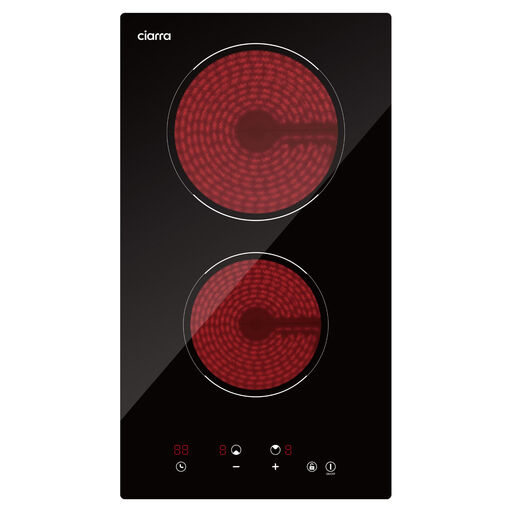
CIARRA CBBCH292T two-zone ceramic hob
This built-in ceramic option suits a household that wants to keep pans that are not induction-compatible. The listed variant has two zones, touch controls, nine power levels, a timer and a child lock; its stated power is 2900 W.
Confirm the worktop opening and electrical connection. Allow the ceramic surface to cool before anyone cleans it.
View on Joybuy
 No image available
IAGREEA DF200-14V10 portable induction cooker
Consider a portable cooking surface if changing the built-in hob is impractical and there is room to use and store a separate unit. The title specifies 2000 W, eight power levels, a 60–270°C temperature-control range, seven presets and a three-hour timer.
It specifies suitable cookware sizes of 12–26 cm. Check that your pan is induction-compatible and confirm the mains connection and safe socket access before use.
View on Joybuy
 No image available
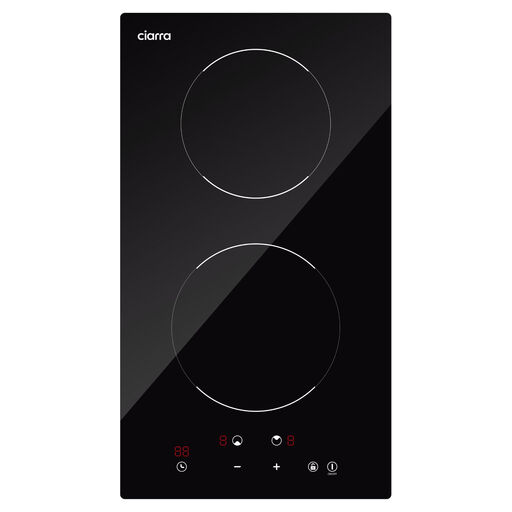
CIARRA CBBIH292T 29 cm two-zone induction hob
This narrower built-in induction option may suit a worktop where the exact installation dimensions match. The listed variant has two zones, touch controls, nine power levels, a timer and a child lock; its stated power is 2900 W.
Check the installation drawing and electrical requirements, as well as the shared household’s pan compatibility.
View on Joybuy
Common questions
Is induction or ceramic more suitable for creamy leeks?
Induction is a sensible choice when your pans are compatible and you want adjustable heat for moving from softening leeks to a gentle sauce simmer. Ceramic keeps a wider range of existing pans usable, according to Bosch UK, but its cooking zone remains hot after switch-off; compare the controls of the exact models you are considering.
Will our saucepans work on an induction hob?
They will work only if they have a suitable ferromagnetic base. Bosch UK names cast iron, enamelled steel and some stainless-steel cookware as examples; check each pan’s induction marking or whether a magnet attaches to its base.
Can every electric hob use a normal 13 Amp socket?
No: the connection depends on the model. Beko describes its HIIP64530UFT as suitable for a standard 13 Amp socket, while the Bosch PIE631BB5E is listed as requiring a 32-amp hard-wired connection. Confirm the chosen hob’s instructions and the kitchen’s supply.
What should I measure before replacing a built-in hob?
Measure the existing worktop cut-out and compare it with the exact model’s installation drawing, rather than relying on its nominal width. Beko, for instance, lists a 560 × 490 mm cut-out for the HIC64102, whose stated appliance width is 580 mm.
Can I replace the hob in a shared or rented kitchen?
Check who controls alterations under your tenancy or household arrangements before arranging a replacement, and confirm what electrical work the selected hob requires. GOV.UK’s Approved Document P concerns electrical safety in dwellings in England; it does not establish permission to change a hob throughout the UK. Check the requirements that apply where you live.


