
24/7 Customer Support

Free returns

Same-day & Next-day Delivery

Quality Guaranteed

Unlock Your Welcome Offers: FREE Delivery | Up to 80% OFF | Free 30-day JoyPlus trial
Download the APP
For any trade professional, a reliable marker is as essential as a tape measure or a spirit level. A faint or smudged line can lead to a mis-cut, wasted materials and lost time. Standard office markers simply don't hold up on a busy construction site or in a demanding workshop environment. They fade in the rain, rub off on dusty surfaces and fail to mark on materials like oily metal or rough concrete.
This guide is designed to help UK trade professionals and serious DIY enthusiasts navigate the options for industrial marker pens. We will outline the key features to look for and provide some practical recommendations to ensure your marks stay clear, permanent and precise, no matter the job.
Selecting the correct marking tool comes down to understanding the demands of your specific task. Before adding a marker to your toolkit, consider these three factors.
The material you are marking is the most important consideration. While standard permanent markers for construction work well on wood, cardboard and some plastics, they can struggle on non-porous or challenging surfaces.
Look for multi-surface marker pens that explicitly state their suitability for materials like metal, plastic, glass and concrete.
The tip of the marker dictates the kind of line you can produce.
A worksite is a harsh environment. Your marking tool needs to be as tough as the job itself. Look for heavy duty markers with robust barrels that won't crack under pressure. The ink or paint should be formulated to resist the elements. A waterproof site marker is essential for any outdoor work in the UK, ensuring your layout marks don't wash away in a sudden downpour. Equally important is resistance to UV fading, so marks made one day are still clear the next.
Based on features that address the needs of trade professionals, here are our recommendations for reliable industrial markers.
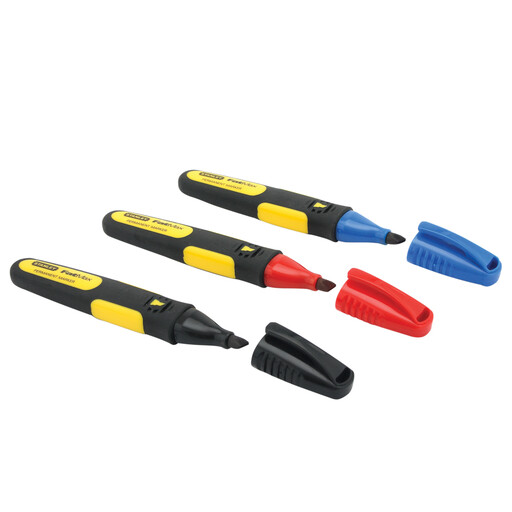
Why It Stands Out: This pack is a versatile workhorse for any tool bag. The combination of a durable build and a functional chisel tip makes it suitable for a wide range of daily tasks, from marking timber to labelling components. The permanent, waterproof ink performs reliably across multiple common construction materials.
Pros:
Who is it for? General builders, carpenters and site managers who need a reliable, all-purpose set of builders markers for everyday use on various surfaces.
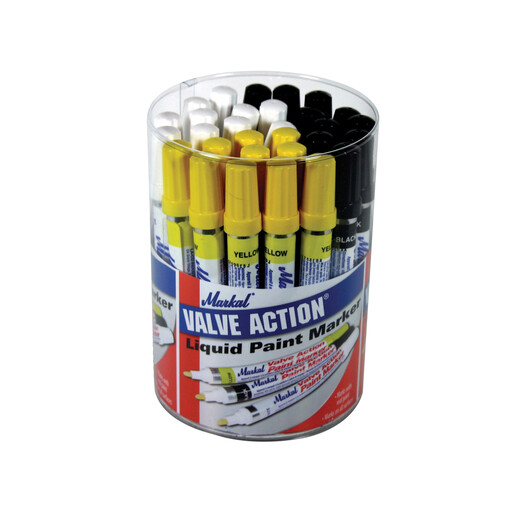
Why It Stands Out: When ink just won't cut it, this paint marker excels. The valve-action tip provides excellent control over the paint flow, delivering a crisp, opaque line on difficult surfaces like oily steel, glass and dark plastics. The weather-resistant paint formula ensures marks remain durable outdoors.
Pros:
Who is it for? Metal fabricators, mechanics, manufacturing facilities and any trade professional who frequently works with non-porous, oily or dark-coloured materials.
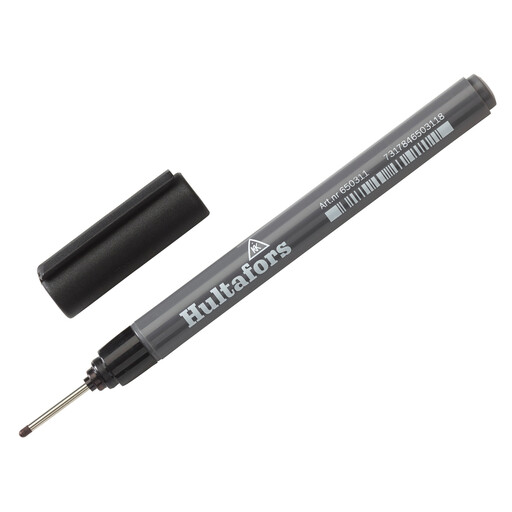
Why It Stands Out: The Hultafors marker is a specialist tool designed to solve a common problem: marking in hard-to-reach places. Its extended, fine tip allows for precise marking through bracket holes, inside fittings or for tracing templates where a standard marker is too bulky.
Pros:
Who is it for? Joiners, kitchen fitters, electricians and plumbers who need to make precise marks for drilling or cutting in confined spaces.
If the specialised markers above aren't quite what you need, or if you're looking for a more general-purpose option for your workshop, a good quality felt tip marker can be a useful addition.
Explore our full range of black felt tip marker pen options to find the right tool for your needs.
An industrial or heavy duty marker is defined by its durability and performance in demanding conditions. This includes a robust physical construction, ink or paint that is permanent and resistant to water, oil and UV fading, and the ability to write effectively on rough, dusty or oily surfaces commonly found on a job site, such as concrete, steel and timber.
Some markers are specifically designed for this. Look for products labelled as waterproof site markers or those that specify performance on damp surfaces. Paint markers often perform better than ink-based markers on wet or oily materials because the paint creates a distinct layer on top of the surface rather than trying to soak into it.
The key difference is the marking substance. A permanent ink marker uses a dye or pigment-based ink that is absorbed by porous surfaces. A paint marker uses liquid paint (often oil-based) that is dispensed through a valve-action tip. This paint forms an opaque, durable layer on the surface, making it far more visible and resilient on non-porous, dark or rough materials like metal and plastic.