
24/7 Customer Support

Free returns

Same-day & Next-day Delivery

Quality Guaranteed

Unlock Your Welcome Offers: FREE Delivery | Up to 80% OFF | Free 30-day JoyPlus trial
Download the APP
An inflatable SUP board can make water activities easier to store, transport and enjoy, whether you are planning calm-lake paddling, coastal touring, yoga or family days out. However, product listings often highlight size and accessories without explaining how those details affect stability, control and setup.
Before buying, look beyond the headline capacity or “all-round” label. The right board should match your body weight, intended use, storage arrangements and the time you are willing to spend inflating it.
Length helps with tracking and glide, but width is a major factor in initial stability. A narrow 12ft board may move efficiently through the water but feel less forgiving for beginners, children, pets or yoga practice. An extra-wide stand-up paddle board can offer a more stable platform, although it may be heavier to carry and less nimble in tight spaces.
A stated maximum weight recommendation should not be treated as the ideal load. Add together the paddler, clothing, buoyancy equipment, water, snacks, dry bags and any child or pet. A board used close to its limit may sit lower in the water and feel less responsive. For shared outings, look for a high-capacity paddle board with meaningful spare capacity.
A SUP board with paddle and accessories can appear convenient, but the bundle may include a basic hand pump, a lightweight fin or storage items you will not use. Check whether the board has suitable D-rings for a shoulder strap or a paddle board with kayak seat compatibility. A seat may be sold separately, so do not assume it is included.
For first-time paddlers, a wide paddle board for beginners is generally easier to balance on than a narrow touring design. Boards around 32–34 inches wide provide more standing space, while an 11ft to 12ft 6in board offers a useful compromise between stability and straight-line movement.
A 12ft paddle board is worth considering for longer sessions or touring because its additional waterline can support smoother tracking. For yoga, family use or a paddle board for pets, prioritise width, deck space and load capacity over speed.
PVC construction with a dual-layer sidewall can help resist abrasion from ordinary handling and launching areas, but no inflatable board is immune to sharp stones, hooks or rough surfaces. Use a launch point with suitable water access and avoid dragging the board over abrasive ground.
Inflation pressure affects rigidity. The listed maximum is not a universal target: always follow the manufacturer’s recommended pressure and never exceed it. The supplied boards below specify maximum pressures ranging from 15 PSI to 18 PSI, while compatible electric pumps may operate up to 20 PSI. Pressure gauges and automatic shut-off are useful because they reduce guesswork during setup.
A properly fitted fin helps the board track in a straighter line. Front bungee storage is useful for a dry bag, towel or spare layer, but secure all loads so they cannot interfere with your feet or leash.
D-rings can support practical additions such as a shoulder strap or kayak seat, subject to the product’s instructions and compatible accessories. For UK outings, also consider where you will store the board while inflated, how far you must carry it from the car and whether a rechargeable paddle board pump is more convenient than manual inflation.
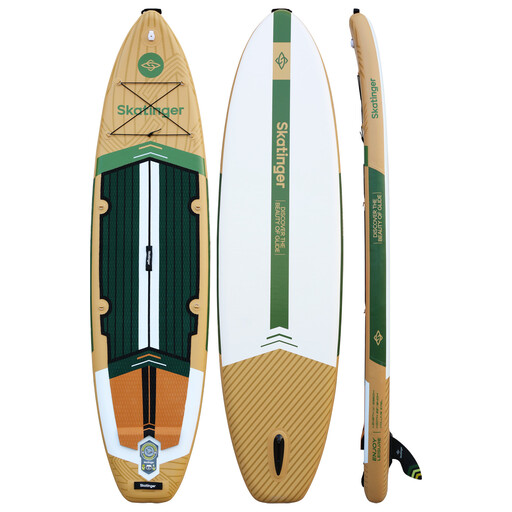
Why This Fits Their Persona: Its 11ft length and 33in width provide a practical starting point for calm-water leisure paddling, without choosing an especially long touring board.
The extra-wide platform addresses the stability issue, while the 375lb maximum weight recommendation gives more allowance for equipment than a compact solo board.
Includes a fibreglass paddle, hand pump, fin, leash, backpack, repair kit and storage bags; it also has D-rings and front bungee storage.
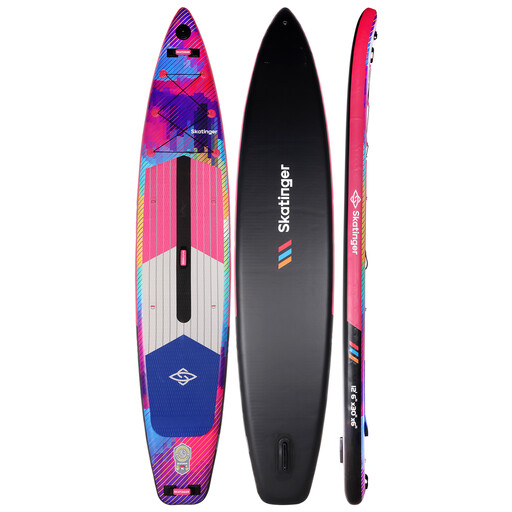
Why This Fits Their Persona: This 12ft 6in board suits paddlers who want a longer platform for relaxed cruising and longer-distance sessions while retaining a manageable 30in width.
Its stated 330lb capacity and 18 PSI maximum are clearly specified, helping buyers compare load and rigidity rather than relying on vague “premium” wording.
It includes a fibreglass paddle, leash, fin, hand pump, backpack and waterproof bag, with D-rings for optional accessories such as a kayak seat.
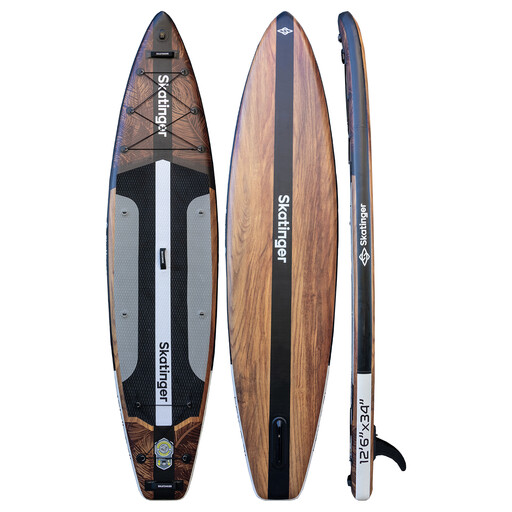
Why This Fits Their Persona: The 34in deck and 450lb maximum weight recommendation make it suitable for family paddling, a child or pet and larger loads on leisurely UK water trips.
The generous width and stated capacity address the common mistake of choosing a narrow board for shared use. Its 15 PSI limit is also stated clearly.
Dual-layer sidewalls, a 10in fin, dual bungee storage and four central D-rings support touring, carrying and optional seated paddling.
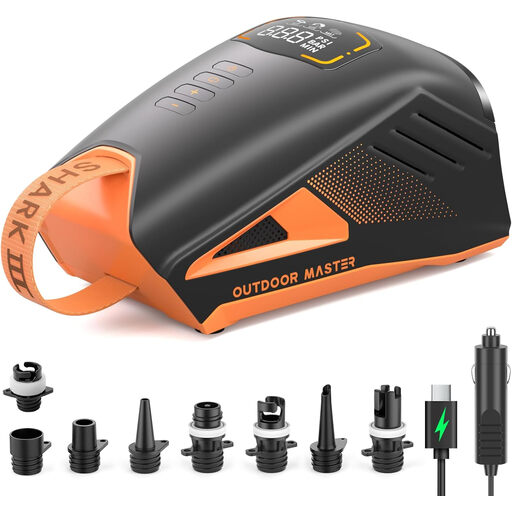
Why This Fits Their Persona: A rechargeable paddle board pump is useful for households inflating several boards or setting up away from a mains socket.
The digital pressure display and automatic shut-off reduce the risk of guessing the pressure, while the battery specification makes running requirements clearer.
The 74Wh battery is specified for up to four SUP inflation and deflation cycles per charge; Type-C and vehicle DC inputs add flexibility.
We have compiled a complete, real-time list of products that fully satisfy these strict selection criteria and UK safety regulations.
A hand pump commonly requires more physical effort and time, particularly for a 12ft paddle board. A high-pressure SUP air pump can make setup more convenient. For example, the Shark3 lists an inflation time of 3 minutes 50 seconds for a 10.6ft board to 15 PSI, although actual time varies with board size, temperature and battery condition.
Durability depends on PVC construction, sidewall design, storage and handling. Abrasion-resistant PVC and dual-layer sidewalls can help with ordinary wear, but avoid dragging the board across rough ground. Drying it completely before storage can also help reduce avoidable deterioration.
Choose a wide paddle board with sufficient deck space and spare weight capacity. An extra-wide stand-up paddle board, such as a 33in or 34in design, may feel more stable for a pet, child or low-impact yoga session. Always account for the combined weight of every person, animal and item carried and use calm, suitable water.