Teachers printing regular colour reference packs
For repeated A4 demonstrations, artist studies and handouts, consider ink capacity and paper handling alongside the wireless workflow you will use each day.


For a small classroom printing colour art references regularly, a refillable ink-tank all-in-one is a sensible starting point. Choose the exact printer by checking its support for your paper, its double-sided printing method, its shared-device workflow and the space it needs with trays open; a stated ink yield or resolution alone cannot tell you how a reference will look on your chosen stock. A cartridge inkjet remains an option if printing is genuinely infrequent.
For repeated A4 demonstrations, artist studies and handouts, consider ink capacity and paper handling alongside the wireless workflow you will use each day.
Check whether the printer fits near the teaching workstation with its trays open, and whether it accepts the particular A4, photo or heavier paper used in lessons.
If several compatible devices need to print and staff also copy or scan worksheets, check wireless setup, operating-system support and the model’s workload guidance.
Start with the paper and reference sheets the class needs, then consider how often staff will print them and how the printer will fit into the room’s workflow.
| Concern | What to check | Who this matters to |
|---|---|---|
| Recurring colour printing | Compare the exact model’s ink system and stated yield basis with your expected colour-heavy output. Do not treat a document-page yield as a count of full-page art prints. | If I prepare colour references repeatedly, I want to plan ink supplies without treating the bottle yield as a promise for my images. Around 31% of consumers put recurring print capacity first. |
| Paper and image flexibility | Check supported sizes, paper types and weights, plus borderless options; sample-print on the intended stock if colour appearance is important. | When the lesson depends on the appearance of an image on particular paper, I need to know that the printer accepts that stock. Paper and reference appearance come first for around 31% of consumers. |
| Shared classroom workflow | Confirm compatibility with staff devices and school Wi-Fi, and whether scanning, copying or a particular double-sided printing method is needed. | If several staff members use one machine for handouts and originals, I need their devices and routine tasks to work together. Around 23% of consumers prioritise that shared workflow. |
| Space and upkeep | Measure the placement with trays open and cable access; check the exact model’s cleaning instructions and replaceable parts. | With little room beside the teaching workstation, I need space to load paper and maintain the printer. For around 15% of consumers, fitting and looking after it is the primary concern. |
Epson’s stated ET-2950 yields are page figures; a colour-heavy reference sheet may use ink differently from the pages behind a yield claim.
Plan supplies around the class’s own output and try a representative reference sheet before relying on a stated yield.
Heavily covered images may mean replacing ink sooner than a headline page figure suggests.
Canon UK specifies manual two-sided printing for the PIXMA G3570, while a Joybuy listing for the named model describes automatic duplex printing. That difference matters when staff prepare double-sided packs.
If automatic duplex is essential, check the exact model’s manufacturer specification and obtain written clarification from the seller before ordering.
Manual double-sided printing adds paper handling when preparing packs.
A resolution figure does not establish how colours and tones will appear on the stock used for lessons; supported media also varies by model.
Match the manufacturer’s paper specifications to the intended size, weight and finish, then sample-print a colour-critical reference on that stock.
Canon states that print-head cleaning consumes ink, so unnecessary cycles use supplies without addressing a visible printing problem.
Follow the exact model’s instructions and run cleaning when symptoms such as missing lines call for it, rather than as an automatic routine.
Epson’s EcoTank ET-2950 illustrates a refillable A4 print, scan and copy option for recurring classroom sheets.
Canon’s PIXMA G3570 is a refillable all-in-one to examine when A4 borderless references and a choice of photo or speciality media matter.
HP’s Smart Tank 7005 offers a refillable wireless all-in-one example for staff sharing a classroom printer.
These printers offer different starting points for classroom reference printing, including A4 multifunction models and an option to check against your required paper sizes. Match each one to printing frequency, intended stock and available space rather than assuming every model meets the same needs.
 No image available
For repeated classroom reference sheets, check that this model accepts your intended paper weights and finishes. Measure the space available with its trays open and allow access for cables; sample-print on your stock if colour appearance affects the lesson.
 No image available
For shared A4 classroom tasks, the product name identifies printing, scanning, copying and Wi-Fi. Check supported paper weights and finishes for your references, and measure the exact installed footprint rather than relying on a compact placement.
 No image available
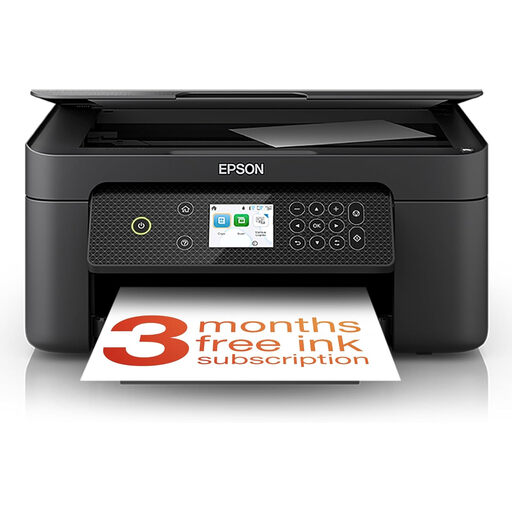
Consider this A4 Wi-Fi inkjet if classroom colour-reference printing is occasional rather than frequent. Its product name states 5760 × 1440 DPI; that figure alone does not establish the result on your paper. Check supported weights and finishes and plan for its individual ink cartridges.
 No image available
If you are considering this printer for visual references, confirm that its supported sizes include the A4 sheets you intend to use and that it accepts their weight and finish. Check its installed footprint and whether your classroom also needs scanning or copying.
A refillable ink-tank printer is a sensible starting point when the class prints colour references regularly and wants fewer cartridge changes; a cartridge printer can remain an option for infrequent use. In either case, check the exact model’s paper support and plan ink supplies around your own image coverage rather than a headline yield.
No. DPI describes printer resolution, not how colours and tones will appear from every file on every paper. Check supported media and sample-print on the intended stock when the appearance of a reference matters.
Do not plan on automatic duplex printing for the PIXMA G3570 without clarification: Canon UK specifies manual two-sided printing, while a Joybuy listing describes automatic duplex for the named model. If staff regularly prepare double-sided packs, check the current manufacturer specification and ask the seller to confirm the exact item in writing.
Follow the exact printer’s instructions when print symptoms, such as missing lines, indicate that cleaning is needed. Canon advises that print-head cleaning consumes ink and should be used only when necessary; its general guidance is not a maintenance schedule for every model.
Check the school’s local-authority, academy-trust or contracted waste-provider process for electrical equipment before disposal. GOV.UK identifies the Waste Electrical and Electronic Equipment Regulations 2013, as amended, as underpinning the UK framework; that does not establish one disposal route for every school’s arrangements.