Frequent schedule re-printers
You revise schedules often or print copies for other people. Refilling ink, turning sheets over and reloading paper are the interruptions worth considering before you choose a printer.


If you regularly revise or print several copies of A4 training schedules, consider a refillable ink-tank printer with automatic two-sided printing; check its size and paper handling before choosing one for a hobby room. For occasional, mostly single-sided sheets, a simpler printer may meet the need without paying for capacity or specialist finishing features you will rarely use.
You revise schedules often or print copies for other people. Refilling ink, turning sheets over and reloading paper are the interruptions worth considering before you choose a printer.
You mainly print single-sided A4 schedules, with occasional copying or scanning, and want to print wirelessly from the device where you keep your plans.
You regularly turn schedules into A5 inserts or compact handouts, so the finished paper format matters as much as printing the original A4 page.
Start with how often you reprint schedules and the format you keep them in. Then check the exact printer's wireless setup, two-sided printing, paper support and dimensions against your routine.
| Concern | What to check | Who this matters to |
|---|---|---|
| Ink replenishment | Check whether the exact model takes refillable bottles or replacement cartridges, and compare the ink needed for your usual schedules. | When I regularly replace revised schedules, I want fewer interruptions to replenish ink. Around 43% of consumers would put ink replenishment first. |
| Low-fuss updates | Confirm automatic rather than manual two-sided printing, wireless compatibility with your devices and a suitable paper-tray capacity. | If I print multi-page schedules from another room, I want to send them wirelessly and avoid turning sheets by hand. Roughly 29% of consumers would prioritise easier updates. |
| Format and fit | Measure the available surface, then check supported paper sizes and media before choosing A5 inserts or heavier hobby sheets. | I need schedules that fit my planner or filing system, but the printer must also fit my workspace. About 28% of consumers would make format and physical fit their primary concern. |
Two-sided printing is model-specific. HP specifies automatic duplex printing for the Smart Tank 7005, while the published Canon PIXMA G3570 series specifications do not establish that capability.
Check the exact model's specification for automatic duplex before relying on it for multi-page schedule packs.
Manufacturer page-yield figures do not predict how long ink will last with your mix of text, colour blocks and repeated revisions.
Compare replacement ink for the models you are considering and think about how often you actually reprint schedules.
Paper weight alone does not establish that a particular card or coated sheet will feed properly. Epson notes that third-party media may not be compatible with the ET-2950.
Check the exact printer's paper guidance and try a small pack before buying larger quantities for planner sheets.
Brother's DCP-J1800DW cuts A4 sheets to A5, including two-sided sheets. That workflow addresses a different need from printing ordinary A4 wall schedules.
Consider an integrated cutter when A5 inserts or handouts are a regular finished format.
Epson's EcoTank ET-2950 is an A4 multifunction example for regularly refreshed schedules.
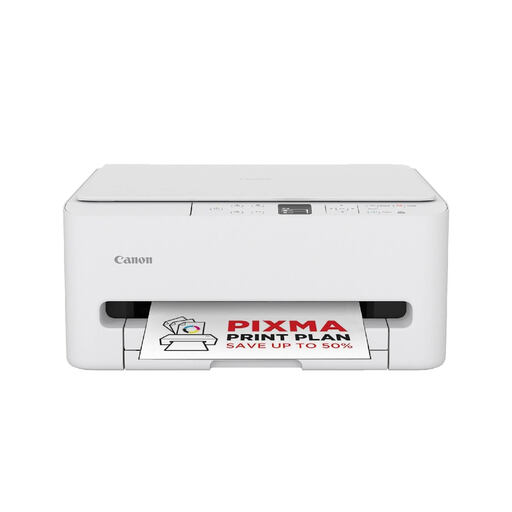
Canon's PIXMA G3570 series is a refillable print, scan and copy option for predominantly A4 schedules.
HP's Smart Tank 7005 is a refillable option to examine when schedules are printed in frequent batches.
Brother has distinct options for paper handling and for turning A4 schedules into A5 sheets.
These printers offer choices for A4 schedule printing, including models selected for frequent reprints and an option to consider for occasional sheets. Compare each exact model's ink system, paper handling and dimensions with your hobby-room routine.
 No image available
Consider this model if you frequently reprint schedules and want to assess a refillable-ink, automatic-duplex setup. Check its paper handling and dimensions against the batches you print and the space available.
 No image available
For regularly revised A4 schedules, consider whether its wireless and two-sided printing options suit your devices and workflow. The product name identifies it as an A4 multifunction printer with Wi-Fi; check the dimensions for your intended surface.
 No image available
For occasional A4 schedules, consider this model alongside your cartridge-replacement needs rather than assuming it has a refillable tank. If you also scan or copy multi-page schedules, confirm the paper-feeding features of the exact model.
Not solely because it has a high advertised page yield. If you print only a few single-sided A4 sheets now and then, give more weight to the printer's size, wireless setup and the ink you will need to keep available; refillable tanks become more relevant when reprinting is a regular task.
Automatic two-sided printing is useful when you regularly make multi-page schedule packs, but it matters less for a one-page wall schedule. HP specifies automatic duplex for the Smart Tank 7005, and Epson lists double-sided printing for the ET-2950; check the exact model before relying on this feature.
Use heavier paper only when the exact printer supports its size, weight and media type. Epson lists a compatible paper-weight range of 64–300 g/m² for the ET-2950 but warns that third-party media may not be compatible, so consult the model's paper guidance before buying speciality sheets.
Consider one if A5 binder inserts or handouts are a regular part of how you use your schedules. Brother states that the DCP-J1800DW can cut A4 sheets to A5, including two-sided sheets; the feature adds little to a routine built around uncut A4 pages.
Check the exact model's device compatibility, manufacturer security-support information and firmware-update instructions. GOV.UK says the UK consumer connectable product security regime came into effect on 29 April 2024; whether a particular printer falls within its scope cannot be determined from Wi-Fi connectivity alone.