Regular puzzle-pack organisers
If several attendees need A4 packs at each session, paper loading and turning sheets can interrupt preparation. These organisers have particular reason to consider tray capacity and automatic two-sided printing.


For recurring A4 puzzle packs, consider a refillable ink-tank all-in-one with automatic two-sided printing, then match its paper capacity and scanning features to the work your volunteers do. Manual two-sided printing can suit smaller, occasional runs, but someone must turn and re-feed the sheets. Treat stated ink yields as comparison figures, not a promise of how many puzzle pages you will print.
If several attendees need A4 packs at each session, paper loading and turning sheets can interrupt preparation. These organisers have particular reason to consider tray capacity and automatic two-sided printing.
Volunteers preparing handouts from paper originals need to consider the scanning and copying workflow as well as printing. An automatic document feeder (ADF) is relevant when they regularly handle multi-page originals.
For small or irregular batches, a volunteer may be willing to turn sheets over for two-sided printing. The group should still decide who will manage paper, ink and print errors before a session.
Start with the group’s usual A4 batch and identify the task that causes the most interruption: replenishing ink, producing double-sided packs, handling paper originals or setting up an occasional print run.
| Concern | What to check | Who this matters to |
|---|---|---|
| Ink replenishment | Compare the stated black-ink yield, replacement bottles and your expected mix of monochrome and colour pages. Check that yields use a comparable test basis. | If I prepare puzzle packs repeatedly, I want to plan ink changes rather than run short before a session; roughly 37% of consumers would make replenishment their primary concern. |
| Batch workflow | Check whether two-sided printing is automatic, how much paper the tray holds and whether the quoted document speed is for mono output. | When I produce several pages for each attendee, turning sheets and reloading paper can slow the batch; around 27% of consumers would put that workflow first. |
| Paper originals | Check for print, scan and copy functions and whether an ADF can feed multi-page originals. | If I turn existing sheets into handouts, I need a manageable way to copy or scan them; approximately 18% of consumers would prioritise this preparation work. |
| Occasional use | Check who will set up the connection and whether manual two-sided printing is practical for the usual batch size. | For a small, irregular session, I may prefer a straightforward setup and accept turning the pages myself; about 18% of consumers would make simplicity their main concern. |
For recurring packs, the printer alone does not show how often the group will need ink or paper. Which? highlights the importance of running costs when comparing cartridge and tank printers, without implying the same saving for every workload.
Estimate the group’s monthly monochrome and colour output, then compare replacement supplies and stated yields for the models you are considering.
Also allow for paper, maintenance consumables where applicable and the volunteer time needed to replace supplies.
Canon lists automatic two-sided printing for the MAXIFY GX1050, as does Brother for the DCP-T780DW. HP specifies manual two-sided printing for the Smart Tank 5105, which requires someone to re-feed the sheets.
If the group makes regular double-sided packs, look for an explicit automatic-duplex specification. With a manual-duplex model, try a small numbered batch to check sheet orientation before printing the full pack.
Turning and checking sheets adds volunteer time and can mean reprinting pages fed the wrong way round.
Canon describes the GX1050’s black-bottle yield as an estimate based on an ISO/IEC 24712 chart and continuous-print simulation. Different puzzle layouts, settings and maintenance patterns can change actual output.
Compare yields stated on the same basis, and plan replacement ink before a recurring session rather than relying on the quoted page count alone.
Printers in the same range can differ in their paper handling and two-sided printing. A familiar range name is not enough to establish that a particular listing suits the group’s packs.
Check the exact model number and its current product details, including duplex mode, paper capacity and the functions your volunteers need.
These model examples show different features to weigh for community handouts; features described for one model should not be assumed across its brand’s range.
Canon positions the MAXIFY MegaTank GX1050 for compact home-office document work.
Brother’s refillable-tank DCP-T780DW combines A4 printing with scanning and copying.
Epson’s EcoTank range includes refillable all-in-ones; the ET-3950 is an example with double-sided ADF copying and scanning.
HP’s Smart Tank 5105 is a wireless refillable print, copy and scan model aimed at everyday use.
These printers are choices to examine for recurring A4 handouts or for groups that also prepare copies and scans. Compare each exact model with your usual batch size and the work your volunteers need it to do.
 No image available
For recurring puzzle packs, compare this model’s duplex mode, paper capacity and replacement ink with the group’s expected workload before ordering.
 No image available
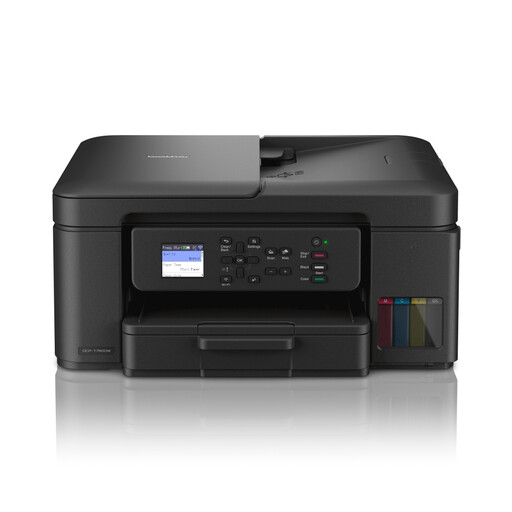
Consider this model when volunteers print double-sided A4 packs and also scan or copy multi-page originals. Brother specifies automatic two-sided printing, a 150-sheet paper tray and a 20-sheet ADF; check whether the tray suits the length of your usual run.
 No image available
For groups that prepare handouts and work from paper originals, this A4 model is described with printing, scanning, copying and Wi-Fi. Check its duplex mode, physical dimensions and what the +Ink variant includes before choosing it for your workspace.
No. A stated yield is a comparison figure, not a guaranteed count for your worksheets. Canon says its GX1050 figure uses an ISO/IEC 24712 chart and continuous-print simulation; page coverage, colour use, settings and maintenance can affect your result.
Automatic two-sided printing is worth considering for recurring packs because it avoids manually turning and re-feeding sheets. Canon lists it for the GX1050 and Brother for the DCP-T780DW; the HP Smart Tank 5105 uses manual two-sided printing, which may be manageable for smaller runs.
An ADF matters most if volunteers also scan or copy multi-page paper originals. Brother lists a 20-sheet ADF for the DCP-T780DW, while Epson lists double-sided ADF copying and scanning for the ET-3950. If handouts are prepared entirely from files, focus first on the printing workflow you need.
For a UK purchase, GOV.UK says a seller must offer a full refund if an item is faulty, not as described or does not do what it is supposed to do. Keep the order confirmation and product description so you can identify the model and explain the problem; change-of-mind returns are a separate question.
Use an appropriate electrical-waste collection or recycling option rather than putting an unwanted printer in household rubbish. UK government guidance says electrical waste should not be disposed of with ordinary household rubbish; check the collection options available where your group is based.