Frequent colour-card printers
Studio users printing repeated batches of colour-coded cards may put fewer ink-replacement interruptions ahead of a simpler cartridge-changing routine.


Choose an inkjet printer whose supported paper type, weight and feed route match the revision-card stock your studio will use. A compact cartridge model can suit occasional batches, while a refillable-tank model is worth considering when frequent printing makes ink replenishment a priority. In either case, check how the printer will be shared and whether it supports your intended one- or two-sided cards.
Studio users printing repeated batches of colour-coded cards may put fewer ink-replacement interruptions ahead of a simpler cartridge-changing routine.
If cards are thicker, coated or otherwise different from ordinary paper, the deciding check is whether the exact printer supports their weight, type and feed route.
Groups printing from several laptops or phones need accessible connections, enough room for the printer and a clear routine for loading paper and maintaining it.
Consider when: Printing is occasional and a shared printer with documented support for your chosen card stock is the priority.
Trade-off: Ink replacement may interrupt frequent batches; a model’s supported one-sided paper weight need not apply to automatic duplex printing.
Consider when: The studio prints recurring batches and wants to replace ink less often.
Trade-off: Published page yields do not predict output for your card designs, and the exact model still needs a separate card-stock check.
| Concern | What to check | Who this matters to |
|---|---|---|
| Ink replenishment | Compare how often you expect to print colour batches and how each printer’s ink is replaced; treat stated yields as ratings, not card counts. | If I reprint colour-coded cards throughout a term, I want fewer interruptions to replace ink. Around 29% of consumers put ink replenishment first. |
| Card-stock feeding | Match your cards’ size, gsm and coating to the model’s stated media types and feed route; check duplex limits separately. | When my cards are thick or coated, I need to know they can feed through the printer I choose. For around 29% of consumers, card-stock compatibility is the primary concern. |
| Shared access | Check connections for the studio’s devices, Wi-Fi coverage and tray arrangements for shared jobs. | If several of us send jobs from different devices, I need access that fits our studio’s setup. Shared access comes first for around 24% of consumers. |
| Space and upkeep | Measure desk and paper-loading clearance, then agree who handles supplies, jams and routine maintenance. | With limited desk space and no dedicated printer manager, I want a setup our group can look after. Around 18% of consumers prioritise space and upkeep. |
Manufacturer page-yield ratings do not measure the coverage or rejected prints from your revision-card layouts.
Estimate how many colour and black-and-white pages the studio prints, and use yield ratings only within their stated conditions.
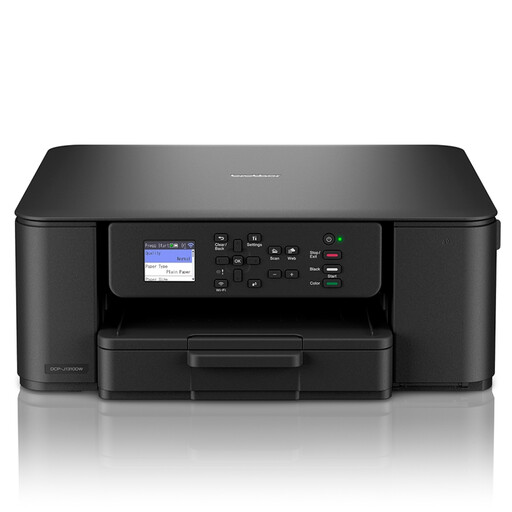
Brother UK specifies 64 to 220 g/m² for the DCP-J1310DW standard tray, but 64 to 105 g/m² for its automatic two-sided printing.
Check the separate duplex specification. For heavier cards, plan on one-sided printing unless the manual permits your intended alternative.
Epson advises checking the exact printer guide for supported media and warns that third-party media above 90 g/m² can cause feeding problems.
Test a small pack of the intended card stock using the sides and feed route you plan to use regularly.
An unsuitable bulk pack can leave the group with unused cards and additional troubleshooting.
Wireless access does not decide who loads card stock, handles a jam or takes responsibility for a queued batch.
Agree which paper belongs in the printer, where supplies are kept and how the group will manage large jobs and maintenance.
These model examples illustrate different checks for a shared studio; their features do not establish compatibility with every revision-card stock.
The DCP-J1310DW is a reference point for a compact A4 all-in-one where shared access and documented paper-weight limits matter.
The EcoTank ET-2950 illustrates a refillable A4 Wi-Fi all-in-one for recurring printing.
The PIXMA G3590 illustrates a refillable wireless all-in-one with a rear paper tray.
These choices cover a compact cartridge printer and refillable-tank printers for shared-studio card batches. Check your exact card stock and connection needs against each model before choosing.
 No image available
Consider this compact cartridge model if the studio prints occasional card batches and needs wireless access. Brother UK specifies 64 to 220 g/m² for its standard tray, but only 64 to 105 g/m² for automatic duplex; confirm your card size, type and coating before buying.
 No image available
Consider this refillable-tank model for recurring shared-studio batches. Check the GX6150’s model-specific guidance for your card size, gsm, coating and feed route, including any separate automatic-duplex limits.
 No image available
Consider this refillable-tank A4 model if the studio prints revision cards regularly and needs a shared Wi-Fi printer. Check the ET-5150’s supported card types, weights and feed routes before selecting stock or planning automatic two-sided printing.
No: check the exact model’s supported card size, media type, weight and feed route. Epson advises consulting the model’s guide and warns that third-party media above 90 g/m² can cause feeding problems.
Only when the printer’s automatic-duplex specification covers your exact stock. Brother UK lists 64 to 220 g/m² for the DCP-J1310DW standard tray, but 64 to 105 g/m² for automatic two-sided printing.
Confirm that the printer can connect to the devices and network the group will use, then agree who loads paper, manages queued jobs and handles ink and maintenance. Wireless capability provides a connection option, not a shared-use routine.