Occasional project-card printers
If you are printing cards for one project or only now and then, start with the card media you need. A large ink supply may matter less than finding a printer that accepts that stock.


For an occasional school project, consider a cartridge inkjet if the exact model supports the card stock you intend to use. If colour cards will be printed regularly, a refillable ink-tank model may be worth the larger initial commitment; either way, check the media type, feed tray and ink arrangement before choosing.
If you are printing cards for one project or only now and then, start with the card media you need. A large ink supply may matter less than finding a printer that accepts that stock.
Recurring revision cards and worksheets make ink replenishment a more important part of the choice, particularly when several learners share a printer.
If your projects also use photo cards, stickers or other media, check the supported sizes, finishes and feed tray for each material rather than relying on one paper-weight maximum.
Choose the card stock first, then consider how often you will print and which shared-home functions you will use.
| Concern | What to check | Who this matters to |
|---|---|---|
| Card compatibility | Match the card’s size, type and weight in g/m² to the exact model’s supported media and feed tray. A photo-paper limit is not necessarily a plain-card limit. | If my chosen cards cannot go through the specified tray, colour printing alone will not make the printer useful for my project. Around 44% of consumers would put card compatibility first. |
| Ink replenishment | Compare the supplied ink, compatible cartridges or bottles, and the conditions behind any stated page yields against how often you expect to print. | When I make colour cards throughout the school year, I want an ink arrangement that suits repeated printing. For roughly 33% of consumers, replenishment would be the primary concern. |
| Shared-home use | Check wireless and mobile-print compatibility, whether scanning and copying are included, and how double-sided printing works for your chosen media. | If several people share the printer, sending work from our devices and copying school materials may matter most. Approximately 23% of consumers would prioritise that convenience. |
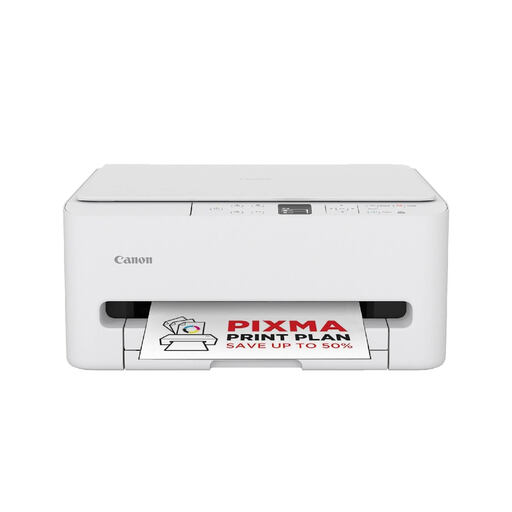
Canon specifies photo paper up to 300 g/m² through the PIXMA TS5350i’s rear tray, but lists plain paper at 64–105 g/m². HP likewise gives different limits for HP cards and photo paper on the DeskJet 2820.
Check the exact card type, size and weight against the printer manual and tray instructions before buying a pack for the project.
A refillable tank is geared towards repeated printing, while an occasional project may not call for the same ink capacity. Manufacturer page yields depend on their stated conditions, not your particular card designs.
Estimate how many colour sheets you will print over the school year, then compare the compatible ink arrangements and supplied ink for the models you are considering.
Canon’s stated automatic duplex support for the PIXMA TS5350i applies to specified plain-paper sizes; Brother lists manual two-sided printing for the DCP-J1200W. Neither specification establishes automatic duplexing for every card stock.
If cards need printing on both sides, confirm support for the exact media or plan a test print with manual re-feeding.
Manual re-feeding takes time, particularly when producing a batch of cards.
Epson’s EcoTank ET-2950 is an A4 refillable-ink model with print, scan, copy, wireless operation and automatic duplex printing.
Canon’s PIXMA TS5350i illustrates a creative-media route for projects that mix revision cards with supported photo media and smaller print sizes.
Brother’s DCP-J1200W is a wireless print, copy and scan inkjet for shared home use.
HP’s DeskJet 2820 specification provides a reference point for occasional projects needing basic print, copy and scan functions.
These two colour inkjets offer different ink arrangements for school-project printing: a PIXMA model for home use and a refillable MAXIFY model to consider if printing will be repeated. Confirm card-media support for the exact model before choosing either one.
 No image available
For a home school project that also involves copying or scanning materials, consider this colour inkjet once you have confirmed that it accepts your intended cards.
The listing describes wireless printing from phones, tablets or laptops, alongside print, copy and scan functions. Check the card type, weight, size and feed tray; if you need two-sided cards, confirm whether duplex printing applies to that stock.
 No image available
For repeated colour printing, consider this refillable MegaTank model if its ink arrangement suits your expected use.
The listing describes Wi-Fi and mobile printing, plus print, copy and scan functions. Before using it for revision cards, check the exact card type, weight, size and feed conditions, including whether your chosen stock can be printed on both sides.
Only if the exact printer and feed tray support that particular card. Canon lists up to 300 g/m² for its photo paper in the PIXMA TS5350i’s rear tray, but specifies 64–105 g/m² for plain paper; HP lists a different limit for HP cards than for its photo paper on the DeskJet 2820. Match the card’s type and size as well as its weight.
It is more relevant if that project is part of regular colour printing at home. Epson positions its EcoTank ET-2950 around refillable, high-yield bottles; for a one-off project, first look for a printer that supports your cards and consider whether you will use the larger ink capacity afterwards.
Choose inkjet-suitable card or photo media that falls within the printer’s stated type, size and weight limits. Manufacturers distinguish between plain paper, cards and specialty photo media, so suitability for one does not establish suitability for another.