Caption-first scrapbook makers
If you mainly print small titles, journalling strips and labels, judge text at the size and on the stock you intend to use. Maximum photo size may matter less to you.


Choose a printer around the material you will actually use: readable captions on ordinary paper call for a different check from feeding card, photo paper or adhesive sheets. If you print project batches regularly, compare refillable and cartridge ink systems using yields for the kind of work you do; for either type, confirm that the exact printer supports your intended media.
If you mainly print small titles, journalling strips and labels, judge text at the size and on the stock you intend to use. Maximum photo size may matter less to you.
If captions sit alongside photos, decorative pages or card, check the feed path and supported materials. A photo-printing label alone does not establish craft-card compatibility.
If you make repeated caption sheets or project batches, consider how the ink system works and which stated yield category resembles your printing. Bottle, document and photo yields describe different tasks.
Start with your smallest caption text and chosen stock, then check the media feed and ink supplies against the work you expect to print.
| Concern | What to check | Who this matters to |
|---|---|---|
| Readable captions | Try your smallest text size on the intended paper or label stock. Check whether a text-output claim applies specifically to plain paper. | Small journalling strips need to remain easy to read once they are cut out and added to a page. Around 36% of consumers putting caption clarity first would make this their main check. |
| Craft-media flexibility | Match the material’s thickness, coating, format and backing to the supported media and required feed path. | For photo inserts or card captions, I need the sheet to feed properly, not just a printer described as photo-capable. Around 29% of consumers would put specialist-media handling first. |
| Ongoing ink supplies | Identify the replacement ink for the exact model and compare stated yields for documents or photos, as appropriate to your work. | Repeated project batches make the type and frequency of ink replacement more important to me. Around 21% of consumers would prioritise ongoing ink supplies. |
| Everyday convenience | Check the mobile-printing method you need, whether scanning or copying is useful, and the printer’s space requirements. | When scrapbooking is only one occasional home task, I may value a straightforward way to print and scan more than specialist-media breadth. Around 14% of consumers would make everyday convenience their primary concern. |
Media handling depends on the exact material and feed path. Epson specifies an ET-8500 straight feed for media up to 1.3 mm thick, while Canon lists selected cardstock products for the PIXMA TS8750; neither claim covers every textured or adhesive-backed sheet.
Check the thickness, coating and backing of your material against the printer’s instructions, then try a small pack before committing to a larger project.
A misfeed can use up card or adhesive sheets before you have a usable print.
Epson and Canon publish yields for different ink systems and print types. A document-page figure cannot stand in for the number of photos or colour-heavy craft sheets you will produce.
List the supplies for each exact model and compare the stated yield category closest to your usual mix of captions, graphics and photos.
Availability and seller terms can change, even when a manufacturer’s product information remains accessible.
Before ordering, confirm the exact model and variant, included setup supplies, current availability and the warranty offered by that seller.
Epson’s EcoTank range includes general home models and the photo-oriented ET-8500, which has specialist-media feeds.
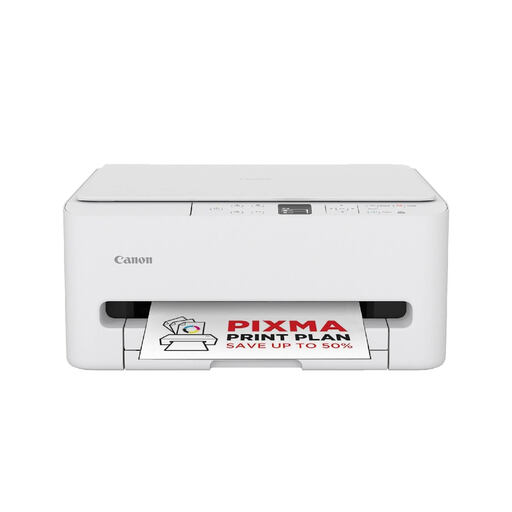
Canon’s PIXMA TS8750 combines photo printing with scanning and copying, using six individual inks and a rear paper tray.
HP’s ENVY Inspire 7920 is a home all-in-one for printing, scanning, copying and photo tasks.
These inkjet models offer different starting points for caption and home printing. Check small-text output and the supported feed path for your scrapbook stock before choosing between them.
 No image available
Consider this model for captions alongside other home printing, with scanning or copying among your intended tasks. Check a sample of your smallest text and confirm the feed instructions for your chosen scrapbook stock.
 No image available
Consider this photo-oriented model if scrapbook pages will include colour elements as well as captions. Confirm the supported paper sizes and craft-media feed, and try your smallest intended text on the stock you plan to use.
 No image available
Consider this model if caption sheets are part of broader document printing and you also want to scan or copy. Check caption samples, photo needs and the supported materials separately; general document use does not establish craft-card suitability.
No; check the material and feed path for the exact model. Epson specifies media up to 1.3 mm thick for the ET-8500 straight feed, while Canon names selected cardstock products for the PIXMA TS8750. Neither specification establishes support for every textured, coated or adhesive-backed sheet.
An all-in-one is useful if you also plan to scan keepsakes, copy templates or handle other household tasks. Canon lists print, copy and scan functions for the PIXMA TS8750, and HP lists those functions for the ENVY Inspire 7920; if you only need to print captions, decide whether you will use the additional functions.
Compare yields for the kind of output you expect to make on each exact model. Epson describes the ET-8500’s included-bottle yield in photos, whereas Canon publishes separate document and photo yields for PIXMA TS8750 cartridges. Those figures use different print categories and will not predict your personal mix of captions and colour elements.
Confirm the exact model and variant, included setup supplies, current availability and the warranty offered by the seller you intend to use. Check your chosen card or label stock against the model’s media instructions as well; a retailer listing alone does not answer that compatibility question.