Small teams printing briefs
People sharing one printer for recurring A4 project briefs who need two-sided printing, enough paper ready for group print runs and access from multiple devices.


For recurring A4 project briefs at a shared desk, start with an inkjet all-in-one that offers automatic two-sided printing, connections suited to everyone’s devices and a paper tray sized for the group’s print runs. A refillable ink tank is worth considering if changing supplies less often matters; if the group also scans multipage documents, check for an automatic document feeder (ADF) rather than relying on a duplex-printing claim.
People sharing one printer for recurring A4 project briefs who need two-sided printing, enough paper ready for group print runs and access from multiple devices.
People who must fit a printer beside laptops and documents, particularly where reaching behind it or moving it to load paper would disrupt the workspace.
People printing regularly enough to consider refill frequency, stated ink yields and access to replacement supplies and maintenance parts.
For A4 project briefs printed by several people, consider print interruptions first, then the upkeep of ink supplies and the space needed to operate the printer.
| Concern | What to check | Who this matters to |
|---|---|---|
| Keeping print runs moving | Check automatic duplex printing, input-tray capacity and connection methods supported by the group’s devices. | When several people need briefs close together, I want to avoid stopping to turn pages, reload paper or sort out connections. Around 42% of consumers put this continuity first. |
| Managing ink supplies | Compare the exact supplied and replacement ink sets, stated yields and any model-specific maintenance consumables. | If briefs are printed regularly, I would rather plan refills than interrupt a job to change supplies. This is the primary concern for around 33% of consumers. |
| Making room on the desk | Measure the space with trays in use, including access for loading paper, collecting output and scanning. | Where the printer sits beside active work, I need to use its trays and scanner without shifting other equipment. Desk fit comes first for around 25% of consumers. |
Automatic two-sided printing describes how the printer handles output, not how it scans originals. Canon lists a flatbed scanner for the MAXIFY GX1050, while Epson lists a 35-page ADF for the EcoTank ET-5150.
If the group scans or copies multipage packs, check the feeder and duplex-scanning specifications separately.
Stated yields apply to particular ink sets and test conditions; the number of project briefs printed will vary with their content and settings.
Check the exact replacement bottles and maintenance consumables for the model, and consider how often the group prints in black and colour.
Canon gives the MAXIFY GX1050 dimensions as approximately 374 × 380 × 186 mm with trays retracted. That measurement does not describe all the space needed to load paper and collect output.
Measure the desk with the printer’s trays in their working positions, and allow access for scanning and refilling.
HP describes the Smart Tank 7005 for teams of up to three users and gives a recommended monthly volume of 400–800 pages. That guidance is specific to the model.
Estimate the group’s busiest month and longest print batch, then compare them with the chosen printer’s guidance and paper capacity.
EcoTank refillable all-in-ones include A4 document models with different levels of paper and scanning capability.
The MAXIFY GX1050 is a refillable, front-operating A4 option to consider where desk access matters.
The Smart Tank 7005 is a refillable all-in-one with published small-team usage guidance.
The DCP-T580DW is a refillable option for groups considering wireless document printing in smaller batches.
These models are options to assess for A4 project briefs at a shared desk. Check each one against the group’s paper handling, connection and multipage-scanning needs.
 No image available
For a desk that also handles multipage documents, check the GX6150’s feeder configuration, paper capacity and duplex-paper compatibility against the group’s work.
 No image available
For recurring print runs and multipage scanning, Epson specifies a 250-sheet front tray, automatic two-sided printing and a 35-page ADF for the ET-5150.
Check that its duplex mode supports the paper intended for the briefs, and allow working space for the trays and feeder.
 No image available
For shared document work, check whether this all-in-one’s paper handling, two-sided printing options and connections suit the team’s briefs.
Confirm its replacement supplies and the space needed to operate it before choosing.
 No image available
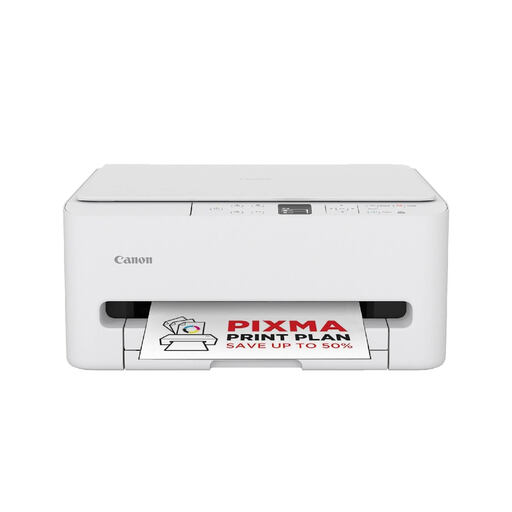
For shorter brief packs, compare the TS6550i’s input capacity and device connections with the number of people using the desk.
If the group scans multipage originals, check for a feeder; also confirm which paper types support automatic two-sided printing.
Automatic two-sided printing is useful when briefs regularly run to several pages and the group wants to avoid turning sheets by hand. Check the supported paper: Canon specifies the MAXIFY GX1050’s duplex mode for A4 and Letter plain paper, with a stated plain-paper range of 64–105 g/m².
A 250-sheet tray is useful for recurring group print runs, but a smaller tray can suit shorter or less frequent jobs. Canon specifies 250-sheet input for the MAXIFY GX1050, Epson for the ET-5150 and HP for the Smart Tank 7005; Brother specifies 150 sheets for the DCP-T580DW.
An ADF is worth checking for when the group regularly copies or scans multipage project packs. Epson specifies a 35-page ADF for the ET-5150, whereas Canon specifies a flatbed scanner for the MAXIFY GX1050, which means handling multipage originals manually.
No: use a stated yield to compare the specified ink set, not as an exact count of project briefs. Actual output depends on page coverage, colour content, print settings and maintenance cycles.