Occasional register printer
If you print a modest number of A4 sign-in sheets and sometimes copy or scan a completed page, look for straightforward paper handling and the functions you will use in one device.


For occasional A4 visitor-register sheets, choose a wireless inkjet all-in-one if you also need to copy or scan completed forms. For repeated register packs, consider a refillable-tank model but check how it handles scanning; an automatic document feeder (ADF) matters most when you regularly process batches of completed sheets, whether the printer uses cartridges or tanks.
If you print a modest number of A4 sign-in sheets and sometimes copy or scan a completed page, look for straightforward paper handling and the functions you will use in one device.
If you repeatedly prepare register packs, notices or activity paperwork, compare refillable tanks with cartridges and check how often your chosen ink system will need attention.
If you regularly copy or scan several completed register sheets together, an ADF may save you from loading each sheet separately. Check its supported paper sizes and scanning method on the exact model.
For hobby-room visitor registers, start with your main task: occasional sheets, repeated print runs or batches of completed forms. Then check the functions and paper handling needed for that task.
| Concern | What to check | Who this matters to |
|---|---|---|
| Simple occasional printing | Check A4 support, connection to the device holding your template, and built-in copy and scan functions if needed. | If I print a few sign-in sheets at a time, I want an uncomplicated setup that also lets me retain an occasional completed form. Around 45% of consumers put that occasional-printing need first. |
| Repeated register packs | Compare the exact model’s ink system and stated yields, and check whether copying or scanning requires an app. | When I prepare packs and notices repeatedly, I want fewer interruptions to replace or refill ink. Roughly 33% of consumers prioritise that recurring-output need. |
| Batch copying and archiving | Confirm the ADF’s capacity, supported paper sizes and whether it scans both sides; check duplex printing separately. | If completed registers arrive as multi-page batches, I need to process them without loading every sheet by hand. For about 22% of consumers, batch handling is the primary concern. |
A printer that offers app-assisted scanning may not suit you if you need to place completed registers directly on a built-in scanner and copy them there.
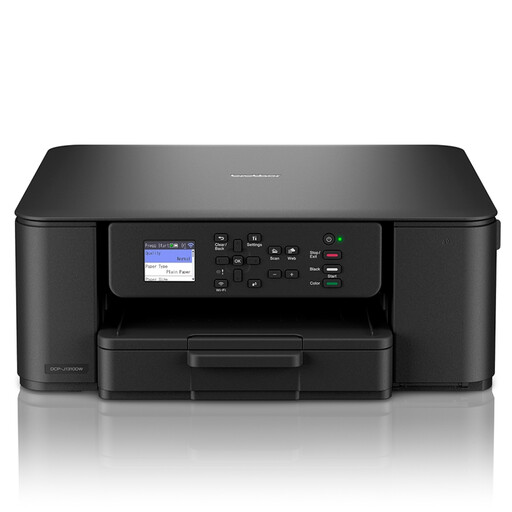
Check print, copy and scan separately on the exact model. Epson describes the ET-1810’s scan and copy functions as app-assisted, while Brother lists the DCP-J1310DW as a print, copy and scan device.
A feeder helps with batches of completed sheets, but offers little advantage when you handle only an occasional single-page register.
Decide whether batch copying or scanning is routine before giving an ADF priority over the printer’s size and everyday paper handling.
Manufacturer yields describe particular models under stated conditions, not the number of pages your register layout will produce. Print-head cleaning also uses ink.
Check the yield conditions for the exact ink set and model. If print quality deteriorates, follow that manufacturer’s nozzle-check and cleaning instructions rather than repeatedly running cleaning cycles.
Brother’s DCP-J1310DW is a compact A4 inkjet all-in-one to consider when occasional register printing needs to share a device with copying and scanning.
Epson’s EcoTank ET-1810 is a refillable-tank example for people whose main task is printing repeated register packs.
Canon’s PIXMA TS7550i and TS7750i are document-handling examples to examine if you regularly process completed register sheets in batches.
These models address different visitor-register tasks: occasional A4 printing with copying and scanning, repeated print runs with refillable ink, and handling batches of completed forms. Match the printer’s functions and physical size to your main task before choosing.
 No image available
Consider this all-in-one for occasional A4 register sheets when you also want to copy or scan completed forms. Brother UK specifies a 150-sheet input tray and automatic duplex printing; check that duplex supports the paper used for your register layout. If batch scanning matters, confirm the scanner’s document-handling method before buying.
 No image available
Consider this model if repeated register packs make a refillable-ink workflow appealing and you also need to handle completed forms. Check the exact feeder and scanning functions, applicable ink-yield conditions and dimensions against your paperwork and available space.
 No image available
Consider this model when copying or scanning completed registers in batches is a regular task. Check the feeder’s supported sheets and sizes, then make sure the printer’s dimensions and weight suit the surface available in your hobby room.
An ADF is worth considering if you routinely copy or scan batches of completed sheets; it adds little to an occasional one-page task. Check the exact model’s feeder capacity, supported sizes and whether it scans one side or both.
A refillable-tank printer is worth comparing if you print register packs repeatedly and want fewer ink replacements. Check its copy and scan workflow too: Epson describes the ET-1810 as offering app-assisted scan and copy functions rather than a conventional built-in scanner.
Yes, if the exact printer supports automatic duplex printing for your chosen paper size and type. Canon UK specifies automatic duplex on A4 or letter-size plain paper for the PIXMA TS7550i and TS7750i; check the model’s instructions before using a different medium.
Follow the print-quality procedure for your exact printer model. Epson advises running a nozzle check before head cleaning for relevant print faults and cautions against cleaning when ink is low; avoid assuming another manufacturer uses the same controls.