Recurring handout coordinators
Organisers preparing multi-page packs for regular meetings who want automatic two-sided printing and fewer pauses to load paper or replace ink.


For recurring multi-page A4 instruction packs, choose an inkjet printer with automatic two-sided printing and a paper tray sized for your usual run; a refillable ink tank is worth considering if frequent ink changes would interrupt preparation. A compact 100-sheet model requires more reloading for larger packs, while an automatic document feeder (ADF) matters if the group regularly scans or copies stacks of forms.
Organisers preparing multi-page packs for regular meetings who want automatic two-sided printing and fewer pauses to load paper or replace ink.
Groups producing smaller A4 batches that can accept a compact paper tray and scanning one original at a time.
People who print instructions and also scan or copy sign-up sheets and other paperwork. An ADF becomes useful when those originals regularly run to several pages.
Start with the largest routine print run, then decide whether scanning paperwork and sharing the printer change what the group needs.
| Concern | What to check | Who this matters to |
|---|---|---|
| Uninterrupted pack printing | Confirm automatic two-sided A4 printing and compare the input tray with your largest routine run. | When I prepare double-sided packs for regular meetings, stopping to turn or reload sheets disrupts the job; around 36% of consumers put fewer interruptions first. |
| Occasional, compact printing | Check the ink format and supplied ink, alongside tray capacity and automatic duplex. | For smaller, less frequent handouts, I can accept reloading a compact tray rather than planning for long unattended runs; roughly 21% of consumers prioritise this compact-printing need. |
| Scanning and copying forms | Check whether an ADF is included and how many sheets it holds; print duplex does not establish double-sided scanning. | If I regularly digitise multi-page sign-up forms, placing each sheet on a flatbed takes time; around 29% of consumers put batch document handling first. |
| Shared-device setup | Confirm connections and driver or app support for volunteers’ devices, and decide who will retain administrator access. | When several volunteers use one printer, I need a setup they can access without relying on one person’s computer; roughly 14% of consumers prioritise shared access. |
Manual two-sided printing requires someone to re-feed the paper, which adds handling to every double-sided pack. HP specifies manual two-sided printing for its Smart Tank 5100 series but automatic duplex for the 7000 and 7600 series.
Look for automatic two-sided printing in the specification for the exact model, not just the printer family.
Headline page yields can describe different ink configurations. Canon UK gives 17,000 black pages for the MAXIFY GX2051 with three included black bottles, while stating a separate 3,000-page yield for a standard black bottle.
Compare the included bottles and replacement-bottle yields on the same basis, taking account of whether the group prints mainly black text or colour sheets.
A 100-sheet tray can suit occasional handouts but means more loading during a larger pack run. The Epson EcoTank ET-2950 Joybuy listing specifies 100 sheets; Brother UK specifies 150 for the DCP-T780DW, and Canon UK specifies 250 for the MAXIFY GX2051.
Size the tray against the group’s largest routine batch, allowing for reprints.
Brother’s ink-tank models include options for groups that need automatic duplex and document handling.
Canon’s MAXIFY MegaTank GX2051 is a reference point for organisers preparing larger batches and handling multi-page originals.
Epson’s EcoTank ET-2950 illustrates a compact refillable A4 option with automatic two-sided printing.
HP Smart Tank models differ in how they handle two-sided printing and document feeding.
These Brother inkjet printers are choices for groups preparing A4 instruction sheets. One has a refillable ink tank; compare the exact model’s paper handling and scanning arrangement with the group’s routine jobs.
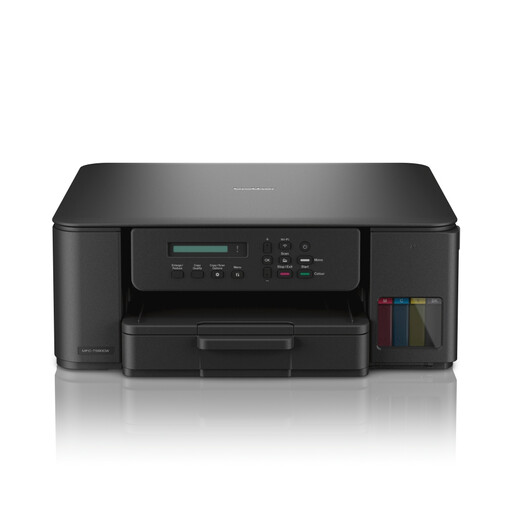 Image unavailable
A refillable ink-tank choice for groups preparing repeat instruction-sheet runs. Check its two-sided printing and tray capacity against the usual batch, and confirm whether its scanning arrangement meets any need to process stacks of forms.
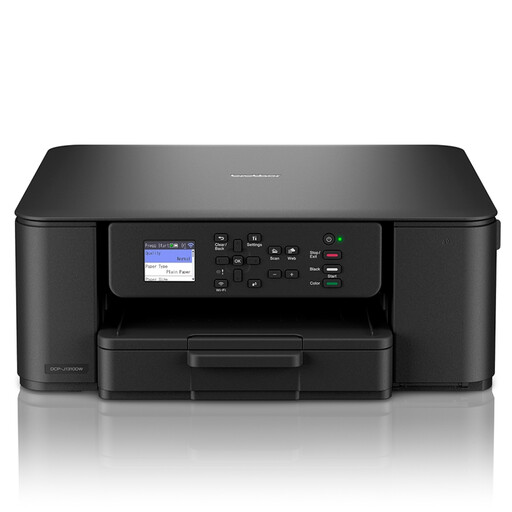 Image unavailable
A wireless inkjet choice for instruction sheets and occasional paperwork. Compare its ink format and two-sided printing with the group’s needs, and confirm whether the exact configuration includes an ADF before planning to scan multi-page forms.
Yes, if the group routinely prints multi-page packs on both sides: it removes the step of turning and re-feeding sheets. Check the exact model specification; HP lists manual two-sided printing for its Smart Tank 5100 series and automatic duplex for the 7000 and 7600 series.
Choose capacity against the largest routine batch, allowing for reprints. For reference, the Epson EcoTank ET-2950 Joybuy description lists 100 sheets, Brother UK specifies 150 for the DCP-T780DW, and Canon UK specifies 250 for the MAXIFY GX2051; a larger tray reduces reloads but does not itself establish print speed.
An ADF is useful if someone regularly scans or copies several pages of forms or revised instructions; it is not needed just to print packs. Brother UK specifies a 20-sheet ADF for the DCP-T780DW, while Canon UK specifies a 35-sheet ADF for the MAXIFY GX2051. Check the chosen model separately from its print-duplex capability.
Confirm that the exact printer supports the volunteers’ devices and the group’s network, and decide who will manage its settings. Check the manufacturer’s stated security-update period for that model rather than assuming every printer receives the same length of support.