Students making cards on thicker or smaller media
Your chosen cards need to match the printer’s supported size, weight, paper type and feed tray. Support for plain A4 worksheets alone is not enough.


Choose an inkjet printer only after checking that its specified tray accepts your revision cards’ size, paper type and weight; automatic duplex printing for ordinary paper does not establish double-sided card compatibility. For a shared flat, then weigh direct wireless printing, duplexing for study sheets and tray capacity against how often you print.
Your chosen cards need to match the printer’s supported size, weight, paper type and feed tray. Support for plain A4 worksheets alone is not enough.
If several flatmates print notes or handouts, wireless connection options, duplexing for ordinary study sheets and tray capacity can affect everyday handling.
If you mainly print plain-paper materials now and then, a basic print, copy and scan device may suit your routine. Check card compatibility separately if you also plan to use thicker stock.
Start with the cards you intend to use, then consider how the printer will connect and how many study sheets your flat is likely to print.
| Concern | What to check | Who this matters to |
|---|---|---|
| Card compatibility | Match the card’s size, weight and paper type to the specified feed tray. Check duplex support separately if the cards need printing on both sides. | If I use pre-cut or coated revision cards, I need to know they can feed through the printer I choose; around 29% of consumers put card compatibility first. |
| Shared-flat setup | Check for a documented direct wireless option if you cannot use the flat’s network, and check compatibility with the devices residents will print from. | When I cannot rely on the shared router, I want a workable way to print from my device; roughly 29% of consumers prioritise connection and shared use. |
| Repeated study printing | Compare tray capacity, cartridge-yield information and whether duplexing works for your ordinary-paper study sheets. | During repeated print runs, I want fewer interruptions for loading paper or turning sheets; around 21% of consumers make printing routine their primary concern. |
| Occasional plain-paper use | Compare the recommended monthly page volume, tray capacity and manual versus automatic duplexing. Verify card support if your plans change. | If I only print worksheets occasionally, I can accept more manual handling rather than choosing features I rarely use; about 21% of consumers put occasional-use suitability first. |
Paper-weight limits can depend on the tray and media type. Canon specifies up to 300 g/m² for Canon photo paper in the PIXMA TS5350i rear tray, not for every third-party card; Epson also advises checking the exact model and media.
Choose the stock first, then check its size, weight and coating against the printer’s paper guidance. Try a small pack before committing to a larger quantity.
A poor match can waste cards and time if sheets fail to feed.
Canon specifies automatic duplexing on the PIXMA TS5350i for listed sizes of plain paper. A printer’s two-sided feature therefore does not, by itself, establish support for your chosen card stock.
Check the duplex media restrictions for the exact model and stock. If the combination is unsuitable, plan one-sided cards or print layouts on supported sheets that you can cut afterwards.
HP lists a recommended monthly volume of 50–100 pages, a 60-sheet input tray and manual duplexing for the DeskJet 2820e. Those specifications warrant a closer look if you expect frequent double-sided study packs.
Estimate your printing in a typical revision month and compare the model’s recommended volume, tray capacity and duplex method before choosing.
A replacement leaves electrical equipment to dispose of. GOV.UK describes retailer take-back arrangements for like-for-like electrical purchases under its applicable rules.
Check the seller’s take-back arrangements before checkout, or arrange an appropriate electrical-recycling route for the old printer.
The PIXMA TS5350i is worth examining if you want to check a rear-feed option for particular card or photo media.
The Expression Home XP-5200 is relevant if direct wireless printing and ordinary A4 study sheets are central to your routine.
The DCP-J1050DW offers a model-specific set of paper sizes to examine if you intend to print smaller revision materials.
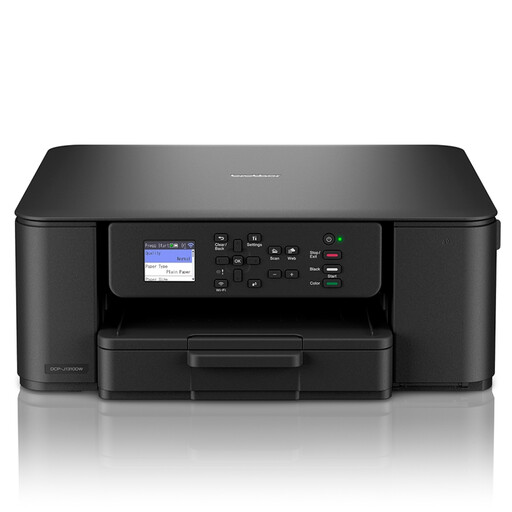
This wireless inkjet is a product to examine for revision-card printing in a shared flat. Confirm that your chosen stock and any double-sided card layout are supported before deciding.
 No image available
Consider this wireless model if you need a printer for a shared study space. Before choosing it for revision cards, check your exact card size, weight, coating and feed path against the DCP-J1310DW guidance; check card-specific duplex support separately if you need two-sided cards.
No: check the card’s size, weight and paper type against the exact printer and feed tray. Epson advises checking model-specific media information and says its cited general guidance does not recommend or support third-party media over 90 g/m²; Canon and Brother specifications also show that limits differ by model and tray.
Not necessarily: duplex support may be limited to particular paper sizes and types. Canon, for example, specifies automatic duplexing for A4, A5, B5 and Letter plain paper on the PIXMA TS5350i. Check the duplex restrictions for your exact printer and card stock.
Look for a documented direct-print connection that works with your device. Epson lists Wi-Fi Direct on the XP-5200 for printing without a wireless network; check the connection and device requirements of any other model you consider.
Check the seller’s take-back arrangement for a like-for-like purchase, or arrange appropriate electrical recycling. GOV.UK sets out in-store take-back requirements for retailers to which its rules apply, so confirm the available route with your seller before bringing in the old printer.