Volunteers printing regular batches
If the group produces meeting notes, handouts or mail-outs, compare how often someone will need to refill ink, reload paper or turn sheets by hand.


For recurring A4 local-history notes, a refillable ink-tank all-in-one is a sensible starting point if the group also needs to copy or scan, but compare replacement ink and expected print volume before assuming it will cost less to run than a cartridge printer. Canon UK specifies a 250-sheet cassette for the MAXIFY GX1050, Brother UK specifies a 20-sheet document feeder for suitable loose originals on the DCP-T780DW, and Epson lists automatic double-sided printing and stated included-ink yields for the EcoTank ET-2950. Which matters most depends on how the group prepares and prints its notes.
If the group produces meeting notes, handouts or mail-outs, compare how often someone will need to refill ink, reload paper or turn sheets by hand.
If volunteers also digitise local-history material, distinguish suitable loose sheets from delicate or bound originals. A document feeder can help with the former; a flatbed is the more cautious choice for material that should not pass through rollers.
If notes are mostly text but sometimes include maps or photographs, consider colour-ink use and supported paper types rather than relying on a black-page yield figure alone.
Start with the group’s usual print batch and the condition of any originals it needs to scan. Then compare ink, paper handling and connection options for the exact printer model.
| Concern | What to check | Who this matters to |
|---|---|---|
| Ink and refills | Compare included black and colour ink, the stated yield basis and replacement bottles for the group’s likely page volume. | If we print notes regularly, we need ink replacement to be manageable without treating a stated yield as a promise of our own output. Around 31% of consumers put ink use and refill interruptions first. |
| Batch handling | Check A4 tray capacity and whether automatic double-sided printing supports the paper the group uses. | When volunteers prepare meeting handouts, frequent reloading and turning sheets can interrupt a batch. Roughly 31% of consumers make paper handling their primary concern. |
| Scanning originals | Check for a flatbed and, if needed, a document feeder suitable for the size and condition of loose pages. | We may need to copy several source sheets, but delicate historical material must be handled separately. Around 23% of consumers chiefly need a workable way to scan and copy originals. |
| Shared setup | Confirm the required Wi-Fi or wired connection, device compatibility and who will manage updates and maintenance. | When several volunteers use one printer, each needs a way to connect and someone must look after it. Approximately 15% of consumers put shared setup and support first. |
A refillable printer’s stated ink yield does not establish what recurring group printing will cost. Paper capacity and maintenance also affect how much volunteer attention a batch needs.
Estimate monthly pages and likely colour coverage, then compare replacement ink, included ink, paper handling and maintenance for the exact models under consideration.
Replacement ink and paper, maintenance consumables and time spent reloading can all add to the work of producing notes.
Canon UK bases its MAXIFY GX1050 yield figure on an ISO/IEC 24712 chart and a continuous-printing simulation. Local-history notes may have different coverage and settings.
Compare yields only alongside their test conditions, and plan ink purchases around the group’s actual mix of text and colour pages.
Brother UK specifies a 20-sheet automatic document feeder for the DCP-T780DW, but its capacity does not establish that fragile, bound or irregular historical items can pass through safely.
Use a flatbed for delicate single sheets and agree a handling approach with the archive owner or a conservator before feeding originals automatically.
Damage to an irreplaceable source page may not be reversible.
Epson’s EcoTank line includes refillable A4 all-in-ones such as the ET-2950, which Epson lists with printing, copying, scanning, wireless connectivity and automatic double-sided printing.
Canon’s refillable MAXIFY GX range includes the GX1050, which Canon UK specifies with printing, copying, scanning, Wi-Fi, Ethernet and a 250-sheet front cassette.
Brother’s tankbenefit range includes the refillable A4 DCP-T780DW all-in-one for printing, copying and scanning.
These printer models are relevant to groups assessing recurring A4 notes and, where the model supports it, copying or scanning source pages. Check each exact model’s paper handling and ink requirements against the group’s workload.
 No image available
For regular group handouts, confirm this model’s A4 paper support, automatic double-sided printing and tray capacity against the size of a typical batch before choosing it.
 No image available
For A4 notes that sometimes need scanning or copying, this model’s name identifies scan and copy functions alongside Wi-Fi. Confirm its duplex capability, tray size and the contents of the +Ink offer before planning group print sessions.
 No image available
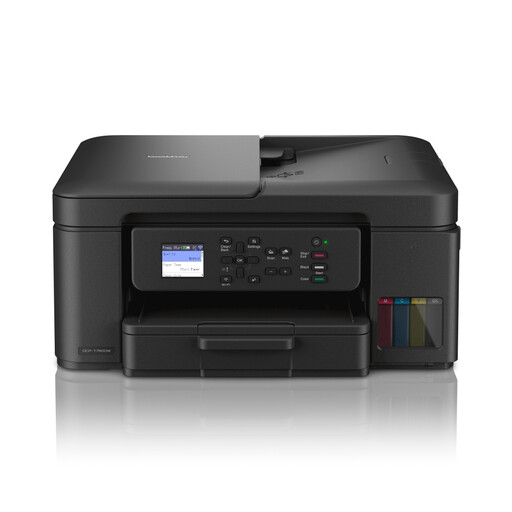
For groups that scan suitable loose source pages as well as printing A4 notes, Brother UK specifies a 20-sheet document feeder, automatic double-sided printing and a 150-sheet tray for this model. Use a flatbed rather than the feeder for delicate originals, and confirm the included colour-ink yield before planning ink purchases.
Yes, when the notes are designed for supported A4 paper and volunteers print repeated batches: it avoids turning sheets by hand. Canon UK, Brother UK and Epson specify automatic A4 double-sided printing for the MAXIFY GX1050, DCP-T780DW and EcoTank ET-2950 respectively; check the paper and settings supported by whichever exact model you choose.
Use a document feeder only for originals that are loose and robust enough to pass through it. Brother UK specifies a 20-sheet feeder for the DCP-T780DW, but that does not establish suitability for fragile, bound, creased or irregular items; use a flatbed or seek archival handling advice for those originals.
No: a stated yield is a test-based comparison input, not a cost-per-page promise for your notes. Canon UK describes the MAXIFY GX1050 yield as based on an ISO/IEC 24712 chart and continuous-printing simulation, so compare replacement ink alongside the group’s expected page volume, colour coverage and settings.
Check an appropriate electrical-equipment collection route rather than putting the printer in ordinary waste. GOV.UK describes the UK waste electrical and electronic equipment framework; ask the relevant local authority about its electrical-recycling service or check whether the retailer offers take-back for your purchase.