
24/7 Customer Support

Free returns

Same-day & Next-day Delivery

Quality Guaranteed

Unlock Your Welcome Offers: FREE Delivery | Up to 80% OFF | Free 30-day JoyPlus trial
Download the APP
An inspection camera can save time when you need to look inside an engine, behind a wall panel, through an HVAC duct or into a narrow pipe. However, many buyers focus on screen resolution or advertised magnification while overlooking the design details that determine whether the camera is genuinely useful.
The wrong model may have a probe that cannot fit through the access hole, a cable that is too floppy to control or a light that creates glare rather than revealing detail. Before choosing an automotive inspection camera or industrial endoscope camera, check these common purchasing traps.
A high-resolution image is of limited value if the probe cannot enter the area you need to inspect. Spark plug holes, access ports and narrow pipes all have different clearance requirements. A 3.9 mm probe may reach locations that an 8.5 mm model cannot.
Always measure the smallest opening first, then allow a little clearance. Product descriptions may state a minimum hole diameter, but the actual route may also include bends or obstructions.
A soft cable is convenient for winding into storage, but it may be difficult to push around a bend or hold in position. Semi-rigid probes usually offer more control, while an articulating borescope allows the camera tip to change direction after insertion.
Check the stated articulation range and the control method. A thumb wheel or lever can be more practical than manually twisting the entire cable when inspecting the back of a component.
Some inspection cameras are designed for damp areas, while others are intended only for dry inspection. A camera used in a drain, pool system or wet pipe should have a clearly stated water-resistance rating suitable for that task. Do not assume that a sealed camera head makes the display, charging port or handle waterproof.
For plumbing or HVAC work, clean and dry the probe after use, protect the lens window and follow the manufacturer’s operating instructions.
Probe diameter determines where the camera can go. For narrow engine access points or small service openings, a slim probe inspection camera is often more practical. The Teslong TD500, for example, uses a 3.9 mm camera and specifies an inspection opening of at least 4.5 mm. By comparison, an 8.5 mm probe may provide a larger camera assembly but needs a wider opening.
Probe length also matters. A 1.5 m or 5 ft cable may suit vehicle components, wall cavities and domestic pipe sections, but it may not be enough for a long drainage run. A semi-rigid cable can be shaped before insertion and may hold its position better than a very soft lead.
A fixed camera looks only where the probe tip is pointing. A two-way articulating model can direct the lens around corners and behind obstacles. The TD300P, TD450S and TD500 models listed below provide up to 210° of bi-directional movement according to their specifications.
This feature is particularly useful for inspecting engine cylinders, brake systems, HVAC ducts and the rear of wall panels. It does not remove the need to insert the probe slowly: forcing the cable or exceeding its natural bend radius can damage the internal wiring.
An inspection camera with light should offer adjustable brightness so reflective metal surfaces do not become washed out. Multiple LEDs can help in dark cavities, but illumination is only useful when the lens is kept clean and positioned at a suitable distance.
For regular maintenance work, consider:
A dual-lens borescope can show forwards and sideways, reducing the need to withdraw and reposition the probe. For occasional household checks, a simpler model may be sufficient.
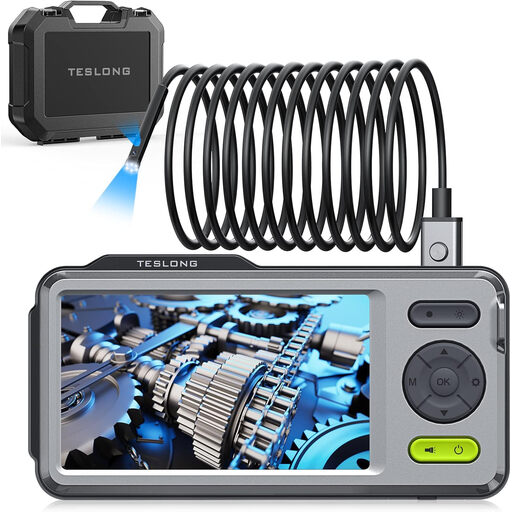
Why This Fits Their Persona: A practical choice for vehicle owners and DIY users who want a self-contained screen rather than a phone-connected tool.
The 5 mm dual-lens design is specified for access holes of at least 6 mm, while the built-in 5-inch display avoids relying on a separate app or phone connection.
It includes adjustable LED lighting, photo and video recording, a 32GB TF card and a 3,500mAh battery.
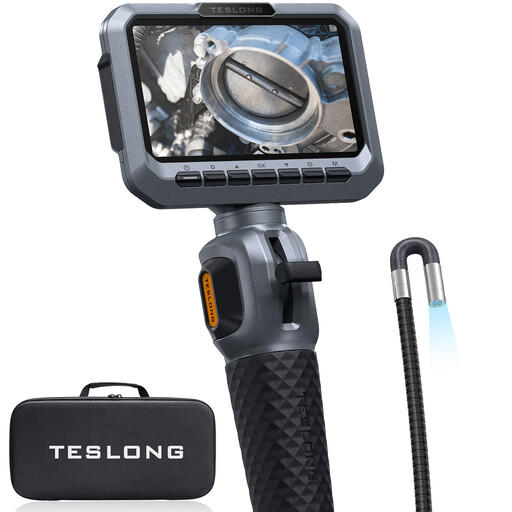
Why This Fits Their Persona: Suitable for mechanics, HVAC engineers and maintenance teams who need controlled viewing and a portable all-in-one unit.
Its 5.5 mm probe is paired with two-way thumb-controlled articulation, helping users view around obstructions rather than repeatedly repositioning the cable.
The 5-inch IPS display, six adjustable LEDs, 1,920×1,080 photo capture and 3,000mAh rechargeable battery support documented inspections.
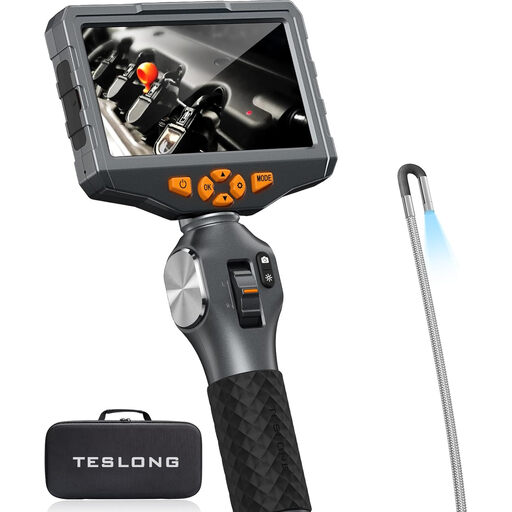
Why This Fits Their Persona: Designed for mechanics and technicians working through narrow engine, injector, fuel-system and pipe access points.
The 3.9 mm probe is specified for openings of at least 4.5 mm, addressing the common mistake of buying a camera that is too wide for the job.
It offers 210° two-way articulation, 1,920×1,080 video and photo capture, a 32GB card and a 20–100 mm depth of field.
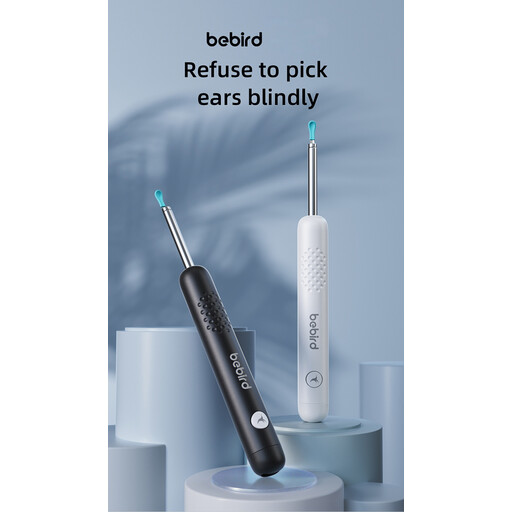
Why This Fits Their Persona: Intended for adults seeking a smartphone-connected visual ear inspection tool for home use.
The 3.5 mm lens is designed for visual access, but the device is not a medical device. Do not insert it deeply, use it on children without proper supervision or continue if there is pain.
The Wi-Fi otoscope connects with iOS, iPad and Android devices, offers 1,920×1,080 images and has an approximately 60-minute operating time.
We have compiled a complete, real-time list of products that fully satisfy these strict selection criteria and UK safety regulations.
Some models use Wi-Fi or an app, while others include a dedicated display. A phone-connected ear camera is convenient for viewing and saving images, but a handheld industrial borescope with its own screen may be more dependable in a workshop, garage or outdoor setting.
Battery life varies by model, screen brightness, LED use and recording activity. The listed products include batteries ranging from 3,000mAh to 3,500mAh for industrial models, while the Verbex SL11 lists approximately 60 minutes of use. Fully charge the unit before planned work and avoid storing it for long periods with a completely depleted battery.
In everyday product listings, borescope, endoscope camera and inspection camera often describe similar tools: a small camera on a cable used to view enclosed spaces. The important differences are probe diameter, cable stiffness, articulation, lighting, recording functions and resistance to moisture. Choose according to the access opening and environment rather than the product name alone.