Choose counted black-coffee sticks when guests or staff need individual portions; choose loose instant coffee when a shared kitchen can provide a spoon and manage serving sizes. For planning 240 mugs, Nescafé states a standard serving of 1.8g with 200ml water, which works out at about 432g of coffee. A larger pack gives room for that stated serving basis, but stronger drinks use more coffee.
Who is buying for 240 mugs?
Office and shared-kitchen buyers
If colleagues measure their own coffee, a larger pack of granules can cover the planned number of mugs without issuing individual sticks. Decide how coffee will be dispensed and whether the expected serving size matches the pack allowance.
Hospitality and self-service buyers
Individual sticks make it straightforward to offer one black-coffee portion at a time and count what has been put out. Check the case count: Nisbets lists its Nescafé Original stick case as 200 portions, short of a 240-portion requirement on its own.
Buyers providing white or sweet coffee
Choose the drink recipe before choosing a case size. Nescafé describes its 2-in-1 sachets as coffee with milk and its 3-in-1 sachets as coffee with milk and sugar; neither is the same purchase as plain black-coffee portions.
What should you check before ordering?
Start with the drink you intend to serve, then check whether the pack states a portion count or a weight that needs converting using an appropriate serving size.
| Priority |
What to check |
Your needs |
| Enough coffee |
Check the number of black-coffee sticks or the net weight of granules. Nescafé states 1.8g per 200ml mug; 240 mugs at that rate use about 432g. Allow for larger servings. |
I need enough coffee for roughly 240 mugs, not just a pack whose description contains the number 240. |
| Serving method |
Confirm whether portions are individually wrapped or must be measured from a jar or tin. Nisbets lists a Nescafé Original case of 200 sticks. |
For guests serving themselves, I may want one ready-counted portion each. In a staffed kitchen, measuring from a shared container may be workable. |
| Drink recipe |
Read the exact product description and ingredients. Nescafé says its 2-in-1 contains coffee and milk; its 3-in-1 contains coffee, milk and sugar. |
If people should choose their own milk and sugar, I want plain instant coffee rather than a prepared white or sweet recipe. |
| Allergen information |
Check the ingredients on each milk-containing variant and retain its product information. GOV.UK says any of the 14 allergens present in prepacked food or drink must be clearly labelled in the ingredients list. |
When I offer sachets to staff or guests, I need the ingredient information for the precise recipe being served. |
Where can bulk orders go wrong?
-
Assuming “240” means 240 black-coffee portions
A number in a listing may describe a different item or pack measure. Loose granules have a weight, not a fixed number of portions; the yield changes with the amount used per mug.
Check what is being counted. For granules, calculate the amount needed using the serving guidance for the coffee you plan to buy, with an allowance if people make stronger drinks.
-
Substituting 2-in-1 or 3-in-1 sachets for black coffee
These sachets make different drinks. Nescafé says its 2-in-1 contains milk, while its 3-in-1 contains milk and sugar; the latter lists 8.4g sugars per prepared mug.
Specify whether you need black coffee with milk and sugar offered separately, white coffee, or sweet white coffee. Check the ingredients and per-mug nutrition information for the exact variant.
-
Treating a stick count and a jar weight as equivalent
A 200-stick case gives a stated number of individual portions. A jar or tin can be planned against a serving weight, but the number of mugs made from it depends on how much each person uses.
Compare the formats against the same planned mug size and serving assumption, then decide whether measured servings or individually issued portions suit the setting.
-
Overlooking the label on milk-containing sachets
A milk-containing recipe needs different ingredient checks from plain black coffee. GOV.UK guidance requires any of the 14 allergens present in prepacked food or drink to be clearly labelled in the ingredients list.
Keep the original packaging or accurate information for each recipe available, and check the precise label before offering the sachets to people with allergy requirements.
Relevant brands and ranges
These ranges illustrate different ways to supply instant coffee; a brand name alone does not tell you the portion count or drink recipe.
Nescafé
Nescafé offers black instant coffee alongside portioned sticks and milk-containing sachet recipes.
- Nescafé states a standard black-coffee serving of 1.8g with 200ml water, a useful basis for planning mugs from its loose coffee.
- Nisbets lists Nescafé Original sticks in a 200-pack, so one such case does not provide 240 sticks.
Kenco
Kenco appears in grocery listings and in Euroffice’s workplace range, which lists a Really Smooth 750g instant-coffee tin.
- A loose-coffee catering tin is a format to consider where a shared kitchen can measure servings.
- Check the particular product name: a milk-based sachet recipe is not an interchangeable black-coffee portion.
Douwe Egberts
Euroffice lists Pure Gold Continental instant coffee in a 750g workplace format, while Tesco lists a smaller Pure Gold instant-coffee pack.
- The 750g format lets buyers plan a shared supply by pack weight.
- It is loose coffee rather than a box of counted portions; check the serving guidance for the exact product when estimating mugs.
Tesco
Tesco’s instant-coffee listing includes its own range alongside smaller packs from national brands.
- The range offers pack formats to examine when assembling a mixed supply.
- Check each listing’s weight, ingredients and pack count rather than assuming a grocery pack contains 240 portions.
Sainsbury's
Sainsbury’s lists its own Gold Roast instant coffee in a 500g jar alongside national-brand coffee and sachets.
- The stated jar weight can be compared with a planned quantity of loose coffee.
- A jar is not a counted stick case; use serving guidance for the exact coffee rather than treating its weight as a guaranteed mug count.
Joybuy multi-jar options
These multi-jar packs are options for a shared supply of instant coffee measured by the spoon, rather than individual sticks or a single catering tin.
 No image available
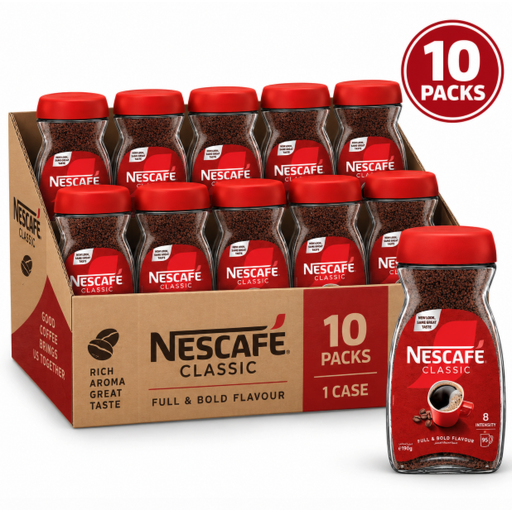
Nescafé Classic Original instant coffee, 190g × 10
For a shared kitchen where people measure their own coffee, ten 190g jars provide 1,900g across the pack. They are not individually portioned sticks, so the serving area will need a spoon and a way to manage portions.
View on Joybuy
 No image available
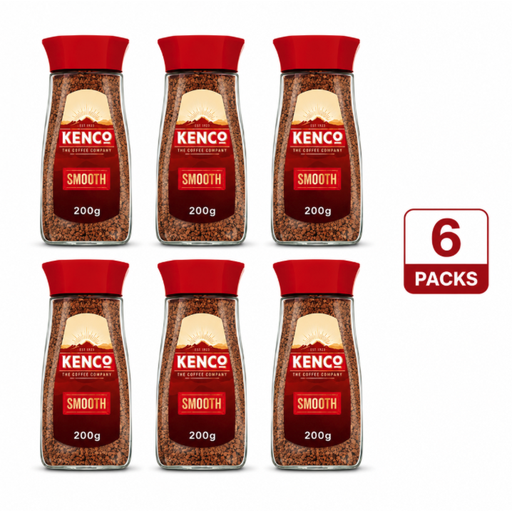
Kenco Smooth instant coffee, 200g × 6
For a shared supply measured by the spoon, six 200g packs provide 1,200g in total. This is a multi-pack rather than a case of ready-counted sticks; provide a spoon and check the product’s serving guidance when planning mugs.
View on Joybuy
Common questions
Does a box described as “240” contain 240 black-coffee sticks?
Check exactly what the number counts before ordering. For comparison, Nisbets lists its Nescafé Original coffee sticks as a 200-pack, so one of those cases falls short of 240 portions and two would exceed the target.
How much loose instant coffee should I plan for 240 mugs?
At Nescafé’s stated standard serving of 1.8g with 200ml water, 240 mugs require about 432g. A 750g Nescafé tin works out at about 416 servings on that basis, but the number falls if people use more coffee per mug.
Should I order black coffee, 2-in-1 or 3-in-1 sachets?
Order black coffee when people should add their own milk or sugar; choose a milk-containing or sweet recipe only when that is the drink you intend to provide. Nescafé describes its 2-in-1 as coffee with milk and its 3-in-1 as coffee with milk and sugar, with 8.4g sugars per prepared mug stated for the latter.
What should I check before offering milk-containing sachets?
Check the ingredients and allergen labelling for the exact sachet and keep that information available when serving it. GOV.UK guidance says any of the 14 allergens present in prepacked food or drink must be clearly labelled in the ingredients list.


