Households planning around 80 breakfast coffees
If full Scottish breakfasts are being served repeatedly, work out how many mugs a pack makes at the strength you intend to use rather than assuming you need 80 individual sachets.


For roughly 80 breakfast mugs, a large jar of black instant coffee lets guests add milk and sugar separately; an 80-sachet box is not essential. Calculate capacity from the coffee used per mug, and choose a stronger, medium-roast or decaffeinated option to suit the drinkers. All-in-one sachets make portions simpler but fix what is already added to each drink.
If full Scottish breakfasts are being served repeatedly, work out how many mugs a pack makes at the strength you intend to use rather than assuming you need 80 individual sachets.
Kenco describes Rich as intensity 9. It is a strength-led option for those who want a more robust coffee alongside breakfast, but its intensity rating does not tell you how many mugs a jar will make.
A separate decaf jar or black coffee with milk and sugar added individually offers choices that an all-in-one sachet does not. Check the current pack when caffeine content or ingredients matter to a guest.
Decide how many drinks you need, then compare serving instructions, coffee strength and what each format already contains.
| Priority | What to check | Your needs |
|---|---|---|
| Enough servings | Check the serving weight or stated mug yield on the exact pack. NESCAFÉ UK & IE gives 1.8g of instant coffee with 200ml water as its standard mug measure; using more coffee reduces the calculated yield. | I’m planning around 80 mugs and need enough coffee at the strength people will actually drink. |
| Strength and flavour | Compare the product descriptions rather than relying on brand alone. Kenco calls Rich intensity 9; Tesco describes Douwe Egberts Pure Gold as medium roasted and strength 3. The labels use different strength descriptions. | Some guests want a robust coffee with breakfast, while others may prefer a medium-roast option. |
| Milk and sugar | Check whether additions are separate or already included. NESCAFÉ describes its 3-in-1 sachets as containing coffee, milk and sugar. | I’d like people to choose their own milk and sweetness, unless ready-portioned sweet white coffee is what we intend to serve. |
| Caffeine and ingredients | Check the current caffeine wording, ingredients and allergen information on each pack, particularly for decaf and all-in-one products. | If guests have different requirements, I need to identify the decaf option and know what is in each drink before serving it. |
A serving calculation changes when you use more coffee per mug. NESCAFÉ UK & IE specifies 1.8g for a standard mug with 200ml water, while preparation directions for other products may use teaspoons instead.
Check the serving weight or yield on the jar you buy and calculate against your intended mug size and strength.
NESCAFÉ 3-in-1 sachets already combine coffee, milk and sugar, so guests cannot leave either addition out of that prepared sachet.
Choose black instant coffee with additions served separately if individual control matters. If choosing sachets, count the portions needed for the breakfast plan.
Kenco describes Rich as intensity 9, while Tesco lists Douwe Egberts Pure Gold as strength 3 and medium roasted. Neither label establishes a jar’s mug yield or an individual drink’s caffeine content.
Choose the flavour profile separately from the pack-capacity and caffeine checks; consider a distinct decaf option for guests who request one.
Ingredients can differ between black coffee and prepared coffee sachets, making the current product information important when serving guests with allergies.
Read the physical pack’s ingredients, allergen information and preparation directions before serving. The Food Standards Agency says food businesses must provide allergen information for both prepacked and non-prepacked food and drink.
These product lines illustrate different formats and flavour descriptions; brand inclusion does not mean every product is among the Joybuy options below.
Black instant coffee, decaf and all-in-one sachets cover different ways of serving breakfast coffee.
Kenco Rich is a jar option for drinkers seeking the brand’s more robust flavour description.
Pure Gold offers a medium-roast alternative to an intensity-led choice.
Classique is a smaller jar to assess against the number of breakfasts being served.
Tesco Gold is a 200g own-label jar with preparation directions based on teaspoons.
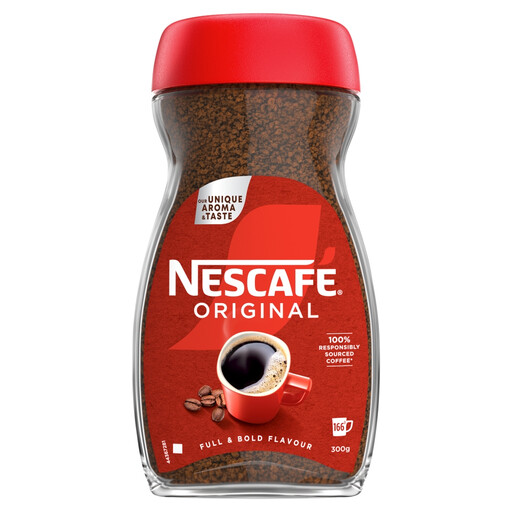
These two 300g NESCAFÉ jars offer a black-coffee choice and a decaffeinated choice for repeated breakfast servings. Serving estimates use NESCAFÉ’s general standard-mug measure, not a stated yield for either pack.
 No image available
A black instant-coffee jar for breakfasts where milk and sugar can be added separately. At NESCAFÉ UK & IE’s general measure of 1.8g per 200ml mug, 300g calculates to approximately 167 mugs, not a guaranteed yield for this pack. Check its current serving directions if you make stronger cups.
 No image available
A decaffeinated instant-coffee jar for guests who request decaf. At NESCAFÉ UK & IE’s general measure of 1.8g per 200ml mug, 300g calculates to approximately 167 mugs, not a stated yield for this pack. Check the current pack’s serving and caffeine information rather than assuming decaf means caffeine-free.
It can if the jar holds enough coffee at the serving size you use. NESCAFÉ UK & IE gives 1.8g with 200ml water as a standard mug measure; at that measure, 190g calculates to approximately 105 mugs. Using more coffee per drink lowers the yield, so check the directions on the exact pack.
No, if measuring coffee from a jar works for your breakfast setup. Sachets make individual portions simpler; NESCAFÉ 3-in-1 sachets also include milk and sugar. If you choose sachets for 80 drinks, check the count across the packs you buy.
Follow the directions on the coffee you buy and use the same measure for each mug. NESCAFÉ UK & IE specifies 1.8g with 200ml water as its standard instant-coffee mug measure, while Tesco Gold directs buyers to use one to two teaspoons per cup.
Read the current pack’s ingredients and allergen information for each product, especially all-in-one sachets containing milk or creamer. The Food Standards Agency says food businesses must provide allergen information for prepacked and non-prepacked food and drink.
Offer a clearly identified decaf option and check the current pack if residual caffeine matters. For pregnancy specifically, the NHS advises no more than 200mg caffeine a day and estimates 100mg in a cup of instant coffee; caffeine from other drinks and foods also counts towards that daily amount.