If 80 means roughly 80 mugs of black instant coffee, compare a refill or jar rather than assuming you need 80 sachets: Tesco and Sainsbury's list plain coffee in jars and refills, while their cited sachet packs contain 8 or 12 portions. Nescafé UK & IE states that its standard mug uses 1.8g, which puts 80 mugs at about 144g; a 150g refill comes close at that measure, but the number of mugs depends on how much you use.
Who is each format for?
Households making black coffee regularly
A refill or jar lets you measure each mug without opening an individual sachet. Using Nescafé UK & IE's 1.8g standard serving, 150g makes about 83 mugs; choose a larger jar when the household will use the extra coffee.
Shoppers who need individual portions
Sachets are worth considering for work, travel or guests, particularly when a prepared milky coffee drink is wanted. Check the pack count and ingredients: the cited Sainsbury's examples include 8- and 12-sachet packs, and some are drink mixes rather than plain coffee.
Shoppers looking for decaf
Look for an explicitly labelled decaffeinated coffee in the format you want. A flavour-intensity number is not a caffeine measure, so check information for the exact product instead.
What should you check before buying?
Start with what the 80 refers to—mugs of plain coffee or individual prepared drinks—then check the serving size and pack format.
| Priority |
What to check |
Your needs |
| Amount of coffee |
Check the pack weight and its serving directions. At Nescafé UK & IE's stated 1.8g per standard mug, 80 mugs use about 144g; stronger mugs use more. |
I want enough for around 80 mugs without choosing a much larger pack than my household will use. |
| Pack format |
Check whether the product contains soluble coffee or individually portioned drink mix. A refill needs a suitable storage container; sachets come with a stated portion count. |
For coffee made at home, I can measure from a jar or refill. For work or guests, separate portions may matter more. |
| Drink style |
Read whether the pack is plain coffee or a cappuccino, latte or other prepared mix. Check its ingredients and nutrition information if choosing sachets. |
I want to know whether I'm buying coffee to prepare my own way or a mix that already contains other ingredients. |
| Caffeine and ingredients |
Look for explicit decaf labelling if that is the requirement. Check caffeine information for the exact product, plus ingredient and allergen information for flavoured or milky sachets. |
Decaf needs to be clear on the pack; an intensity number or a familiar product name is not enough for me to judge its caffeine content. |
| Storage |
Check the pack's storage directions and whether a refill can be transferred to a clean, dry container. Consider whether a larger quantity fits regular household use. |
If I buy more than I need for 80 mugs, I need somewhere suitable to keep the rest. |
What can go wrong with an 80-mug plan?
-
Assuming 80 mugs means 80 sachets
The cited Tesco and Sainsbury's ranges include plain coffee in jars and refills, while the cited sachet examples contain 8 or 12 portions. Several small sachet packs may be an awkward way to supply black coffee at home.
Use the serving directions to turn your mug target into a weight. At Nescafé UK & IE's standard 1.8g serving, 80 mugs take about 144g; compare that with a 150g refill and available jar sizes.
-
Treating every coffee sachet as plain instant coffee
Cappuccino, latte and 3-in-1 sachets may contain ingredients beyond coffee. They will not necessarily make the unsweetened black coffee you intended to buy.
Choose a product labelled as plain instant coffee for that purpose. If buying a drink mix, read its ingredient, nutrition and allergen information on the exact pack.
-
Using flavour intensity to judge caffeine
Nescafé UK & IE explains that its intensity scale describes flavour rather than directly measuring caffeine. A lower intensity number therefore does not identify a decaf coffee.
When caffeine content affects your choice, look for explicit decaf labelling and check the exact product's caffeine information.
Which brand ranges are relevant?
These ranges illustrate jars, refills and decaf choices; the format and pack details matter more to an 80-mug plan than the brand name alone.
Nescafé
Its UK range includes Original granules, refills, decaf and coffee-drink sachets.
- Nescafé UK & IE states a standard serving of 1.8g, a useful basis for estimating mugs from a pack's weight.
- The estimate depends on how each mug is prepared; check the directions for the exact product.
Kenco
Its instant-coffee range includes Smooth, decaf and refill formats.
- Kenco describes its Smooth paper refill as a 150g pack for refilling a jar.
- A refill requires a suitable container, and Kenco's flavour-intensity description does not state how many mugs a particular pack will make.
Douwe Egberts
Tesco lists Pure Gold, Pure Indulgence and Pure Decaffeinated instant coffees in 190g formats.
- The listed 190g size is an option to compare with a 150g refill when planning around 80 mugs.
- Choose the specific variant you want; flavour descriptions are not a substitute for checking whether the pack is decaffeinated.
Carte Noire
Tesco lists a 150g Carte Noire instant-coffee refill, a format to consider if you already have a suitable container.
- Its stated 150g weight is close to the amount calculated for 80 mugs at Nescafé UK & IE's standard serving size.
- Check current stock before making this refill part of a weekly shop; Tesco marked the cited listing out of stock.
Sainsbury's
Its Gold Roast instant-coffee range includes 200g and 500g jars and a decaffeinated version.
- Different jar sizes let shoppers compare a more moderate quantity with a larger household supply.
- A 500g jar exceeds an 80-mug target at the stated 1.8g serving measure; consider whether the household will use that quantity.
Joybuy instant-coffee options
These jars offer decaffeinated and everyday instant-coffee options for making coffee at home. Each contains more than the approximately 144g calculated for 80 mugs at Nescafé UK & IE's standard serving size.
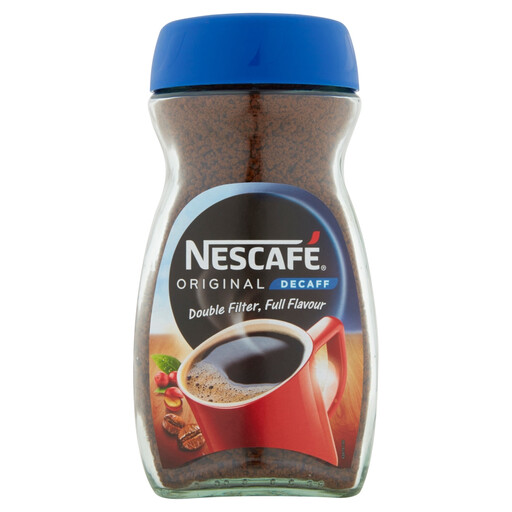 Image unavailable
Nescafé Decaf (New Shape) 200g
This 200g jar is a decaffeinated option for coffee made at home. At Nescafé UK & IE's general 1.8g standard serving, 200g works out to about 111 mugs; check this pack's directions before relying on that estimate.
View on Joybuy
 Image unavailable
Nescafé Original Decaff Coffee 300g
This 300g decaffeinated jar suits a household that expects to use more coffee than an approximate 80-mug supply. Nescafé UK & IE's general 1.8g serving would make about 167 mugs from 300g; the directions on this pack and the amount used per mug determine the actual yield.
View on Joybuy
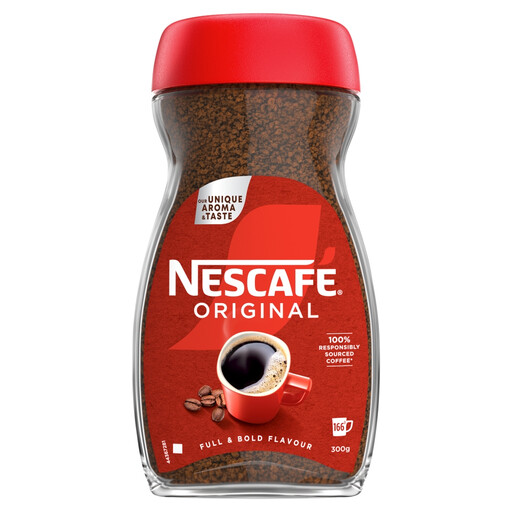 Image unavailable
Nescafé Original Instant Coffee 300g
This 300g jar is an option for regularly making plain instant coffee at home when the household will use more than 80 mugs' worth. At Nescafé UK & IE's general 1.8g standard serving, it works out to about 167 mugs; check the pack's directions for the serving you make.
View on Joybuy
Frequently asked questions
How much instant coffee do I need for about 80 mugs?
At Nescafé UK & IE's stated 1.8g per standard mug, 80 mugs need about 144g, so 150g would make roughly 83 at that serving size. Check the exact pack's directions and allow for the amount you actually use in each mug.
Do I need an 80-count box for a weekly shop?
No, if your aim is approximately 80 mugs of black instant coffee: a jar or refill can supply that quantity without individual sachets. The cited Tesco and Sainsbury's examples list plain coffee in jars and refills, while sachet examples contain 8 or 12 portions; choose sachets when separate portions or a prepared drink mix are the point.
Does a lower flavour-intensity number mean less caffeine?
No. Nescafé UK & IE says its intensity scale generally describes flavour, not caffeine content. If caffeine matters to your choice, check the exact product's caffeine information or look for explicit decaf labelling.
Should I check the ingredients in coffee sachets?
Yes. The cited cappuccino and 3-in-1 sachets are drink mixes rather than simply portions of plain coffee, and formulations can differ. Read the exact pack's ingredients, nutrition and allergen information if those details affect what you buy.


