Hosts providing one everyday coffee
A smooth or medium blend gives guests with unknown tastes a less specialised starting point than an intense dark roast. Guests can still decide whether to drink it black or add milk.


For a self-catering cottage where guests’ preferences are unknown, a smooth or medium instant coffee is a practical one-jar starting point. Add a separately labelled decaf jar if guests may want that choice, and treat an intense dark roast as an additional flavour option rather than the only coffee. Check the current pack for preparation, ingredients and storage directions before putting it on the guest tray.
The number of jars worth providing depends on whether the cottage needs a straightforward shared coffee or distinct choices for guests.
A smooth or medium blend gives guests with unknown tastes a less specialised starting point than an intense dark roast. Guests can still decide whether to drink it black or add milk.
A separate jar marked decaffeinated lets guests identify that option for themselves. A mild-tasting regular blend is not a substitute for a decaf label.
Where guests might actively prefer a robust coffee, an intense blend can sit alongside a smoother everyday jar rather than replacing it.
Decide what the main jar needs to do, then consider whether decaf or a more intense flavour warrants a separate place on the tray.
| Priority | What to check | When it matters to me |
|---|---|---|
| Everyday flavour | Read the stated roast and flavour description. Smooth, medium and well-balanced describe a different intended profile from dark or intense; they do not guarantee that every guest will like it. | If I am leaving just one jar for guests whose tastes I do not know, I would start with a less specialised flavour profile. |
| Decaf identification | Look for an explicit decaffeinated designation on the exact pack. Keep the decaf and regular jars clearly distinguishable; mild flavour alone says nothing definite about caffeine content. | Guests looking for decaf should be able to find it without guessing which jar contains it. |
| Richer flavour | Use dark-roast descriptions and tasting notes to identify an additional robust option. Treat a brand’s intensity number as flavour guidance, not a caffeine measurement or a scale for comparing every brand. | I may want a second jar for guests who ask for a more pronounced coffee taste, while keeping a gentler shared option. |
| Pack size and storage | Compare the pack size with expected use between bookings. Check the current pack’s storage and best-before directions, and close an opened jar as directed. | A larger jar makes more sense to me when bookings are frequent and there is a suitable place to store it between stays. |
| Preparation and label | Read the particular coffee’s directions for the amount to use and water temperature. Check ingredients and other relevant label information on the physical pack before setting it out. | I want guests to have clear preparation directions, especially when the tray contains more than one coffee. |
A dark roast offers a deliberately robust profile, which may not suit guests who prefer a gentler cup.
Start with a smooth or well-balanced shared coffee when preferences are unknown; add an intense jar if you want to offer that distinct flavour.
An intensity description tells guests about the intended taste, not whether the coffee is decaffeinated.
Choose a product explicitly labelled decaffeinated for the separate decaf jar, and retain its identifying label on the guest tray.
An opened jar may remain in the cottage between bookings, so its size needs to fit both expected use and the available storage space.
Check the pack’s storage directions and best-before information, and keep the container closed between uses.
Product details can change, making an earlier online description an unreliable substitute for the coffee actually supplied.
Read the physical pack for its ingredients, decaf designation and preparation directions before placing it on the tray.
These named coffees illustrate different stated flavour and decaf options; the descriptions are not an independent taste comparison or a list of products necessarily stocked together.
Nescafé describes Gold Blend as smooth and well-rounded, making it a reference point for a shared everyday jar. Its Original Decaf is a separately identified decaf product.
Kenco describes Smooth as full-flavoured without being overly strong or bitter, and gives it an intensity rating of 7.
JDE Professional UK describes Pure Gold as mild, smooth and well-balanced in a professional pack format.
Sainsbury’s describes Carte Noire Intense as a dark-roast Arabica and Robusta blend with an intense character.
Tesco describes its Gold Instant Coffee as freeze-dried coffee made with Robusta and Arabica beans, with a rich and smooth profile.
Sainsbury’s labels Gold Roast as a smooth and rich medium instant coffee, and Gold Roast Decaffeinated as a separate smooth and well-rounded medium option.
These options cover smooth or medium coffees for a shared jar, a separately labelled decaf choice and an intense dark roast for guests who prefer that flavour. They are different roles on a cottage coffee tray, not a single flavour ranking.
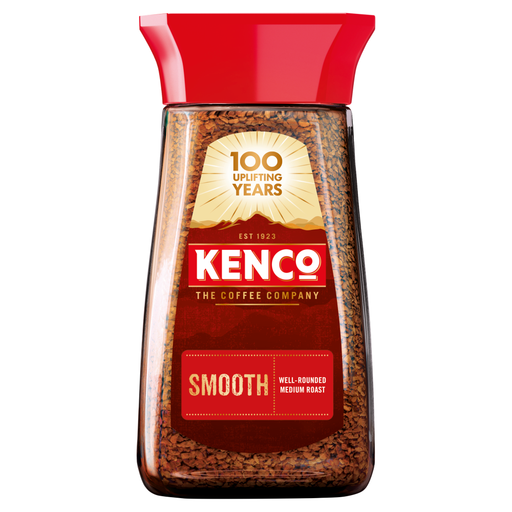 No image available
A smooth-flavour option for the main guest jar. The listed pack is 200g; Kenco describes Smooth as full-flavoured without being overly strong or bitter. Provide a separately labelled decaf product if guests need that choice.
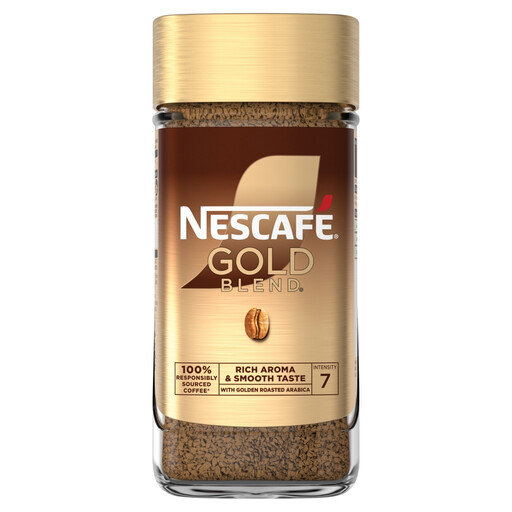 No image available
For an everyday shared jar, Nescafé describes Gold Blend as smooth and well-rounded. This listed pack is 190 g. Check the pack’s preparation directions and provide a distinct decaf jar if wanted.
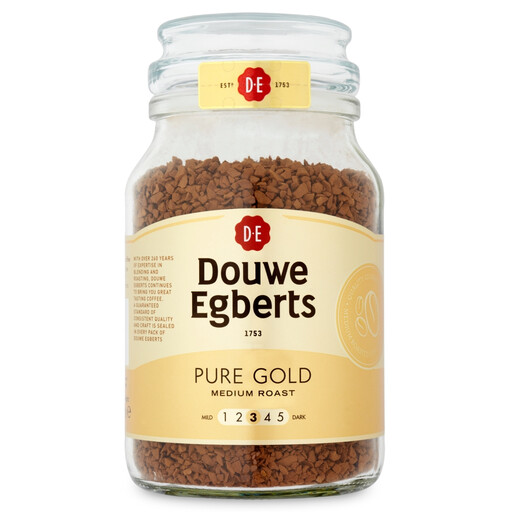 No image available
The medium-roast designation makes this another option to consider for a shared jar. The listed pack is 190g. Check the exact pack for preparation and storage directions before leaving it for guests.
 No image available
An explicitly named decaf option to place separately from regular coffee. The listed jar is 190g. Decaffeinated does not mean caffeine-free; check the current pack if a particular caffeine limit matters to a guest.
 No image available
The stated intense dark-roast profile makes this a distinct second flavour choice for guests who prefer robust coffee. The listed pack is 100g; keep a gentler jar as the shared option if guest preferences are unknown.
Start with a smooth, medium or well-balanced coffee when guests’ preferences are unknown, rather than assuming everyone wants an intense dark roast. That is a practical selection judgement based on stated flavour profiles, not a guarantee about individual tastes.
No. Mild describes flavour, whereas decaf must be identified on the product label. If you offer it, keep a clearly labelled decaffeinated jar distinct from regular coffee; check the pack if a guest needs to know its residual caffeine content.
Follow the directions on the particular pack rather than using one measure for every blend. Check its stated amount of coffee and water-temperature guidance, then make those directions easy for guests to see.
Close it as directed on the pack and follow its storage and best-before information. Check the jar before putting it back on the guest tray, particularly if it has been stored through several changeovers.
Check the physical pack supplied to the cottage instead. Sainsbury’s advises reading the label because ingredients can change; this is particularly important when considering a flavoured coffee or a mix containing other ingredients.