Who is this choice for?
The right jar depends on the person’s caffeine tolerance, drinking routine and ability to prepare a cup.
Older adults limiting caffeine
If caffeine makes bladder symptoms worse, a decaffeinated jar may help preserve a familiar coffee routine. NHS Tayside notes that caffeine can worsen many bladder and bowel symptoms; follow any individual advice about limiting it.
Relatives and carers supporting regular drinks
Coffee can be one of the drinks offered during the day: the NHS includes tea and coffee in daily fluid intake. Older adults are at greater risk of dehydration, so consider the wider drinking routine rather than relying on coffee alone.
Care-home and supported-living shoppers
A familiar coffee may fit a resident’s routine, but jar choice sits alongside their individual food, fluid and clinical requirements. Norfolk and Waveney ICB’s care-home guidance identifies greater malnutrition and dehydration risk as people become older and more dependent.
What should you check?
Start with caffeine tolerance and the person’s food and drink routine, then check whether the pack and preparation work for them.
| Priority |
What to check |
Your needs |
| Caffeine |
Check whether the jar is labelled decaffeinated and follow any individual caffeine restriction. Decaf need not mean that every trace of caffeine has been removed: NESCAFÉ says most caffeine is removed from its Original Decaf. |
“Caffeine seems to make bladder symptoms worse, but I still want to offer coffee.” NHS Tayside notes that caffeine can aggravate many bladder and bowel symptoms. |
| Daily drinks |
Consider where coffee fits among the person’s other regular drinks. The NHS says tea and coffee count towards daily fluid intake and that older adults are at greater risk of dehydration. |
“A warm drink is part of the routine, but I also need to keep track of drinks across the day.” |
| Food and nutrition |
Keep coffee separate from meals and any individual nutrition plan, particularly where poor appetite or malnutrition risk is a concern. Check preparation ingredients rather than assuming every cup is made the same way. |
“I’m choosing something the person enjoys drinking, not a replacement for food.” Norfolk and Waveney ICB’s care-home guidance highlights malnutrition risk among older, more dependent people. |
| Jar handling |
Check the actual lid, jar weight and label with the intended user. Also consider how they will measure the coffee and handle hot water; pack size alone does not establish ease of use. |
“The person needs to be able to open the jar, read its directions and make a cup within their usual routine.” |
| Pack size and storage |
Match the jar size to how often coffee is used, and check the pack’s storage and preparation directions. Tesco lists cool, dry storage for Douwe Egberts Pure Decaffeinated Instant Coffee 190 g; Sainsbury’s lists a 100 g Carte Noire decaf jar. |
“For an occasional cup or a first try, I would rather check that the coffee and jar suit the person before choosing a larger pack.” |
Brand and range references
These examples illustrate decaffeinated formats to compare; a brand’s wider range may include different products.
Nescafé
NESCAFÉ Original Decaf is an option for someone who wants a decaffeinated instant coffee.
- NESCAFÉ says it removes most of the caffeine using water; the Joybuy selection below includes an Original Decaff 300 g jar.
- Check the exact jar and its directions rather than assuming every Nescafé decaf format has the same pack size or preparation instructions.
Kenco
Kenco Decaf offers smaller and medium-sized instant-coffee formats to consider.
- Kenco lists 95 g and 190 g Decaf sizes, while Tesco describes a separate 200 g Kenco product as decaffeinated instant coffee.
- Check the precise variant and jar size: descriptions of one Kenco listing do not establish the details of another.
Douwe Egberts
Pure Decaffeinated Instant Coffee is a 190 g format listed by Tesco.
- Tesco’s listing gives the pack size and instructs shoppers to store it in a cool, dry place.
- Assess the actual jar and current pack directions for the person who will use it.
Carte Noire
Its 100 g decaffeinated instant coffee is a smaller-jar example for an occasional coffee routine.
- Sainsbury’s lists a 100 g jar and directions of one or two teaspoons per cup.
- Check the current listing and pack before relying on those directions or planning a purchase.
Tesco
Tesco Classic Decaffeinated Coffee is an own-brand instant-coffee option.
- Tesco’s directions for its 200 g product say to use one or two teaspoons per cup with hot, not boiling, water.
- Check the current pack if its ingredients or directions matter for the person’s routine.
Sainsbury's
Sainsbury’s lists own-brand decaffeinated coffee granules in its range.
- Its decaffeinated category includes a 200 g Gold Roast jar.
- Choose by the particular product label and jar format rather than assuming the own-brand range is uniform.
Decaf jars on Joybuy
These decaffeinated instant-coffee jars offer 100 g, 200 g and 300 g pack sizes to consider when matching a coffee routine to the person using the jar.
 Image unavailable
Kenco Decaff Instant Coffee 100g
The 100 g decaf jar is a smaller-pack option if coffee is made infrequently or the person is trying this product for the first time. Check that they can open the lid, read the directions and handle hot water safely.
View on Joybuy
 Image unavailable
NESCAFÉ Original Decaff Coffee 300g
This 300 g decaffeinated soluble-coffee jar may fit a routine where coffee is made regularly. Check whether the larger jar is manageable for its user, and follow the directions on the pack when preparing it.
View on Joybuy
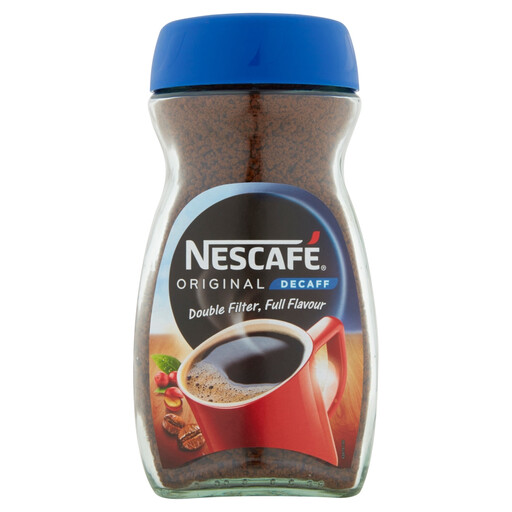 Image unavailable
NESCAFÉ Decaf (New Shape) 200g
This 200 g decaffeinated soluble-coffee option sits between the smaller and larger jars shown here by pack size. The New Shape variant still needs an individual check for lid handling, label readability and pack directions.
View on Joybuy
Questions about choosing and using a jar
Can instant coffee replace food for an older person with poor appetite?
No. Choose coffee as a drink the person enjoys, not as a replacement for meals or their individual nutrition plan. Norfolk and Waveney ICB’s care-home guidance highlights malnutrition risk among older, more dependent people.
When might decaf be a better fit than regular coffee?
Consider decaf if caffeine worsens the person’s bladder symptoms or they have been advised to limit caffeine. NHS Tayside notes that caffeine can aggravate many bladder and bowel symptoms; the choice should still reflect the person’s own circumstances and preferences.
Does coffee count towards an older person’s daily fluids?
Yes. The NHS includes tea and coffee in daily fluid intake. Coffee can be part of a regular drinking routine, while other drinks and any individual fluid requirements still need consideration.
How can I tell whether a coffee jar will be practical to use?
Check the actual jar with the intended user: can they manage the lid and weight, read the label, measure a serving and handle hot water safely? A stated pack size cannot answer those handling questions on its own.
What matters when buying coffee for someone in a care setting?
Fit the coffee choice into the resident’s individual food, fluid and clinical requirements rather than treating the jar as a stand-alone nutrition decision. Check the current pack label and preparation directions before serving it.


