Relevant brand and retailer references
These examples help distinguish instant jars from prepared cold drinks; they do not describe the Joybuy selection below.
M&S
M&S describes instant coffees for dry storage and separately lists a ready-to-drink Classic Latte Cold Brew Coffee.
- M&S describes its Gold Instant Coffee as 100% arabica and medium roast; its Italian Style Instant Coffee is freeze-dried.
- The 250ml Classic Latte Cold Brew Coffee is intended to be enjoyed from the fridge, not used as an instant jar.
Tesco
Tesco’s NESCAFÉ Original 190g listing provides a specific iced-frappé preparation method.
- Its instructions use cold water or milk and ice, making this particular jar relevant to make-your-own iced drinks.
- Check the pack when buying; Tesco advises that food formulations and labels can change.
Sainsbury's
Sainsbury’s lists instant coffee, including Gold Roast and Gold Roast Decaffeinated granules.
- The category provides both regular and decaffeinated instant-jar options to examine.
- Check an individual jar’s directions before choosing it specifically for cold-water preparation.
Waitrose
Waitrose lists instant coffee separately from iced-coffee products, including prepared drinks and a concentrate.
- The separate formats make it possible to compare a make-your-own jar with a prepared drink.
- Check each product’s preparation, ingredients and storage directions rather than applying one format’s instructions to another.
Sandows
Sandows identifies itself as a cold-brew coffee brand.
- Check a specific product’s pack format, preparation and storage directions before treating it as an alternative to an instant jar.
Instant-coffee jars on Joybuy
These two decaffeinated instant-coffee jars are options to consider for a holiday stay with cool, dry storage. Check their individual preparation directions if making a drink with cold water is essential.
 No image available
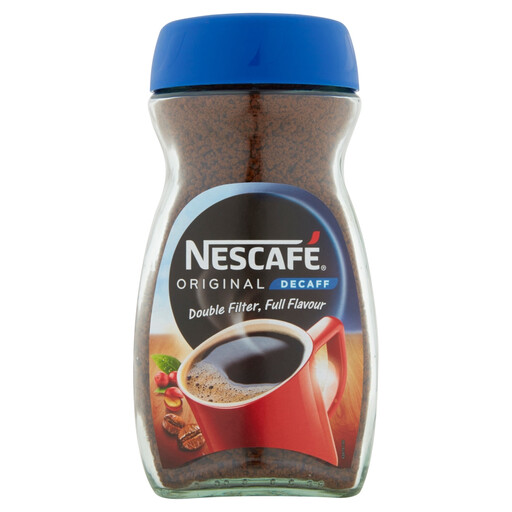
NESCAFÉ Original Decaff Coffee 300g
A decaffeinated soluble-coffee jar to consider if you plan to make drinks at your accommodation. The 300g jar has cool, dry storage directions; check its preparation instructions before relying on cold water alone, and check the label if you need its caffeine amount.
View on Joybuy
 No image available
NESCAFÉ Decaf (New Shape) 200g
Another decaffeinated soluble-coffee jar for making drinks where you are staying. This is a 200g jar with cool, dry storage directions; check the pack for cold-water preparation instructions and for the caffeine information you need.
View on Joybuy
Questions about holiday coffee
Is instant coffee the same as cold brew?
No. Instant coffee is soluble coffee that you prepare as a drink; a chilled ready-to-drink cold brew is a different format. Choose by how you intend to prepare, carry and store the drink, and check the directions on the particular product.
Can I make iced coffee from a jar without hot water?
Yes, when the particular jar gives a suitable cold-preparation method. Tesco’s directions for NESCAFÉ Original 190g use 1 teaspoon with 150ml cold water or milk and ice in a shaker. Check other jars separately rather than assuming they use the same method.
Where should I keep an instant-coffee jar on holiday?
Follow its pack instructions. M&S describes cool, dry storage for its instant coffees and directs shoppers to the lid for the best-before date. Keep the lid closed and choose a dry place rather than leaving the jar somewhere hot or damp.
What should I check when taking a chilled coffee?
Read its label for refrigeration, after-opening and date instructions, then plan how to follow them while travelling. Food Standards Scotland advises consumers to check labels for fridge storage and whether a product needs refrigeration after opening.
Does a cold coffee still count towards caffeine intake?
Yes. Ice and milk do not remove caffeine from the coffee. For pregnancy, the Royal College of Midwives’ June 2024 summary cites NHS and RCOG guidance of up to 200mg of caffeine daily; caffeine from tea, cola, energy drinks and chocolate also counts.


