What should you check before choosing?
Start with the equipment at your stall, then choose a quantity and serving method that fit the drinks you expect to make.
| Priority | What to check | Your needs |
|---|
| Preparation |
Confirm that the pack says instant or soluble coffee. Check its water and spoon-measure directions; Tesco’s directions for its Classic Decaffeinated Coffee specify 1–2 teaspoons per cup and hot, not boiling water. |
With only hot-water provision at my stall, I want to make each cup without setting up brewing equipment. |
| Jar size |
Compare the labelled quantity with likely orders and how you will store any remainder. The named instant-decaf options include smaller jars and 190g–200g sizes. |
For a short trial sale, I would rather choose a smaller jar; if orders are likely to continue through the event, I may need more. |
| Product description |
Check the exact variant and pack label. Kenco describes its Decaf as smooth and balanced with an intensity rating of 7; M&S describes Gold Decaf as medium-roasted, freeze-dried arabica from Fairtrade farms. |
I want to know what the maker says about the coffee without treating a flavour description as a taste-test result. |
| Decaf wording |
Keep the product’s decaf identification available and check the label before making any more specific caffeine claim. Decaf does not, by itself, establish that a drink contains no caffeine. |
Customers may ask what decaf means, so I need to describe the coffee without promising that it is caffeine-free. |
| Serving customers |
Check whether your planned activity is a food business and contact the relevant local authority about registration. Check the current labels of the coffee and every added ingredient so you can give accurate allergen information. |
If I sell prepared cups with milk or other additions, I need to plan for the whole drink, not just the coffee jar. |
Brand and format references
These references describe particular product lines and formats; they do not establish which products a local shop will carry.
Nescafé
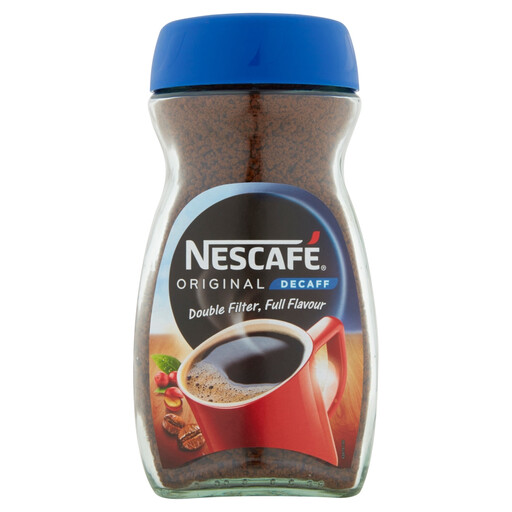
Original Decaf is an instant coffee offered in several jar sizes, including 100g, 190g and 300g.
- Nescafé says Original Decaf contains 100% pure coffee and uses beans decaffeinated with water.
- The decaf description should not be presented as a guarantee that the drink contains no caffeine.
Kenco
Kenco Decaf is an instant-coffee route for buyers comparing smaller and regular-size jars.
- Kenco describes this coffee as smooth and balanced, with an intensity rating of 7.
- Those flavour and intensity descriptions are the manufacturer’s claims, not independent taste-test findings.
Tesco
Tesco Classic Decaffeinated Coffee is a 200g instant-jar option with stated preparation directions.
- Tesco directs users to add 1–2 teaspoons per cup and use hot, not boiling water.
- Read the jar you purchase for its current ingredients and serving instructions.
Sainsbury's
Sainsbury's Gold Roast Decaffeinated Instant Coffee Granules is a 200g own-label jar to compare with other instant formats.
- The named product is instant decaf granules in a 200g pack.
- Check the current pack and local availability when planning supplies for an event.
M&S
Gold Decaf is a 200g instant option with a stated bean type and production method.
- M&S describes it as medium-roasted arabica from Fairtrade farms that is ground and freeze-dried.
- M&S advises checking the pack because ingredients and allergen information can change.
Taylors of Harrogate
Taylors Decaffé Roast ground coffee and decaf coffee bags are alternative brewing formats mentioned in Sainsbury's decaf range.
- These formats may suit a stall equipped to prepare ground coffee or coffee bags.
- Check the format before buying: the named products are not substitutes for an instant jar in a hot-water-and-spoon setup.
Instant decaf jars on Joybuy
These instant decaf jars cover different quantities for a hot-water stall setup. Choose the pack size against likely orders and read the actual jar before serving.
 No image available
NESCAFE Gold Blend Decaf Coffee 190g
A 190g decaf jar to consider when that quantity matches the orders expected at a regular stall. Check the jar’s directions for the measure to use in each cup.
View on Joybuy
 No image available
Kenco Decaff Instant Coffee 100g
This 100g instant-decaf jar is a smaller quantity to consider for a short sale or uncertain demand. Follow the directions on this pack when preparing drinks.
View on Joybuy
 No image available
NESCAFÉ Decaf (New Shape) 200g
The 200g jar is a quantity to consider for a stall expecting repeated decaf orders. Read its serving and storage directions before the event.
View on Joybuy
 No image available
NESCAFÉ Original Decaff Coffee 300g
This 300g jar gives you a larger quantity if you expect more decaf orders. Consider what you will do with any remainder, and check the pack for preparation and storage directions.
View on Joybuy
Common questions
Is instant decaf practical for a car boot sale stall?
Yes, if you have suitable hot-water provision and want to make coffee without a brewing machine. Check the chosen jar’s directions: Tesco, for example, specifies 1–2 teaspoons per cup with hot, not boiling water. Ground coffee, coffee bags and pods need their own preparation arrangements.
What size decaf jar should I take?
Base the quantity on likely orders and whether you can store and use any remainder according to the pack instructions. A smaller jar may suit a short trial sale; compare 190g–200g jars for repeated orders and consider a 300g jar if you expect greater demand.
Can I tell customers that decaf contains no caffeine?
No: the word “decaf” alone does not support a caffeine-free claim. Nescafé says most caffeine is removed from the beans used for Original Decaf. Describe the drink using its actual pack information rather than promising zero caffeine.
Do I need to register to sell prepared coffee from a stall?
If your activity is a food business, GOV.UK and Food Standards Agency guidance for England, Wales and Northern Ireland includes temporary stalls in food-business registration. Contact the relevant local authority about your planned activity before trading; that guidance does not establish the position for a stall in Scotland.
What allergen information matters when I serve decaf coffee?
For food businesses in England, Wales and Northern Ireland, Food Standards Agency guidance requires allergen information for both prepacked and non-prepacked food and drink. Check the current labels for the coffee and everything added to each cup, including milk, plant drinks, creamers or syrups, and make accurate information available to customers.


