Quick-breakfast coffee drinkers
An instant jar suits a breakfast cup made by adding hot water, without setting up a cafetière or filter. Check that the pack says instant or soluble: ground decaf needs brewing instead.


For a quick weekend breakfast, start with a jar labelled instant or soluble, then choose a flavour direction: NESCAFÉ describes Original Decaf as bold and Gold Blend Decaf as smooth, while Kenco describes its Decaf as balanced. Pick a jar size that fits how often you will use it, and do not assume decaf means caffeine-free.
An instant jar suits a breakfast cup made by adding hot water, without setting up a cafetière or filter. Check that the pack says instant or soluble: ground decaf needs brewing instead.
A decaf jar offers a coffee option when you want to reduce caffeine, but decaf does not necessarily mean caffeine-free. Check the product label if caffeine content matters to your choice.
If several people make coffee at home, compare jar weights and choose a size that fits how regularly the household will use it.
Confirm the preparation format first; then compare flavour descriptions, jar sizes and decaf wording for the products on your shortlist.
| Priority | What to check | Your needs |
|---|---|---|
| Preparation | Look for instant or soluble coffee in a jar. Ground coffee requires brewing; Taylors of Harrogate gives a four-to-five-minute cafetière method for its Decaffé ground coffee. | I want to add hot water and make coffee without getting brewing equipment out at breakfast. |
| Flavour direction | NESCAFÉ describes Original Decaf as bold and Gold Blend Decaf as smooth and rounded. Kenco describes its Decaf as balanced and gives it an intensity rating of 7 on Kenco’s own scale. | A flavour description helps me narrow the choice, but I would not treat different brands’ descriptions or intensity scales as a taste test. |
| Jar size | Check the net weight of the exact jar. NESCAFÉ lists Original Decaf in 100g, 190g and 300g jars and Gold Blend Decaf in 95g and 190g jars; Kenco lists 95g and 190g Decaf jars. | For a jar shared at home, I want a size that matches how often we make coffee. |
| Caffeine | Confirm that the chosen jar is labelled decaf, but do not read that as a zero-caffeine guarantee. NHS pregnancy guidance counts caffeine from all sources. | If I am keeping track of caffeine, the word decaf alone does not tell me that a cup contains none. |
Decaffeinated coffee can still contain caffeine. During pregnancy, NHS guidance says to have no more than 200mg of caffeine a day from all sources, so a decaf label should not replace consideration of other drinks and foods.
Check the particular product’s decaf wording. If you need individual advice about restricting caffeine, speak to your maternity team or another appropriate clinician.
Taylors of Harrogate Decaffé is ground coffee, and its cafetière instructions call for a four-to-five-minute brew. It will not make the same just-add-water cup as soluble coffee.
Check the preparation instructions before choosing: select instant or soluble coffee for a jar you can stir into hot water.
Ground coffee also means allowing time for brewing and having suitable equipment.
Words such as bold, balanced and smooth describe how the manufacturers position these coffees. Kenco’s intensity rating is its own scale, not a direct numerical comparison with another brand.
Use those descriptions to narrow your shortlist, then consider a smaller suitable jar if you have not tried the blend.
NESCAFÉ lists Original Decaf and Gold Blend Decaf as instant coffees in several jar sizes.
Kenco lists its Decaf instant coffee in 95g and 190g jars.
Tesco Groceries lists Decaffeinated Classic Coffee and Decaff Gold Instant Coffee in 200g jars.
Taylors of Harrogate Decaffé is a ground-coffee alternative, not a jarred instant coffee.
These Joybuy options are decaf soluble-coffee jars for a quick home breakfast. Their product names identify different sizes and ranges; use the details of each jar rather than assuming they have the same flavour.
 No image available
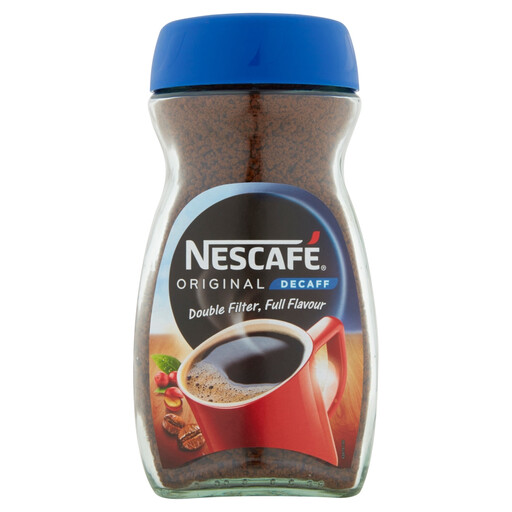
This 300g jar contains decaffeinated soluble coffee for a just-add-water breakfast cup. NESCAFÉ describes its Original Decaf range as bold and intense and says it uses water to remove most of the caffeine.
 No image available
This 190g jar contains decaffeinated soluble coffee for a cup made with hot water. NESCAFÉ describes Gold Blend Decaf as a smooth, rounded, freeze-dried blend of Arabica and Robusta.
 No image available
This 200g jar contains decaffeinated soluble coffee, fitting a breakfast routine without brewing equipment. If flavour direction or decaffeination method matters to you, check the details for this exact variant before choosing it.
No: decaf is not a promise of zero caffeine. In England, the Coffee Extracts and Chicory Extracts (England) Regulations 2000 allow a decaffeinated description for a coffee extract when residual anhydrous caffeine does not exceed 0.30% of its coffee-based dry matter.
Choose a jar labelled instant or soluble if you want to add hot water and stir. NESCAFÉ Original Decaf, NESCAFÉ Gold Blend Decaf and Kenco Decaf are instant-jar options; Taylors of Harrogate Decaffé is ground coffee that requires brewing.
Yes. NHS guidance says to have no more than 200mg of caffeine a day during pregnancy, counting all sources. A decaf label does not establish that a cup is caffeine-free; ask your maternity team if you need advice for your circumstances.
Choose the jar size that fits how regularly your household will use it, rather than assuming the largest is the right fit. Check the exact net weight, the pack’s storage instructions and whether everyone who will drink it wants that blend.