Budget households baking oat bread regularly
Choose a plain oat ingredient in a larger pack when you bake repeatedly and need enough oats to measure into several loaves. Quaker UK lists its Traditional Rolled Oats in 500g, 1kg and 1.5kg formats.


For regular oat-bread baking, a larger pack of plain rolled or porridge oats is usually the more suitable starting point because it gives you a simple ingredient to measure with flour. Plain instant sachets can work for an occasional test loaf when the exact ingredient list contains oats alone, but avoid flavoured sachets and milk-powder pots when you need control over the recipe.
Choose a plain oat ingredient in a larger pack when you bake repeatedly and need enough oats to measure into several loaves. Quaker UK lists its Traditional Rolled Oats in 500g, 1kg and 1.5kg formats.
Plain instant sachets can be useful for a small test loaf when the exact pack lists oats alone. Do not assume flavoured sachets or milk-powder pots will behave like plain oats in a bread formula.
Check the declaration on the exact pack rather than relying on the product category. Standard oats can carry wheat or barley cross-contact statements, while some ready-to-prepare porridge products contain milk powder.
Choose this when: You bake oat bread regularly and want to measure the oats, liquid and flavouring yourself.
Trade-off: Larger bags are not pre-portioned, and the exact allergen statement still needs checking.
Choose this when: Small, pre-measured portions are more useful than a large baking supply and the label lists oats alone.
Trade-off: Sachets provide less oats per pack and create more individual packaging for repeat baking.
Choose this when: You specifically want an individual porridge breakfast or a recipe intentionally uses the added ingredients.
Trade-off: Added dairy, flavouring or preparation directions can change a bread recipe.
| Priority | What to check | Your needs |
|---|---|---|
| Ingredient simplicity | Read the full ingredient list. Plain oats or oat flakes let you decide the dairy, sweetening and liquid in the dough. | I want the oat ingredient to fit a neutral bread recipe without unexpected milk powder or flavouring. |
| Pack format | Compare the total weight and whether the oats are in a bag, sachets or a prepared-porridge pot. Match the format to how often you bake. | A larger plain pack suits repeated baking, while sachets can make sense for a small trial batch. |
| Recipe suitability | Use a recipe test when changing oat format. Quaker UK’s oat-bread recipe combines oats with wheat flour rather than using a ready-made porridge pot. | I need oats that I can measure into a dough formula instead of a one-serving breakfast product. |
| Allergen checks | Check the exact pack for wheat, barley, soya and milk declarations. For gluten-free requirements, look for an explicit gluten-free label. | If gluten-free suitability or milk avoidance matters, I need the current pack declaration to match that requirement. |
Pack count does not tell you how much plain oat ingredient you have for bread. Small portions can be convenient but may not suit frequent baking.
Compare total weight, portion format and the unit label before choosing between sachets and a larger bag.
A ready-to-prepare pot may include added dairy and be designed around a fixed hot-water method, which can alter the liquid balance of bread dough.
Read the ingredients before baking and choose plain oats or oat flakes when you need to control dairy, water, salt and sweetening.
Gluten-free suitability depends on the labelled product. The Food Standards Agency states that food labelled gluten-free must contain no more than 20mg/kg gluten.
Where gluten-free suitability is essential, choose an explicitly labelled product and check the current allergen statement each time you buy it.
A product can be useful in principle but still be unsuitable if its ingredient list, pack weight or availability no longer matches your baking plan.
Confirm the current pack details before planning a batch of bread around a particular instant-oat product.
Quaker offers Traditional Rolled Oats in larger packs alongside Oat So Simple instant sachets in several pack counts.
Tesco offers own-label instant oat sachets as well as larger porridge-oat packs, making it useful for comparing pack formats.
Sainsbury's offers ready-to-prepare porridge pots designed for individual servings.
Flahavan's offers porridge oats, jumbo oat flakes and quick-oat formats, including natural options.
M&S offers traditional porridge sachets, porridge pots, instant breakfast cartons and Scottish oats.
These Joybuy options cover bulk plain oats and a plain instant-sachet format for households baking oat bread.
 No image available
A 1kg plain-oat option for bread recipes requiring controlled ingredients and an explicitly gluten-free product.
Listed as 100% gluten-free oat flakes and suitable for baking. Contains oats, so it is not suitable for an oat allergy. Check the current on-pack declaration when gluten-free suitability is essential.
 No image available
A larger plain-oat quantity for frequent bread baking and recipes where you control dairy, sweetness and flavouring.
Two 1kg packs; listed ingredient: 100% organic whole-grain oat flakes. No explicitly gluten-free claim is stated, so check the exact pack if that requirement applies.
 No image available
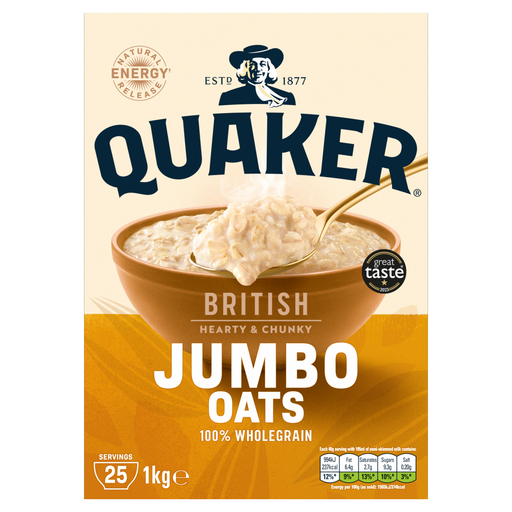
A plain 1kg rolled-oat option for regular oat-bread recipes measured alongside flour.
Listed as 100% rolled oats. The product may contain gluten from wheat and barley, so it is not the choice where an explicitly gluten-free oat product is required.
 No image available
A 1kg plain-oat choice for bread and other baking uses where added dairy and flavouring are not wanted.
Listed as 100% whole-grain oat flakes and described for baking use. It may contain traces of wheat; check the current allergen statement if gluten-free suitability is essential.
 No image available
A plain instant-oat sachet option for occasional baking or a small test loaf using pre-portioned oats.
Six 38.5g sachets with wholegrain rolled oats listed as the ingredient. The 231g pack is less suited to frequent bulk baking than the 1kg and 2kg options.
For regular baking, start with plain rolled or porridge oats in a larger pack. Quaker UK’s oat-bread recipe uses oats with wheat flour, while plain instant oats are better treated as a convenience-led alternative when the exact ingredient list contains oats alone; make a small test loaf before relying on a new format.
They are not the default choice for a neutral bread recipe. Use a flavoured product only when the recipe intentionally includes that flavour and you can account for its ingredients; otherwise choose a pack limited to oats or oat flakes.
It may be possible with recipe adaptation, but it is a poor default purchase for bread baking. Sainsbury’s Original Porridge Pot contains skimmed cows’ milk powder as well as oat flakes and is designed for preparation with boiling water, so it changes both the dairy and liquid inputs compared with plain oats.
If you require gluten-free oats, choose a product expressly labelled gluten-free and check the exact pack. The Food Standards Agency states that food labelled gluten-free must contain no more than 20mg/kg gluten; a standard oat product with a wheat or barley may-contain statement is not equivalent.
Check the best-before date and storage instructions on the exact pack, then choose a size you can use while the oats remain in good condition. A larger plain-oat pack is most practical when you have dry storage space and bake often enough to use it.