Buying priorities
Start with the number of breakfasts the pack needs to cover, then compare portion size, preparation method, ingredients and the current allergen label for the exact variant.
| Priority |
What to check |
Your needs |
| Pack coverage and portions |
Compare sachet count and grams per sachet. Quaker Original is sold in 6-, 10-, 16-, 20- and 60-sachet formats, with a stated 27g sachet; loose oats need measuring. |
A pack should cover several breakfasts while keeping individual portions predictable. Fixed sachets can simplify serving, while loose oats allow different bowl sizes. |
| Preparation alongside cooking |
Check the exact microwave instructions, liquid amount and microwave-power condition. Quaker Original specifies two minutes after mixing with 180ml milk in an 800W-or-higher microwave; Flahavan's describes its Quick Oats as ready in two minutes. |
Porridge needs to fit around eggs, meat, potato items and other breakfast components without creating a separate lengthy task. Individual sachets suit separate bowls; loose oats can suit a larger batch. |
| Plain ingredients and sweetness control |
Read the ingredient list and compare nutrition panels on the same basis. Plain oats give a neutral base; check ingredients and the preparation liquid before drawing conclusions about sugars. |
Plain oats let each person choose toppings at serving time. If porridge is part of a substantial breakfast, consider the whole meal rather than relying on one package statement. |
| Allergen and coeliac suitability |
Read the current ingredients, precautionary statements and any product-specific suitability claim. Quaker Original lists oats and states that it may contain wheat, barley and soya; the cited M&S Traditional Porridge is not suitable for coeliacs. |
Where an allergy, intolerance or coeliac requirement matters, select only a product labelled appropriately for that need. A claim on one oat variant does not apply automatically to another. |
Joybuy product options
Joybuy product options for family breakfasts where instant oats are served alongside a substantial cooked meal, including a 20-sachet flavoured pack and a larger-portion plain sachet option.
 No image available
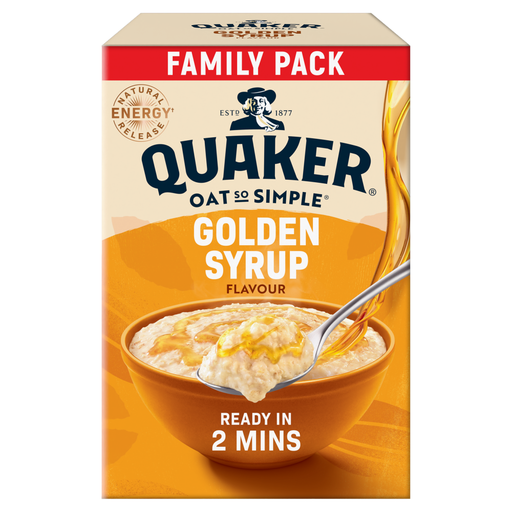
Quaker Oat So Simple Golden Syrup Family Pack, 20 Sachets, 720g
A 20-sachet option for households that want repeatable individual portions during a busy cooked breakfast.
Each sachet is 36g; the stated method uses 180ml milk and a 900W microwave for 2 minutes. The golden syrup recipe includes sugar and salt, and the listing states that it contains oats and may contain barley, wheat and soya.
Joybuy
 No image available
Quaker Oat So Simple Big Bowl Original, 6 Pack, 231g
A plain, larger individual portion for households that want to choose toppings at serving time.
The box contains six 38.5g sachets. The listing describes wholegrain rolled oats with nothing added and gives a 2½-minute microwave method using 245ml semi-skimmed milk; check the complete current allergen label where this is relevant.
Joybuy
Frequently asked questions
How many instant-oat portions should a family pack provide?
Start with the number of people likely to eat porridge and the number of breakfast occasions you want the pack to cover. A 20-sachet pack covers 20 stated portions, while the cited M&S Traditional Porridge box contains 10 portions; loose quick oats can be easier to scale when appetites differ.
Are plain instant oats better than flavoured sachets for a cooked Scottish-style breakfast?
Plain sachets are usually the more flexible choice when porridge is served with other breakfast foods because toppings can be added individually. This is a preference and ingredient-control decision rather than a judgement on flavoured oats; compare the current nutrition panel and ingredients, as NHS guidance notes that sugars in syrups count as free sugars while sugars naturally present in milk do not.
Can someone with coeliac disease or a cereal allergy assume that ordinary instant oats are suitable?
No. Check the current product label and choose a product specifically labelled for the relevant requirement where necessary. GOV.UK includes oats among cereals containing gluten for allergen information, Quaker Original warns that it may contain wheat, barley and soya, and the cited M&S Traditional Porridge is explicitly not suitable for coeliacs.
What allergen information should be available on packaged instant oats in the UK?
For prepacked food, any of the 14 regulated allergens present must be clearly labelled in the ingredients list, according to GOV.UK. For an allergy or intolerance, read the pack as well as any online listing because formulations and allergen information can change.
How should instant oats be stored and checked after purchase?
Follow the storage directions and best-before date on the specific pack. M&S instructs buyers to store its cited porridge in a cool, dry place and to check the side of the pack for the best-before end.


