What to check before buying
Start with the preparation setting, then compare portion size, ingredients and the current allergen statement rather than assuming that every single-serve oat product serves the same purpose.
| Priority |
What to check |
Your needs |
| Customisable plain portion |
Check the dry sachet size, ingredient list and stated preparation method. Plain Quaker Original sachets use 180 ml milk and microwave or hob preparation; Flahavan’s Natural sachets are 35 g portions. |
I want to choose the fruit, yoghurt, milk or other toppings according to the child’s appetite and dietary needs, rather than start with a ready-sweetened flavour. |
| Preparation away from home |
Confirm whether the product needs milk, a microwave or only boiling water. Check the standing time and any instruction not to reheat before preparing a pot outside the home. |
I need a warm option where milk or a microwave is unavailable, but I can supervise preparation with hot water and serve it soon afterwards. |
| Allergen and gluten suitability |
Read the current allergen declaration and look for a specific gluten-free label where needed. Coeliac UK says that “100% oats”, “pure oats” and “organic” do not by themselves show that oats are gluten free. |
I need to check each pack for gluten and relevant allergens, and I will confirm the school or childcare setting’s food and packing rules before sending any product in. |
| Sweetness and ingredients |
Compare products on the same prepared-serving basis. Check whether sugar, milk ingredients, whey powder or flavourings are listed instead of treating plain sachets and flavoured pots as equivalent. |
I want to avoid choosing a sweeter option by accident, so I will compare the ingredients and sugars on the current pack before swapping a plain sachet for a flavoured pot. |
Joybuy product options
Joybuy options for a warm, single-serve oat snack at home, including a plain larger sachet and ready-sweetened sachets. Check the current pack before choosing a product for gluten or allergy management.
 No image available
Quaker Oat So Simple Big Bowl Original, 6 Pack 231g
A plain option for a supervised warm snack at home when you want to add toppings separately.
Six 38.5 g sachets; the listing states wholegrain rolled oats as the ingredient and microwave preparation with milk or water in 2½ minutes.
The larger sachet may exceed some children’s appetite. Check the current pack’s allergen and cross-contact statement before packing for a child with dietary restrictions.
Joybuy
 No image available
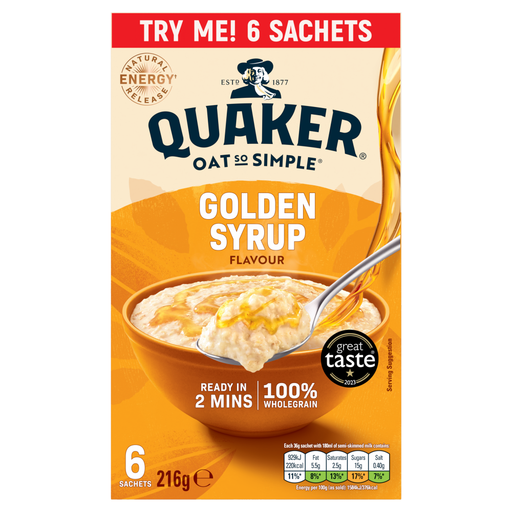
Quaker Oat So Simple Golden Syrup, 6 Pack 216g
A measured, ready-sweetened option for a supervised warm snack where a microwave and milk or water are available.
Six 36 g sachets; one sachet is prepared with 180 ml milk or water and microwaved for 2 minutes. The listing gives 6.4 g sugars per sachet.
The listed ingredients include sugar and natural flavourings, with possible barley, soya and wheat. Check the current physical pack for allergen information.
Joybuy
 No image available
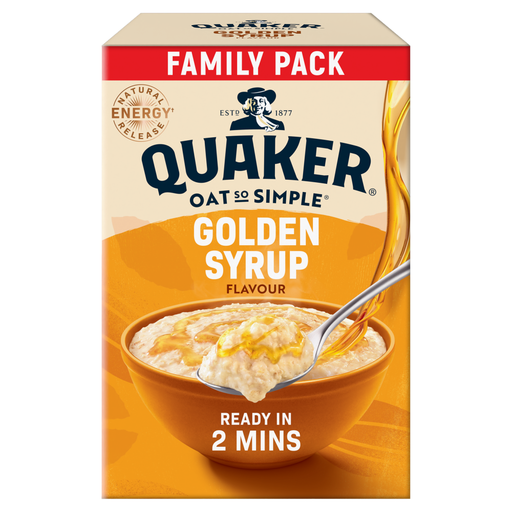
Quaker Oat So Simple Golden Syrup Family Pack, 20 Sachets 720g
Individual sachets suit quick home preparation when a ready-sweetened flavour is acceptable.
Twenty 36 g sachets; the listed method uses about 180 ml milk, a 2-minute microwave cook and standing time before serving. The listing gives 6.4 g sugars per sachet.
The listed ingredients include sugar and natural flavourings, and the allergen statement includes oats with possible barley, wheat and soya. Check the current pack label before buying.
Joybuy
Frequently asked questions
Are standard instant oats gluten free in the UK?
Not necessarily. Coeliac UK says that “100% oats”, “pure oats” and “organic” wording alone does not establish gluten-free status because standard oats can be contaminated with wheat, barley or rye. For a child who must avoid gluten, choose a specifically gluten-free-labelled product and read the current pack.
Why do oat packs list cereals containing gluten when oats are the only ingredient?
The Food Standards Agency includes oats within the “cereals containing gluten” category for mandatory allergen information. That category does not settle whether a particular product meets an individual’s dietary requirements, so check the exact product label and its gluten-free status.
Can a single-serve oat pot be packed for school tea time?
Check the individual school or childcare setting’s food policy first. If a pot is prepared, follow its on-pack method and hot-food instructions; Tesco’s Golden Syrup pot uses boiling water, stands for 2–3 minutes and says not to reheat, so it is better suited to immediate supervised preparation than reheating later.
Which format is easiest when there is no milk available?
A just-add-boiling-water pot is the suitable format when milk is unavailable. Tesco’s Golden Syrup pot uses about 170 ml boiling water, and the M&S Traditional Porridge Pot uses hot water, while Quaker Original sachets specify 180 ml milk for their stated microwave or hob method.
Is a flavoured oat pot the same as a plain oat sachet?
No. Quaker Original lists wholegrain rolled oats as its ingredient, while Tesco Golden Syrup Instant Oats list oat flakes, sugar, dried skimmed milk, whey powder and flavourings, with 13.1 g sugars per prepared pot. Compare the current nutrition panel on the same preparation basis before substituting one for the other.


