What to check before buying
Start with the person's eating plan and preparation routine, then compare the portion, ingredients and nutrition shown for the exact product.
| Priority |
What to check |
Your needs |
| Protein and energy |
Compare protein for the dry portion and for the prepared serving. Check what milk or other liquid is used, as preparation changes the finished bowl. |
A small breakfast may need to provide more nourishment when appetite is reduced. If poor appetite or weight loss is involved, follow the person's clinical or dietetic plan. |
| Everyday value |
Compare retailer unit prices on the same date, alongside pack size and serving format. Check whether a large pack, sachet or pot creates less measuring or waste in practice. |
I want to distinguish a low shelf price from the cost of the amount actually used, and from the convenience of a fixed portion. |
| Fibre and ingredients |
Use the exact pack label to compare fibre per serving and wholegrain ingredients. Check whether fortification is stated for that specific product. |
Wholegrain oats may suit an ordinary diet, but oats and high-fibre foods may be unsuitable when a low-fibre diet has been prescribed. NHS guidance makes that boundary important. |
| Safe preparation |
Check whether the product needs a microwave, hob or boiling water, plus any standing-time instructions. Read the ingredients and allergen statement on the current pack. |
The breakfast needs to fit the person's swallowing plan, allergy requirements and safe access to a kettle or microwave. A prescribed texture plan takes priority over a standard porridge method. |
Joybuy instant-oat options
Joybuy product options for this topic include portioned microwave sachets and a protein-focused sachet for older adults who can safely eat ordinary porridge.
 No image available
Quaker Oat So Simple Big Bowl Original 6 Pack 231g
A fixed 38.5g portion for an independently eating person with microwave access.
Made with 100% wholegrain rolled oats; stated to be ready in 2½ minutes and to provide 12g protein when prepared with 245ml semi-skimmed milk. Check the current pack for allergens and follow any prescribed low-fibre or texture plan.
Joybuy
 No image available
Quaker Oat So Simple Peanut Butter Protein Sachets 8 Pack 344g
A protein-focused sachet for someone who can safely eat ordinary porridge and needs a quick cooked breakfast.
One 43g sachet is stated to provide 9g plant protein from soya and can be prepared with water or milk in a microwave or on the hob. It contains oats and soya, may contain milk, peanuts and nuts, and contains sugar.
Joybuy
 No image available
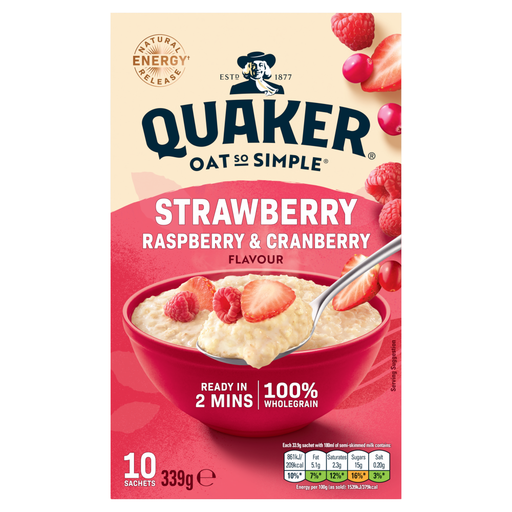
Quaker Oat So Simple Strawberry, Raspberry & Cranberry 10 Sachets 339g
A two-minute fixed portion for someone who prefers flavoured microwave porridge.
Each 33.9g sachet is prepared with milk in a microwave and lists 79% wholegrain rolled oats. It includes sugar, contains oats and cereals containing gluten, and may contain barley, soya and wheat.
Joybuy
Frequently asked questions
Are instant oats enough for an older person with poor appetite or unintentional weight loss?
Not necessarily. Ordinary oats can be a breakfast base, but NHS Food First guidance is intended for people who have lost weight or have poor appetite and addresses protein and energy intake. Follow the person's clinician or dietitian advice; a protein-enriched oat product or fortified milk may be relevant but does not replace assessment.
Does a higher-protein oat sachet always offer better value?
No. It may be the more suitable format when protein is the deciding need, but the right comparison is the nutrition of the prepared serving, the ingredients and the current unit price of the exact pack.
Can someone with dysphagia use ordinary instant porridge?
Only if it matches their prescribed eating plan. NHS speech and language therapy guidance states that modified texture diets and thickened fluids may be recommended after assessment, so ordinary porridge should not be assumed to meet an IDDSI level.
Are oats gluten-free and safe for every person with coeliac disease or wheat allergy?
No. Choose a product specifically labelled gluten-free when this is required and check the current pack. The Food Standards Agency states that gluten-free food must contain no more than 20mg/kg gluten, while oats remain an allergen and a gluten-free oat product may still be unsuitable for someone with a wheat allergy.
What should a carer check before serving a porridge pot?
Check the current label, allergens, preparation instructions and whether the person can safely handle hot water. The Sainsbury's Original Porridge Pot requires boiling water and a standing time of 2 to 3 minutes; it should not be reheated once cooled and is not suitable for microwaving.


