For a shared brunch, plain multi-sachet oats are usually the more flexible choice because guests can add their own toppings. Compare salt figures on the same basis: the NHS describes 0.3g of salt or less per 100g as low, but some labels show dry oats while others show food prepared with milk or water. Individual pots suit self-contained servings when boiling water is available, while flavoured packs offer less control over the base recipe.
Who this brunch plan suits
Hosts serving a build-your-own oat brunch
Plain multi-sachet oats make it easier to set out fruit, yoghurt, nuts and other toppings separately, rather than committing every guest to one flavour. Product information from Quaker UK, Sainsbury’s and Flahavan’s supports this format distinction.
Salt-conscious shoppers
Use a numerical salt figure on a consistent per-100g or per-portion basis rather than relying on a reduced-salt impression in a product name. The NHS uses 0.3g of salt or less per 100g as its low-salt guide.
Hosts accommodating allergy or gluten-related requirements
Check every exact pack before serving. Product statements vary for cereal cross-contact, milk ingredients and coeliac suitability, including an M&S Traditional Porridge warning that it is not suitable for coeliacs.
What to check before buying
Plain multi-sachet oats
Choose this when: you are serving several people and want guests to control toppings and sweetness.
Bear in mind: bowls and a microwave or hob are needed, and dry nutrition figures should not be compared directly with prepared-food values.
Individual hot-water pots
Choose this when: each guest needs a self-contained portion and boiling water is available.
Bear in mind: preparation instructions vary; the cited Sainsbury’s Original Pot is not suitable for microwaving.
Flavoured sachets or pots
Choose this when: a ready-made flavour matters more than a neutral base for toppings.
Bear in mind: compare the current nutrition panel rather than assuming a flavoured option has the same salt profile as plain oats.
| Priority |
What to check |
Your needs and relevant shopping behaviour |
| Comparable salt information |
Compare salt per 100g only where the preparation basis matches. Check whether the value is for dry oats or for food prepared with milk or water. The NHS defines low salt as 0.3g or less per 100g. |
I want to compare like with like before choosing a pack. In a Food Standards Agency and Ipsos Northern Ireland survey of 611 Northern Ireland shoppers conducted from September to November 2024, 49% said they actively used traffic-light labelling when shopping for food; this is a general food-shopping measure, not an instant-oats preference rate. |
| Format for a group |
Check portion count, preparation method and available equipment. Sachets may need bowls plus a microwave or hob, while some pots require boiling water and cannot be microwaved. |
For a toppings bar, I want separate portions without making every guest choose the same flavour. A pot can make more sense when each person needs a quick hot-water serving. |
| Allergens and dietary suitability |
Read the ingredient and allergen panel on the exact pack. Check cross-contact statements, milk ingredients and any explicit coeliac-suitability wording. |
I need a product that matches the requirements of everyone at the table. Plain oats are not automatically suitable for every guest: product notices differ between brands and variants. |
Common buying mistakes
-
Treating dry and prepared nutrition figures as directly comparable
Milk or water can change the figure stated for a prepared serving. Quaker Original, Tesco Natural Oats and Sainsbury’s Porridge Pot present nutrition on different preparation bases.
Compare per-100g salt only when both labels use the same basis. Otherwise, compare each product’s stated per-serving salt and note what liquid or ingredients were included.
-
Assuming plain oats suit every guest
Allergen and dietary statements differ across products. Some list possible cereal cross-contact or milk, while M&S Traditional Porridge is specifically marked as not suitable for coeliacs.
Ask about dietary needs before shopping, then check the current physical pack label rather than relying on the front-of-pack name.
-
Buying individual pots without checking the preparation method
A pot may require boiling water and may not be microwave-safe, which can slow down service when several guests arrive together.
Choose sachets for a group with microwave or hob access and set out toppings separately. Choose pots when single portions and boiling-water access are the priority.
-
Using a retailer page as the final nutrition or stock record
Recipes, allergen information and availability can change. Tesco showed the cited Natural Oats product as out of stock, while M&S notes that nutrition and allergen information may change.
Recheck availability and read the physical pack label immediately before purchase and before serving guests.
Relevant instant-oat brands
Quaker / Oat So Simple
A widely available instant-porridge line with plain Original sachets, larger portions and flavoured or protein variants.
- The cited Original sachets use wholegrain oats and list less than 0.1g salt per 100g for the dry oats.
- Prepared nutrition includes milk, so prepared and dry values should not be compared as though they were the same basis. The product also states possible wheat, barley and soya.
Tesco
Tesco’s own-label range includes Natural Oats Porridge in ten 35g instant sachets.
- The cited Natural Oats product contains oat flakes and has microwave and hob instructions.
- Its listed nutrition is for prepared food, and the product page showed it as out of stock at the time referenced.
Sainsbury’s
Sainsbury’s own-label range includes Original Porridge Pots intended for boiling-water preparation.
- The cited Original Pot lists 0.15g salt per prepared pot and is convenient where boiling water is available.
- It contains skimmed milk powder, is not suitable for microwaving and carries stated manufacturing warnings for peanuts, nuts, wheat and barley.
M&S
M&S offers Traditional Porridge sachets in individually portioned packs for microwave preparation.
- The cited 360g box contains ten portion packs, takes three minutes in a microwave and lists 0.03g salt per 100g.
- M&S marks this product as not suitable for coeliacs or for people with milk, nut, peanut or wheat allergy.
Flahavan’s
Flahavan’s offers plain and organic porridge formats, including Organic Porridge Oat Sachets and Quick Oats Pots.
- Its Organic Porridge Oat Sachets are eight 35g portions made with 100% organic wholegrain rolled oats.
- Flahavan’s describes the sachets as low in salt, but check the current pack nutrition panel for a numeric comparison. The product may contain traces of milk.
Joybuy product options
Joybuy options for flavoured instant-oat sachets with individually portioned servings for a brunch with friends.
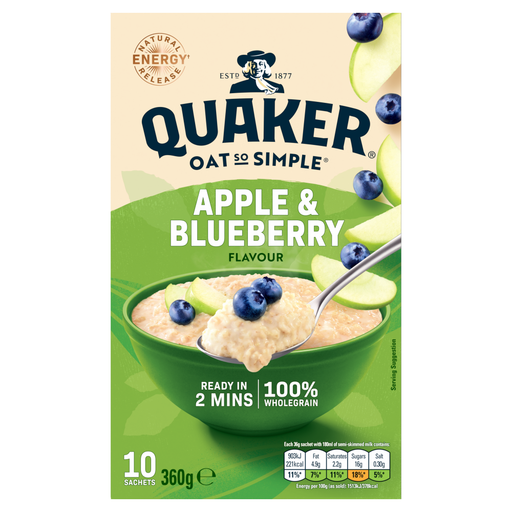 Image unavailable
Quaker Oat So Simple Apple & Blueberry Porridge, 10 Pack 360g
Ten individual 36g portions with a stated two-minute preparation route can help serve guests separately.
The dry nutrition table states 0.2g salt per 100g. Apple-and-blueberry flavouring and added sugar make this less suitable as a fully plain toppings-bar base. It contains oats and may contain wheat, barley and soya; check the current pack for coeliac suitability before serving.
Joybuy
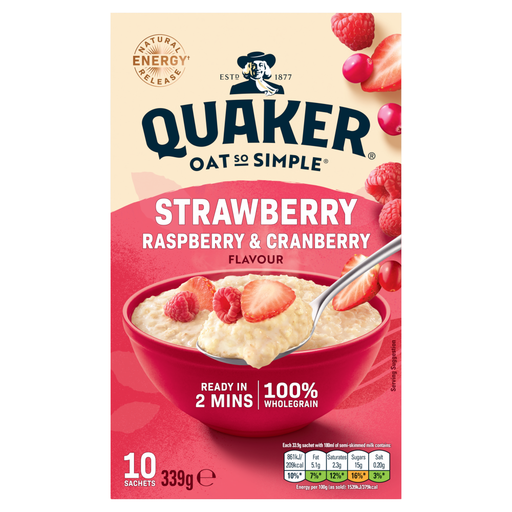 Image unavailable
Quaker Oat So Simple Strawberry, Raspberry & Cranberry, 10 Sachets 339g
Ten 33.9g sachets with stated two-minute microwave instructions suit separate portions where microwave access is available.
The dry nutrition table states 0.0g salt per 100g. The flavoured, sweetened recipe is less adaptable than plain oats for guests who want to choose all toppings. It contains oats and may contain barley, soya and wheat; check the current pack for coeliac suitability before serving.
Joybuy
Frequently asked questions
How do I tell whether instant oats are low in salt?
Compare salt on the same basis. The NHS defines low salt as 0.3g or less per 100g; if one product is listed dry and another after milk or water has been added, do not treat the figures as identical.
Is “reduced salt” enough information to choose a product?
No. Use the current nutrition panel and compare the numeric salt amount on a matching basis. A reduced-salt impression does not show whether a product is lower than the alternatives you are considering.
Can I serve ordinary oat sachets to a guest with coeliac disease?
Do not assume that you can. The cited M&S Traditional Porridge is marked as not suitable for coeliacs, while Quaker Original states that it may contain wheat, barley and soya. Choose a product carrying the required suitability information and recheck the pack before serving.
Can porridge pots be microwaved for brunch?
Check the individual pot. The cited Sainsbury’s Original Porridge Pot uses boiling water, stands for two to three minutes and states that it is not suitable for microwaving.
Are tins the normal format for UK instant oats?
The products discussed here are sold as sachets, pots or boxes rather than tins. Plan around the actual pack format and its preparation instructions when arranging brunch.


