
24/7 Customer Support

Free returns

Same-day & Next-day Delivery

Quality Guaranteed

Unlock Your Welcome Offers: FREE Delivery | Up to 80% OFF | Free 30-day JoyPlus trial
Download the APP
An integrated fridge freezer can give a fitted kitchen a clean, continuous appearance, but choosing the wrong model can create expensive installation problems. Cabinet dimensions, door hinges and internal capacity matter just as much as headline features such as NoFrost or Wi-Fi.
The most common buying traps are:
Most tall integrated fridge freezers are designed for a housing niche approximately 1,775mm high, 560mm wide and 550mm deep, but dimensions vary. Measure:
A product’s listed appliance dimensions are not always the same as its required niche dimensions. Leave ventilation clear in accordance with the manufacturer’s instructions, and arrange electrical connection and installation through a suitably qualified person where required.
For smaller kitchens, an under-counter fridge may fit beneath a worktop. These models commonly provide around 95–134 litres of fresh-food storage, while an integrated larder fridge offers substantially more capacity but needs a tall housing unit.
The split describes the approximate distribution of fridge and freezer space:
Look beyond the ratio and compare the stated net litres. A 50/50 fridge freezer can still have different usable capacity depending on drawer design and shelf layout.
A frost-free fridge freezer or NoFrost fridge freezer uses an automatic system to reduce or prevent ice accumulation, removing the need for routine manual freezer defrosting. Low Frost models generally reduce ice formation but may still require occasional defrosting.
The current UK energy label uses classes from A to G. An E-rated fridge freezer is not automatically the cheapest appliance to run, so compare the stated annual energy consumption in kWh where available. Running costs depend on the appliance, electricity tariff, room temperature and usage.
Noise is measured in decibels, or dB(A). Models listed at around 35–39dB(A) may be more suitable for open-plan kitchens than appliances rated at 42dB(A), although the difference can be less noticeable once the compressor cycles on and off.
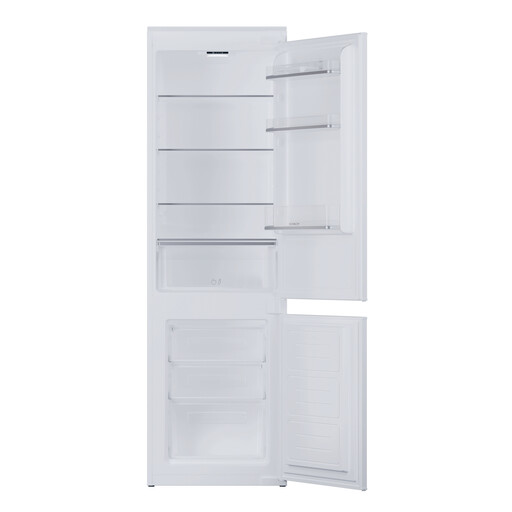
Why This Fits Their Persona: Its 262-litre capacity and 70/30 layout provide more chilled storage for couples and growing households that mainly buy fresh food.
The sliding hinge is clearly specified, and Low Frost is described accurately rather than presented as completely frost-free.
262-litre total capacity; E energy class; reversible sliding hinge system.
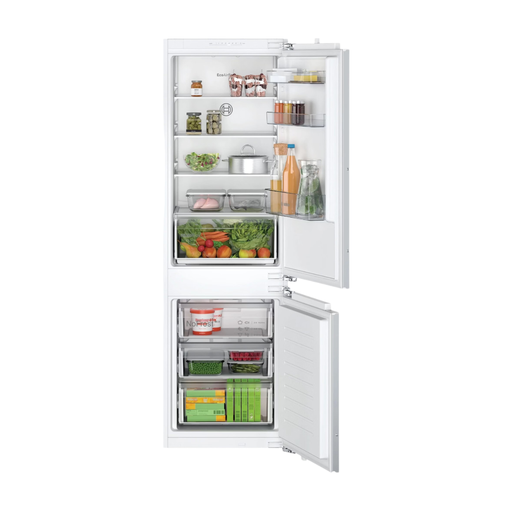
Why This Fits Their Persona: A fixed-format kitchen installation benefits from its 60/40 split, Total NoFrost system and listed 35dBA noise level.
The product specification identifies a fixed hinge and provides the required niche dimensions, helping prevent incompatible cabinet-door purchases.
260-litre capacity; Total NoFrost; MultiBox XXL drawer and SuperFreezing function.
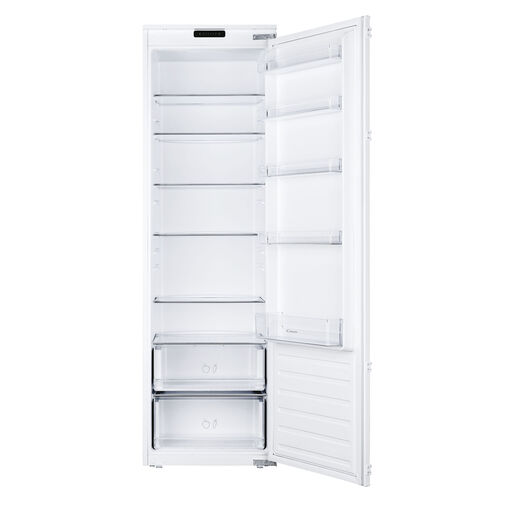
Why This Fits Their Persona: Large families and fresh-food households can use its 316-litre refrigerator capacity alongside a separate freezer.
It is clearly identified as a larder fridge with no freezer, so buyers do not mistake its large capacity for combined storage.
316-litre fresh-food capacity; automatic defrost; reversible sliding hinge.
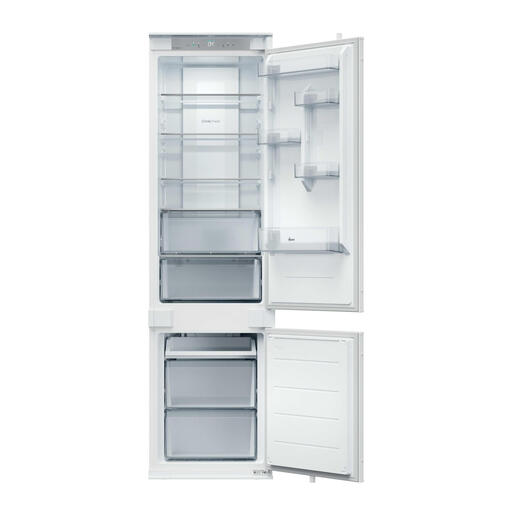
Why This Fits Their Persona: Wi-Fi and hOn app connectivity suit households that want remote controls and food-storage prompts.
Smart functions are listed alongside the practical 70/30 capacity and sliding hinge, rather than replacing core installation information.
Total No Frost; Wi-Fi and Bluetooth connectivity; reversible sliding hinge.
We have compiled a complete, real-time list of products that fully satisfy these strict selection criteria and UK safety regulations.
Before ordering, confirm the following with your kitchen fitter:
Allow a newly delivered appliance to stand for the period stated in its instructions before switching it on. Do not obstruct vents, and avoid loading food until the appliance has reached its recommended operating temperature.
Not necessarily. Running cost depends on the appliance’s energy consumption, energy class, usage pattern, room temperature and electricity tariff. Compare the annual kWh figure where it is provided rather than relying on the letter rating alone.
Lifespan varies according to build quality, installation, ventilation, usage and maintenance. Keeping vents clear, avoiding overloading and following the manufacturer’s care instructions can support reliable operation. Check the retailer and manufacturer warranty terms before purchase, including any registration requirements for extended cover.
For households that dislike manual defrosting, a NoFrost model can reduce routine maintenance and help preserve usable freezer space. It may cost more than a static or Low Frost appliance, so compare the purchase price, capacity, noise level and energy consumption together rather than selecting the feature in isolation.