
24/7 Customer Support

Free returns

Same-day & Next-day Delivery

Quality Guaranteed

Unlock Your Welcome Offers: FREE Delivery | Up to 80% OFF | Free 30-day JoyPlus trial
Download the APP
Integrated fridge freezers create a streamlined kitchen by sitting behind matching cabinet doors. They are particularly useful for new kitchen installations, renovations and replacement projects where a freestanding appliance would interrupt the design.
However, appearance should not be the only consideration. A model can look suitable online yet fail to fit the cabinet, offer the wrong fridge-to-freezer balance or create unnecessary maintenance. The following guide explains the main pitfalls and specifications to check before choosing integrated fridge freezers.
Integrated doors are commonly fitted using either a sliding hinge or a fixed hinge system.
Replacing one hinge type with another may require alterations to the furniture door or cabinet. Check the existing installation before ordering, especially when replacing an older built-in fridge freezer.
Many tall integrated appliances are described as approximately 177cm high, but the required housing niche can differ. For example, several models in this guide require a niche close to 1,775mm high, 560mm wide and 550mm deep, while the appliance itself may be slightly smaller.
Measure:
Do not rely on a product’s advertised external dimensions alone. The installation guide should be checked by the kitchen fitter or installer before purchase.
A frost-free fridge freezer or NoFrost fridge freezer circulates dry air to reduce or prevent frost formation, usually in both compartments. A low-frost appliance reduces ice accumulation but may still require occasional manual defrosting.
A low-frost system can be suitable for buyers prioritising purchase price, while Total NoFrost may be more convenient for households that regularly use the freezer or want to reduce maintenance. Check the exact specification rather than assuming that “automatic cooling” means frost-free operation.
The right capacity depends on shopping habits rather than household size alone.
Net capacity is more useful than general descriptions such as “spacious”. For comparison, the Bosch KIN86NSE0G provides 260 litres, divided into 184 litres of fridge space and freezer storage, while tall larder models such as the Bosch KIR81NSE0G provide 319 litres of refrigerator capacity without a freezer.
The current UK energy label uses an A to G scale, with E-rated fridge freezers appearing frequently in the integrated market. The rating should be considered alongside annual energy consumption, capacity and features.
A larger appliance may use more electricity overall than a smaller one even when both have the same rating. Check the product label for annual kWh consumption where available, and avoid paying for features that do not match your usage.
Noise is especially relevant in open-plan kitchens or flats. Models in the supplied range list noise levels from approximately 35dB to 42dB. A lower dB figure generally indicates quieter operation, although the perceived sound can also depend on flooring, cabinet construction and installation.

Why This Fits Their Persona: Its compact 82cm height suits smaller UK kitchens, rental properties, studios and supplementary storage below the worktop.
The 68-litre capacity and stated 54cm width make it easier to assess against a compact cabinet rather than assuming a tall unit will fit.
Built-under format, sliding hinge, reversible door, ice box and E energy rating.
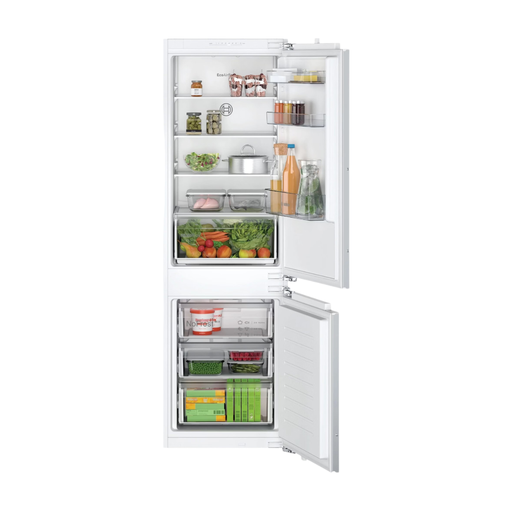
Why This Fits Their Persona: It combines a fixed door-on-door hinge with Total NoFrost and a 260-litre capacity for a fully integrated kitchen finish.
The hinge type, 1772mm appliance height and 1775mm required niche are clearly specified for installation planning.
Total NoFrost, 184-litre fridge section, MultiBox XXL, SuperFreezing and 35dB listed noise level.
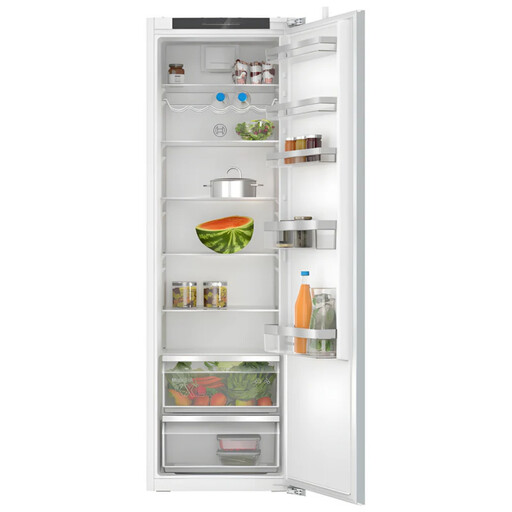
Why This Fits Their Persona: A dedicated 319-litre tall integrated fridge is suited to large families, frequent fresh-food shoppers and households with a separate freezer.
It avoids paying for freezer space you may not use, while retaining a tall 177cm integrated format and automatic defrost.
319-litre capacity, six safety-glass shelves, MultiBox XXL, Eco AirFlow and 37dBA listed noise level.
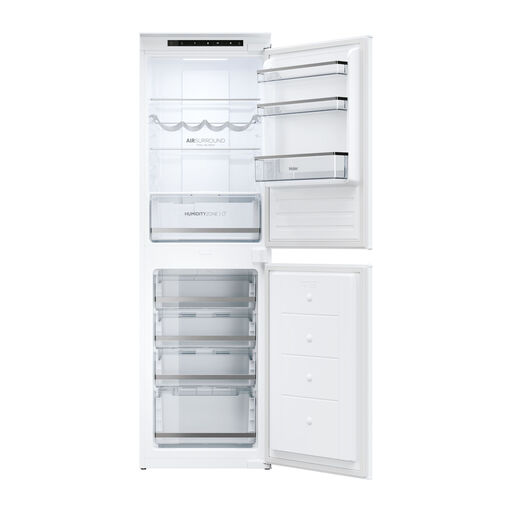
Why This Fits Their Persona: The equal split suits households that need comparable fresh and frozen storage for weekly shopping and batch cooking.
Its sliding hinge, reversible door and stated niche measurements help reduce compatibility surprises during a kitchen refit.
248-litre capacity, Total No Frost, four freezer drawers, Wi-Fi connectivity and 38dB listed noise level.
We have compiled a complete, real-time list of products that fully satisfy these strict selection criteria and UK safety regulations.
Service life varies according to installation, usage and maintenance. Keeping ventilation clear, avoiding overloading and cleaning door seals can support reliable operation. Check the manufacturer’s warranty and parts coverage, particularly for rental properties or developments where long-term support matters.
Running cost depends on the appliance’s annual kWh figure, capacity, temperature settings and how often the doors are opened. An E-rated fridge freezer is measured under the current A-to-G label system, but compare the actual energy-use figure between models rather than relying on the letter alone.
Not always. The cabinet door, hinge positions, niche dimensions and surrounding furniture must all be compatible. Before ordering, compare the existing hinge arrangement with the new appliance’s installation diagram and ask a qualified kitchen fitter to confirm suitability.