
24/7 Customer Support

Free returns

Same-day & Next-day Delivery

Quality Guaranteed

Unlock Your Welcome Offers: FREE Delivery | Up to 80% OFF | Free 30-day JoyPlus trial
Download the APP
An integrated fridge freezer can give a fitted kitchen a clean, uninterrupted appearance, but choosing the wrong model may create expensive installation problems. A cabinet that is a few millimetres too shallow, an incompatible hinge system or an unsuitable fridge-to-freezer split can make an otherwise capable appliance difficult to use.
The most common buying traps are:
Many tall UK kitchen units are built around a housing approximately 1775mm high, 560mm wide and 550mm deep, but the exact requirements vary. Always compare the manufacturer’s required niche dimensions with your cabinet before ordering.
A unit measuring around 177cm may have an appliance height of 1772mm or 1776mm. That difference matters when fitting the appliance into an existing housing. Also check:
A sliding hinge fridge freezer connects the furniture door to the appliance door using rails. This can be useful when replacing an older integrated appliance with existing cabinet doors. A fixed hinge fridge freezer, also known as a door-on-door system, attaches the furniture door directly to the appliance door and may provide a more rigid opening action. Do not assume the two systems are interchangeable without checking the fitting instructions.
The percentage split describes the approximate allocation of internal space, not the exact litre capacity.
Net capacity is more useful than external size. For example, a 70/30 model may have around 181–189 litres of fridge space and 70–73 litres of freezer space. A 50/50 model may offer approximately 148–150 litres in the fridge and 96–110 litres in the freezer.
Consider your actual routine rather than relying on household-size labels. A couple who batch-cooks may need more freezer capacity than a larger household that buys fresh food several times a week.
A frost-free integrated fridge freezer uses airflow and temperature management to reduce or prevent ice build-up. NoFrost systems generally use dry circulating air to reduce frost in the freezer, while low-frost systems reduce the frequency of manual defrosting but may not eliminate it.
The current UK energy label uses classes from A to G. An energy rating E fridge freezer is not the highest class available, but it is a commonly listed rating in this category. Compare the stated annual energy consumption in kilowatt-hours, where available, rather than judging running cost from the letter alone. Your electricity tariff and usage pattern also affect the final cost.
Noise is measured in dB(A). Integrated models listed at around 35–39dB(A) may be more suitable for open-plan kitchens, although the sound can vary according to installation, flooring and compressor cycles.
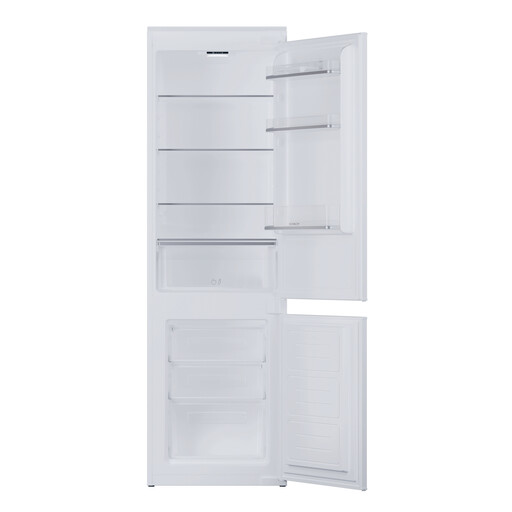
Why This Fits Their Persona: Its 262-litre capacity and 70/30 layout provide practical fresh-food storage for a fitted kitchen, while the standard tall format suits many replacement projects.
The sliding hinge is suited to replacement installations, and Low Frost is clearly specified rather than being confused with a full NoFrost system.
262-litre net capacity; E energy class; adjustable glass shelves and LED lighting.
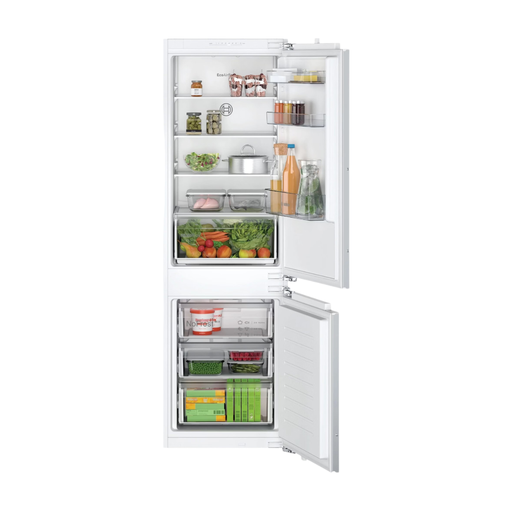
Why This Fits Their Persona: The 60/40 layout gives more fresh storage without removing a useful freezer compartment, making it suitable for homeowners updating an open-plan kitchen.
Total NoFrost is specified, so it is not relying on a low-frost description. The fixed-hinge installation should be checked against the existing cabinet door.
260-litre capacity; 35dB noise level; MultiBox XXL, LED lighting and SuperFreezing.
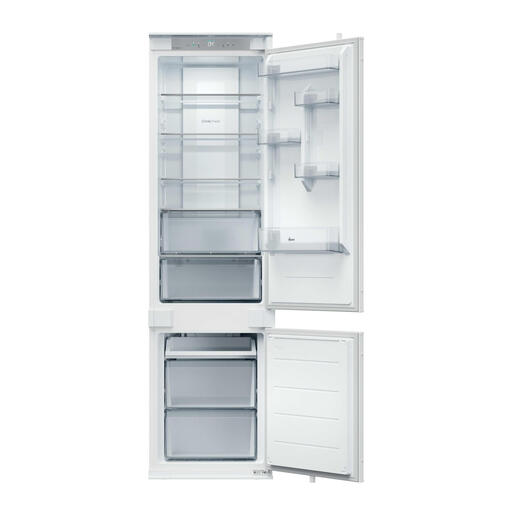
Why This Fits Their Persona: Families buying larger amounts of fresh food may value the 70/30 arrangement, Total No Frost system and app-connected controls.
The specification identifies Total No Frost and a sliding hinge separately, helping buyers distinguish defrosting performance from cabinet fit.
Wi-Fi and Bluetooth connectivity; 1772mm appliance height; E energy class and sliding hinge.
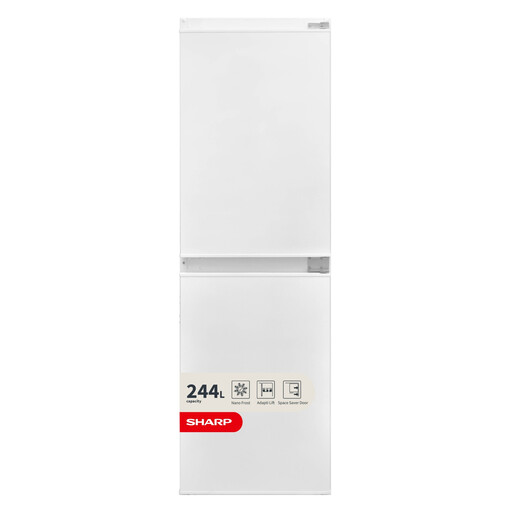
Why This Fits Their Persona: A 50/50 layout works for households that divide shopping between fresh groceries, frozen ingredients and batch-cooked meals.
NanoFrost is identified as low-frost technology, setting a realistic expectation of reduced rather than necessarily eliminated defrosting.
244-litre net capacity; 38dB noise level; reversible door and adjustable safety-glass shelving.
We have compiled a complete, real-time list of products that fully satisfy these strict selection criteria and UK safety regulations.
Before delivery, confirm the following with your kitchen fitter or the manufacturer’s installation guide:
A qualified installer may be appropriate where cabinet modification, electrical work or door alignment is required. Avoid forcing an appliance into a niche that does not meet its stated requirements.
Many tall models are designed around a niche approximately 1775mm high by 560mm wide, but dimensions are not universal. Check the exact product specification, ventilation requirements and hinge system before purchase.
NoFrost can reduce routine defrosting more substantially, particularly in the freezer. Low Frost models may cost less and still reduce ice build-up, but they can require occasional manual defrosting. Choose according to your maintenance preferences and budget.
Running cost depends on the appliance’s annual energy consumption, electricity tariff, room temperature, usage and ventilation. Use the UK energy label and the stated kWh figure to compare models rather than relying on the E rating alone.