
24/7 Customer Support

Free returns

Same-day & Next-day Delivery

Quality Guaranteed

Unlock Your Welcome Offers: FREE Delivery | Up to 80% OFF | Free 30-day JoyPlus trial
Download the APP
Buying an iPhone 17 Pro screen protector should be straightforward, but product listings often make similar promises without explaining the details that affect everyday use. A protector may claim to be ultra-clear, bubble-free or highly durable, yet still leave you with poor edge coverage, trapped dust or reduced touch response.
Before choosing, watch for three common buying traps:
The iPhone 17 Pro and iPhone 17 Pro Max are separate models. Even when both have similarly sized displays, their dimensions and camera layouts can differ. Check the product listing for the exact model name rather than relying only on screen size.
The VoxorAI iPhone 17 Pro model listed for sale specifies a compatible model of iPhone 17 Pro, with a stated body size of approximately 149.6 × 71.5 × 7.95 mm. The Pro Max version has different dimensions and should not be selected for the smaller Pro model.
This is one of the simplest ways to avoid buying a protector that leaves the camera area, corners or display edges incorrectly positioned.
A 9H tempered glass screen protector is designed to provide a hard surface against everyday scratches, abrasions and contact with items such as keys. The “9H” label is useful as a comparison point, but it should not be treated as a universal durability certification or an assurance against accidental drops.
Look for supporting details such as:
A scratch-resistant screen protector can reduce marks on the phone’s original display, but the protector itself remains a replaceable accessory. Avoid repeatedly peeling and reapplying glass, as this may affect the phone’s oleophobic coating.
For photography, streaming and regular reading, an ultra-clear iPhone screen protector with high light transmission is generally more suitable than a heavily tinted or strongly privacy-focused design. The VoxorAI iPhone 17 Pro protector is described as ultra-transparent and designed to preserve image quality and touch response.
Installation also matters. Dust caught beneath the adhesive can create a permanent speck or bubble. An easy-install screen protector that includes an applicator, cleaning materials or a fitting frame can make alignment more manageable. Even a bubble-free screen protector still requires a clean, dust-free environment and careful positioning.
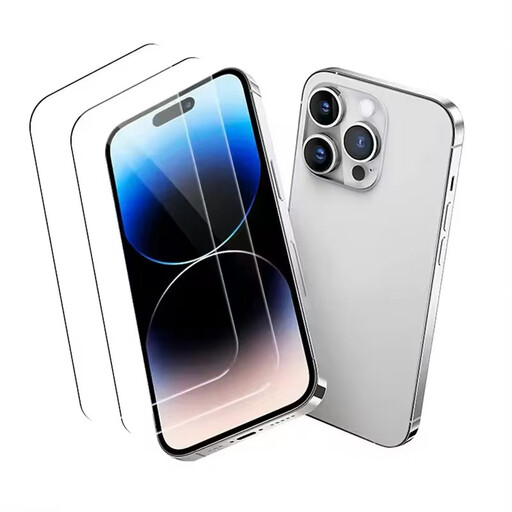
Why This Fits Their Persona: It is the relevant option for shoppers who want straightforward protection for the standard iPhone 17 Pro without adding a privacy filter.
The listing identifies iPhone 17 Pro compatibility and includes an applicator and instructions, helping reduce model confusion and alignment problems.
9H tempered glass, ultra-transparent finish, anti-fingerprint coating and stated case compatibility.
Why This Fits Their Persona: This is intended for iPhone 17 Pro Max owners who prioritise a clearer front-facing view while using their phone in public or at work.
It demonstrates why model checking matters: this Pro Max version should not be purchased for the standard iPhone 17 Pro.
9H glass, anti-fingerprint treatment, stated dustproof coating and a privacy feature described for side-angle viewing.
Why This Fits Their Persona: This option suits households managing different iPhone models, but only when the device is specifically an iPhone 16 Pro Max.
The clearly stated iPhone 16 Pro Max compatibility helps prevent the common mistake of treating similarly named models as interchangeable.
9H tempered glass, ultra-clear finish, smooth surface and anti-fingerprint treatment.
We have compiled a complete, real-time list of products that fully satisfy these strict selection criteria and UK safety regulations.
For a cleaner result, install the glass before fitting your phone case:
A case-compatible screen protector should work with many standard cases, but unusually tight, raised or full-front cases can still create pressure. Check the fit after installation rather than assuming compatibility.
There is no fixed lifespan. A protector may remain usable until it develops cracks, chips, lifting edges or a noticeably worn coating. Replace it when damage affects visibility or when the edges no longer stay attached. Frequent removal and reapplication should be avoided.
A correctly aligned, properly adhered glass protector should allow normal touch use. Touch response can be affected by trapped dust, partial lifting, poor alignment or a damaged protector. If sensitivity changes after installation, remove the case temporarily and check whether it is pressing on the edges.
No. Oleophobic and hydrophobic coatings can make fingerprints, oil and sweat easier to wipe away, but they do not prevent marks altogether. Regular cleaning with a soft, lint-free cloth is still required. Avoid abrasive cleaners, as they may wear the surface treatment.