
24/7 Customer Support

Free returns

Same-day & Next-day Delivery

Quality Guaranteed

Unlock Your Welcome Offers: FREE Delivery | Up to 80% OFF | Free 30-day JoyPlus trial
Download the APP
A phone screen can reveal far more than you intend on a crowded train, in an open-plan office or while waiting at an airport. An iPhone privacy screen protector can narrow the viewing angle, while also helping shield the display from everyday scratches and fingerprints.
However, privacy glass is not automatically suitable for every iPhone or every user. The wrong fit may reduce touch sensitivity, make the screen difficult to read in bright conditions or leave gaps around the edges. Before buying, check these common pitfalls and the specifications that matter most.
Two iPhone models can have similar-looking displays but different dimensions, camera layouts and edge profiles. A protector designed for an iPhone 16 Pro may not fit an iPhone 16 Plus, even if both product listings mention a similar screen size.
Always match the listing to the exact model, including the model suffix. Pay particular attention to:
Some marketplace descriptions can contain inconsistent model references, so check the compatibility section and the product title before ordering.
A 360° privacy screen protector usually refers to a privacy coating designed to restrict visibility from multiple side angles. It does not mean that the display is completely unreadable from every position. Someone standing directly in front of the phone should still be able to view it, while side viewing may appear darker or obscured.
Privacy glass can also make your own display appear dimmer at an angle. This is useful for discreet viewing on public transport, but it may be less convenient when sharing your screen with someone beside you.
9H scratch-resistant glass refers to a surface hardness rating used in product descriptions. It can help resist marks from keys, coins and general handling, but it does not make the protector or the phone case completely impact-proof.
Tempered glass can still crack after a hard impact. Replace it if it becomes chipped or fractured, and handle broken pieces carefully because the edges may be sharp.
The protector should align with the display edges without covering sensors or lifting when a case is fitted. For example, the listed body dimensions for the iPhone 16 Pro Max option are approximately 149.6 × 71.5 × 8.25 mm, while the iPhone 17 Air option lists approximately 156.2 × 74.7 × 5.64 mm.
These measurements are useful for checking the intended model, but they should not replace the manufacturer’s compatibility information.
A privacy coating restricts side visibility by changing how light travels through the glass. Look for clear details about the viewing angle rather than relying only on vague phrases such as “anti-spy”.
Some options list 35° privacy viewing, while others describe 360° all-round privacy. Compare these descriptions with your routine:
An automatic adsorption screen protector uses an adhesive layer to help the glass bond across the display. An easy-install screen protector may include an applicator, cleaning materials or an alignment system.
Before installation:
Do not repeatedly peel and reapply the glass. Dust can contaminate the adhesive, and repeated removal may affect the phone’s original oleophobic coating.
Useful surface features include an anti-fingerprint screen protector coating, hydrophobic and oleophobic layers, and an anti-reflective finish. Some products also list an anti-blue-light screen protector feature. Treat this as a product specification rather than a medical or visual-health benefit.
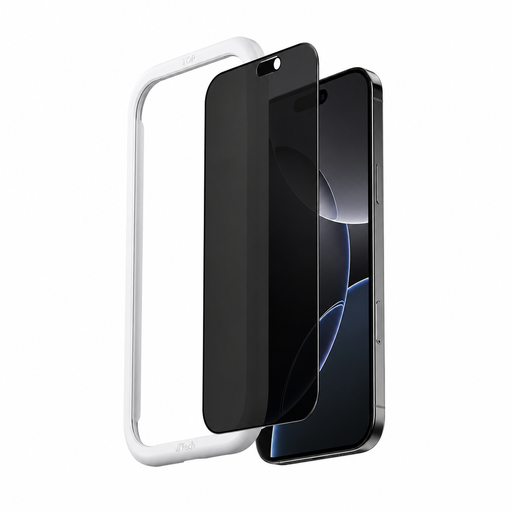
Why This Fits Their Persona: A practical option for iPhone 16 Plus owners who want privacy on commutes without choosing the most restrictive viewing design.
The 35° viewing description is more specific than a general anti-spy claim, while the listing identifies the iPhone 16 Plus model.
9H tempered glass, automatic adsorption, anti-fingerprint and anti-blue-light features are listed.
Why This Fits Their Persona: Suits iPhone 16 Pro Max users who want a discreet, clear front-facing display with several surface treatments.
Its listing states front-only visibility, side-angle dimming and the intended iPhone 16 Pro Max dimensions.
9H glass, OCA optical adhesive, anti-reflective treatment and hydrophobic and oleophobic coatings are specified.
Why This Fits Their Persona: Designed for frequent phone use in busy offices, public transport and travel settings where side-view privacy is a priority.
The product specifies a 360° privacy design, 9H hardness and automatic outward adsorption during installation.
Anti-fingerprint, anti-reflective, dustproof and scratch-resistant treatments are listed alongside an applicator.
We have compiled a complete, real-time list of products that fully satisfy these strict selection criteria and UK safety regulations.
A clean installation is central to touch response and appearance. Install indoors where there is minimal dust, rather than on a train platform or outdoors. Remove the old protector carefully, clean the screen and avoid touching the adhesive surface.
A protector is a replaceable consumable rather than a guarantee against every type of damage. Inspect it regularly for chips, cracks, lifting edges and trapped dirt. If damaged, replace it instead of continuing to use fractured glass.
It can, particularly if the glass is poorly aligned, damaged or incompatible with the phone. A correctly fitted protector with optical adhesive should preserve normal touch response, but remove thick gloves and test key areas after installation.
There is no fixed lifespan. It depends on impacts, keys in a pocket, case pressure, cleaning habits and daily use. Replace the protector when cracks, chips, lifting or persistent bubbles appear.
For people who regularly read messages, enter passwords or use work apps in public, restricted side viewing can provide useful commuter phone privacy protection. It is less suitable if you frequently share your screen with people sitting beside you.