Occasional cotton-dress presser
If you press one or two dresses before going out, a conventional iron keeps set-up and storage relatively simple. Compare its controls and handling rather than choosing by its peak steam burst alone.


For a few cotton dresses at a time, a conventional steam iron is generally easier to put away in a shared house than a steam generator; look for controllable heat and steam, and compare the tank and continuous-steam figures on the exact model. A steam generator makes more sense for regular larger batches if there is room for its separate base. Follow each dress’s care label, and check socket and extension-lead ratings before using an iron alongside other appliances.
If you press one or two dresses before going out, a conventional iron keeps set-up and storage relatively simple. Compare its controls and handling rather than choosing by its peak steam burst alone.
If several cotton garments regularly need pressing in one session, sustained steam and fewer refills may matter more than a compact appliance. Allow space for a generator’s separate base if you choose that format.
When cupboard space and electrical outlets are shared, check where the iron will be used, cooled and stored. Consider its weight, cable position and electrical load alongside its ironing features.
Start with how many dresses you usually press and where the appliance can cool and be stored. A lightweight iron is a variation on the conventional format, not a separate answer to every shared-house constraint.
| Concern | What to check | Who this matters to |
|---|---|---|
| Cotton creases | Compare adjustable heat and steam, continuous-steam output and the soleplate shape on the exact model. Follow the dress’s care label, particularly for blends or details. | If my cotton dresses come out heavily creased, I want enough control to press them without relying on repeated steam bursts. Around 33% of consumers put crease removal first. |
| Storage and handling | Check weight, dimensions, cord length and whether a separate base needs space to cool and be stored. | Carrying an iron back to a shared cupboard makes its size and handling more important to me than maximum output; around 27% of consumers prioritise compact storage and comfortable handling. |
| Longer ironing sessions | Compare tank capacity and continuous steam, rather than judging the session by the peak steam-boost figure. | When several garments need pressing together, I would rather limit refill interruptions, even if that means storing a larger appliance. Around 20% of consumers make batch-ironing capacity their primary concern. |
| Maintenance and electrical use | Read the model’s water and cleaning instructions. Check the iron’s wattage against socket and extension-lead ratings and the other connected loads. | I share sockets and want a cleaning routine I can follow, so safe loading and scale care come before extra steam output. Roughly 20% of consumers put maintenance and electrical use first. |
A burst is a short output, not the steam delivered throughout an ironing session. Tank capacity and scale maintenance also affect how practical an iron is for several garments.
Compare continuous steam, tank size, controls and cleaning requirements on the exact model; treat the burst figure as one additional detail.
Electrical Safety First warns that exceeding an extension lead’s maximum rating can cause overheating and fire. It gives 13 A, or about 3,000 W, as the typical limit for a single socket; Russell Hobbs lists its Powersteam Ultra 20630 at 3,100 W.
Check the appliance instructions and the ratings of the socket and any extension lead before use. Add up other connected loads, never exceed a marked limit and do not daisy-chain extensions.
Which? describes standard steam irons as compact and easy to store, while generators use a separate water tank. That base needs space in a shared house even when the hand-held iron is put away.
Check the intended shelf or cupboard and plan a stable place for the appliance to cool. If you usually press only a few dresses, compare a conventional iron before committing to the larger format.
Scale can build up over time, and cleaning methods differ by model. A procedure intended for another iron may not match yours.
Identify the exact model and follow its manual for water, self-cleaning and descaling instructions.
These examples show features available on particular iron models; they do not describe every appliance made by each brand.
Its conventional Powersteam Ultra 20630 is a reference point for pressing cotton with an integrated-tank iron.
The Ultimate Pure FV9845 is a conventional-iron example for comparing steam output, tank size and cord reach.
The PerfectCare 7000 PSG7300/20 illustrates the separate-tank steam-generator format for longer sessions.
Its conventional irons provide examples for comparing lighter handling with tank capacity.
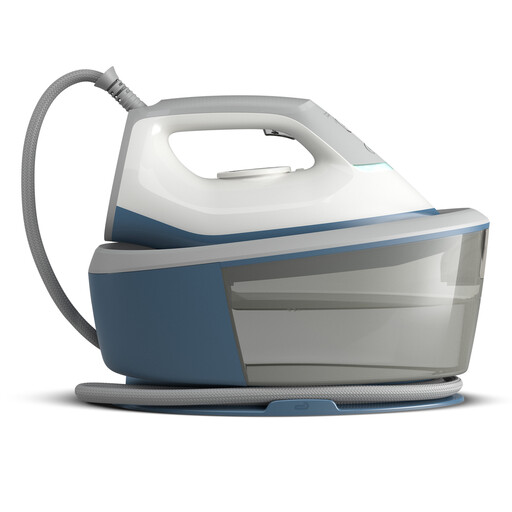
If you regularly press larger batches and have space for a separate base, this steam-generator model is a format to consider. For occasional dress pressing, weigh that storage requirement against a conventional iron.
 No image available
Consider this steam-generator format if you press several garments in a session and can accommodate its separate base. The listed rating is 2400 W; check the appliance instructions and total connected load before using a shared socket or extension lead.
It is most worth considering when you regularly press larger loads and have a stable place for its separate base. Which? describes conventional irons as easier to store, while generators use a separate tank to supply more steam; the extra appliance space may matter more if you press only a few dresses.
Do not assume the setup can take it. Electrical Safety First gives about 3,000 W as the typical single-socket limit and warns against exceeding an extension lead’s rating. Check the iron’s instructions, the socket and lead ratings, and every other connected load; do not use a setup that exceeds its limits or daisy-chain extensions.
Follow the cleaning and water instructions for the exact model. Morphy Richards says descaling and self-cleaning methods vary between appliances, so an anti-scale feature is not a reason to substitute a generic cleaning routine for the manual.
No. Auto-off is an additional feature on models that include it, not a substitute for switching off, unplugging and allowing the iron to cool safely; it also does not make an overloaded extension lead safe.
Search the UK government’s Product Safety Alerts, Reports and Recalls service for the relevant brand or model. Check the model identifier on the appliance against any alert rather than assuming that every iron from the brand is affected.