Frequent changeover linen pressers
If several placemats need pressing in one session, you may value fewer refill interruptions more than compact storage.


Choose a steam-generator iron if you regularly press batches of linen placemats and have a suitable place for its separate base and ironing board. For occasional changeovers or tighter storage, a conventional steam iron is the simpler format, though its smaller tank may mean more refills. Whichever you choose, follow each placemat’s care label and the iron’s instructions for water and maintenance.
If several placemats need pressing in one session, you may value fewer refill interruptions more than compact storage.
If you mainly tidy a limited set before arrivals, an iron that stores as one unit may suit your routine better than a separate generator base.
If the placemats have finishes, dyes or mixed fibres that need particular care, their individual labels and the iron’s controls take priority over a high steam rating.
Start with the size of a typical pressing session, then check fabric-care requirements and whether the appliance fits your working and storage space.
| Concern | What to check | Who this matters to |
|---|---|---|
| Batch pressing and refills | Compare stated continuous steam output and tank capacity; check how the tank is refilled. | If I press several placemats between changeovers, stopping to refill breaks up the task. Around 46% of consumers put uninterrupted batch pressing first. |
| Linen care | Read each placemat’s care label, then check the iron’s fabric settings and permitted steam use. | I want creases out without overlooking a finish or fabric restriction. For around 36% of consumers, care-label compatibility is the primary concern. |
| Storage and setup | Measure the storage space and ironing-board rest; check the appliance and base dimensions where relevant. | When I only press a small set, I need an appliance I can put away easily. Compact setup comes first for around 18% of consumers. |
A steam generator has a separate reservoir unit, so its tank capacity is only useful if the whole appliance can be positioned and stored safely.
Measure the intended storage spot and ironing-board rest before choosing between a generator and a conventional iron.
Permitted water and limescale-care instructions differ between models. A routine suitable for one appliance may not suit another.
Check the exact model’s manual before filling it and follow its instructions for emptying and cleaning.
Libeco Home advises steam on slightly damp linen for one of its linen products, but that does not establish the right method for every placemat finish or blend.
Follow the individual placemat’s label and, if its finish is uncertain, test an unobtrusive area using a method consistent with those instructions.
Automatic shut-off is an appliance feature, not a replacement for handling a hot iron safely or managing fire risks in paying guest accommodation.
Supervise the iron while in use, unplug it afterwards and allow it to cool safely. Consider its use within the property’s fire-risk arrangements.
These model examples show the difference between a separate steam-generator setup and a conventional iron; their published specifications are manufacturer figures, not a measure of results on your placemats.
Tefal UK positions the Pro Express Ultimate GV9580G0 as a steam-generator option for larger ironing sessions.
The Philips Azur 8000 DST8050/26 represents the conventional, single-unit iron route.
Morphy Richards UK offers steam-generator models with separate water reservoirs, including the Power SteamElite Plus and Speed SteamPro.
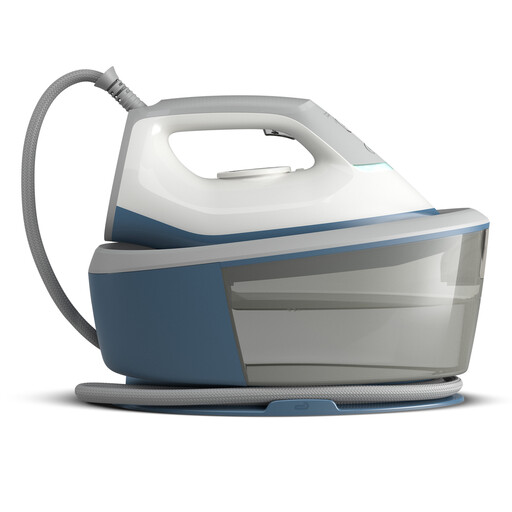
This steam-generator option is relevant if you press placemats in batches and can accommodate a separate base. A conventional iron remains worth considering for smaller sessions or limited storage.
 No image available
Consider this steam-generator format for pressing several placemats in a session if you have room for its base.
The product name states 2400 W; power alone does not establish steam output or suitability for a particular linen finish. Check the base dimensions, the model’s water instructions and each placemat’s care label before use.
No. A steam generator is worth considering for repeated batches when its separate base and larger reservoir fit your setup; a conventional steam iron may be easier to store for occasional pressing. Compare the exact models and follow the placemats’ care labels either way.
Follow each placemat’s care label first. Libeco Home advises steam ironing slightly damp linen, preferably on the inside, for one of its linen products; coated, embroidered or blended placemats may need different treatment.
No; use the water specified in the exact model’s manual. John Lewis & Partners cautions that some irons can be damaged by particular types of treated water, so do not transfer instructions from another appliance.
No. Automatic shut-off does not replace supervising and unplugging an iron or assessing risks at the property. GOV.UK and Home Office guidance addresses fire safety in small paying guest accommodation; check the requirements that apply to your premises and nation.