Regular-changeover hosts
If you press a modest batch of pillowcases between guests, a straightforward steam iron may fit the task. Check its tank and cleaning routine alongside its steam specification.


For regular batches of cotton pillowcases between holiday-let changeovers, start with a corded steam iron and check its continuous steam, tank and scale-care features. A steam generator is worth considering when the linen load is repeatedly large enough to make refill interruptions a concern, provided you have room to store it. Cordless handling suits short sessions where socket placement is awkward, but its recharge cycle can interrupt longer runs.
If you press a modest batch of pillowcases between guests, a straightforward steam iron may fit the task. Check its tank and cleaning routine alongside its steam specification.
If pillowcases are part of repeated, bulky linen loads, a steam generator’s larger reservoir may make refill interruptions less frequent. Allow space for the complete unit before choosing one.
If socket placement or a cramped ironing area makes a cord awkward, cordless handling may be useful for short sessions. Check how long the iron works between returns to its base.
Start with the amount of linen you press at a changeover. Then decide whether uninterrupted work, upkeep or ease of handling matters most in your ironing space.
Choose it when: You press modest or regular pillowcase batches and want one appliance to put away after use.
Bear in mind: Its tank may require more refills during a bulky linen run than a generator’s reservoir.
Choose it when: Pillowcases are part of a repeatedly large linen workload and refill pauses are a practical obstacle.
Bear in mind: The separate base and reservoir need suitable working and storage space.
Choose it when: A cord restricts movement around your ironing position and batches are short.
Bear in mind: You must return the iron to its base to recharge during use.
| Concern | What to check | Who this matters to |
|---|---|---|
| Changeover time | Compare continuous steam and tank capacity for the exact model; a stated steam figure alone does not establish pressing speed. | I need to finish a stack of pillowcases before the next arrival without frequent pauses. Around 42% of consumers put turnaround speed first. |
| Scale care | Check the model’s anti-calc or cleaning provision and its instructions for water and maintenance. | When the iron is used repeatedly, I want its upkeep to fit the time available between changeovers. For around 33% of consumers, maintenance is the primary concern. |
| Space and handling | Check cord reach or cordless working time, plus the space needed to use and store the appliance safely. | If the laundry area is cramped or the socket is poorly placed, I need an iron I can handle and put away safely. Storage and manoeuvrability come first for around 25% of consumers. |
A large tank is useful during bulky, repeated linen runs, but the separate unit also needs working and storage space.
Count the pillowcases and other items in your busiest usual changeover before deciding whether fewer refill pauses would matter.
A cordless iron must return to its base during use. Tefal UK states that its Freemove Power offers 35 seconds of ironing after an 11-second recharge.
Compare the stated working and recharge times with the length of your usual pillowcase batch.
An anti-calc or self-clean label does not mean the iron needs no maintenance, particularly where limescale is a concern.
Read the instructions for the exact model, including its permitted water type and cleaning steps.
Auto-off is a model feature, not a substitute for managing a hot appliance in a holiday let.
Follow the iron’s instructions for unplugging and cooling it, and choose a storage position that fits the property’s fire-risk arrangements.
Tefal UK provides examples of corded, cordless and steam-generator irons relevant to different holiday-let workloads.
Its Mineral Glide 26261 is a conventional steam-iron example for buyers paying attention to tank size and scale care.
Philips offers examples of both a higher-output conventional iron and a steam-generator system for larger loads.
These steam generators are options to consider when pillowcases form part of a repeatedly large holiday-let linen load. For smaller batches, compare the generator’s storage needs with those of a standard steam iron before choosing.
 No image available
Consider this generator if repeated linen batches make tank capacity a priority and you have room for a separate base.
The product name specifies 2800 W and a 1.8 L water tank for the Black & Purple SV8154G0 variant.
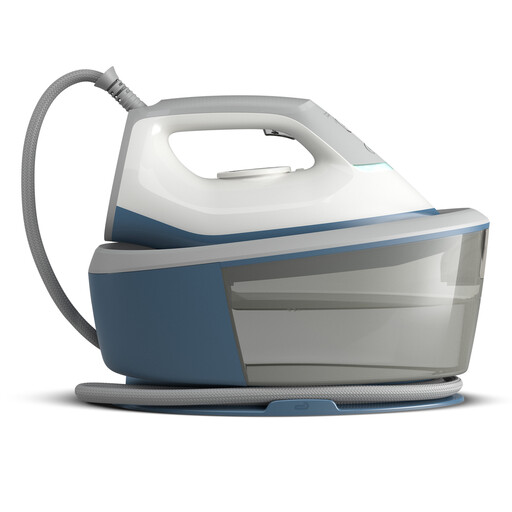 No image available
Consider this generator for repeated pillowcase batches if a separate base fits your ironing and storage area.
The product name specifies 2400 W for the PSG2000/20 variant. Check its dimensions and shut-off behaviour against your space and safe-storage needs.
Usually not for a small or moderate batch: a corded steam iron is a sensible starting point. Consider a generator if pillowcases are part of a repeatedly bulky linen load and fewer refill interruptions would justify the space needed for its base.
A cordless iron can suit short batches or an awkward socket position, but it requires recharge pauses. Tefal UK states that its Freemove Power gives 35 seconds of ironing after an 11-second recharge; check the cycle for the exact model you are considering.
Look for scale-care provisions on the exact iron, then follow its instructions for water and cleaning. An anti-calc, self-clean or calc-release feature does not replace the model’s maintenance routine.
Choose a safe place to use, cool and store the iron, and follow its instructions; do not rely on auto-off alone. The Home Office’s guidance addresses fire safety for small paying guest accommodation within its scope, so check which fire-risk arrangements and accommodation rules apply to your property rather than assuming one rule covers every holiday let.