For collar touch-ups, start by checking conventional steam irons for a tapered tip or button groove: those features address access around fastenings that steam figures alone cannot establish. If collars are part of substantial, regular family ironing sessions, a steam-generator iron with a larger tank may be worth considering, provided its format, fabric controls and care routine suit your home.
Who is this for?
Collar and button-area pressers
If you mostly tidy collar points, seams and plackets, close control matters more to you than getting through a large pile quickly. Russell Hobbs describes the tapered tip and button grooves on its Powersteam Ultra 20630 as features for working around fastenings.
Weekly family-laundry ironers
If several shirts and other garments need pressing in one session, consider tank capacity, continuous steam and the model’s scale-care routine alongside collar access. Russell Hobbs describes larger tanks as a reason to consider a steam-generator iron for longer sessions.
Households sharing an iron
If different adults press a mixture of ironable fabrics, straightforward temperature handling may matter. Check the exact model’s controls, follow garment care labels and plan how the hot iron will be stored safely.
What matters when choosing?
Begin with the shirt areas you need to reach, then consider the size of your usual ironing session, fabric settings and the care the iron requires.
| Concern |
What to check |
Who this matters to |
| Collar and button access |
Look for a tapered soleplate tip or button groove on the exact model; wattage alone does not establish access around fastenings. |
When I mainly press collar points and plackets, I need to work close to seams and buttons. Roughly 36% of consumers would put that precise access first. |
| Family ironing sessions |
Compare tank capacity and continuous-steam ratings; a steam boost is a short burst, not a continuous-output figure. |
With several garments to press at once, I want fewer interruptions for refilling. Around 29% of consumers would make keeping up with the laundry their main concern. |
| Mixed-fabric settings |
Check whether the model uses manual settings or automatic temperature technology, and follow care labels in either case. |
When different ironable fabrics share the laundry pile, I want temperature decisions to be manageable. About 21% of consumers would prioritise simpler fabric handling. |
| Safety and scale care |
Confirm the plug and fuse, check any auto-off feature, and read the exact model’s water and descaling instructions. |
In a busy home, I need a routine for unplugging, storage and scale care that I can keep up. Roughly 14% of consumers would put those household checks first. |
Buying pitfalls
-
Choosing by wattage or steam boost alone
Power and boost figures do not tell you whether the soleplate reaches a collar point or works around a button.
Check the exact model for a tapered tip or button groove before comparing steam figures.
-
Assuming an anti-scale feature needs no attention
Scale can build up, and cleaning methods differ between irons. Philips directs owners to model-specific descaling instructions, while Tefal warns against certain descaling products and additives in its Ultimate Pure guidance.
Read the manual for your model before filling or cleaning its tank, filter or scale collector.
-
Relying on auto-off instead of shutting down
Auto-off is an additional safeguard, not a reason to leave a hot iron unattended. Tefal’s safety guidance says to unplug its iron after use and before filling or cleaning it.
Switch off, unplug and store the iron safely after each session.
-
Overlooking electrical suitability
An iron’s plug, cable and condition matter in a family home. Electrical Safety First advises checking for a standard UK 3-pin plug and fuse.
Confirm those details for the product you intend to buy, and inspect the plug and cable before use.
Brands to consider for this task
Russell Hobbs
A reference point for conventional steam irons with features aimed at close work around shirt fastenings.
- Russell Hobbs specifies a tapered tip and button grooves on the Powersteam Ultra 20630.
- Check the controls and safety features of the particular model rather than assuming every Russell Hobbs iron shares them.
Tefal
A reference point for households considering a conventional iron for larger ironing sessions; the Ultimate Pure FV9845 is the model described here.
- Tefal specifies a 350 ml tank, 60 g/min continuous steam, a 260 g/min boost and a 3 m cord for the FV9845.
- Its MicroScale filtering and glide statements are manufacturer claims, not a comparison proving that it outperforms another iron.
Philips
A reference point for mixed-fabric households interested in the temperature handling offered on specified Azur 8000 Series models.
- Philips describes OptimalTEMP as reducing temperature-setting decisions for ironable fabrics.
- Check garment care labels and follow the exact iron’s instructions; the brand’s fabric claim does not replace either step.
Joybuy products for family ironing
This steam-generator option is relevant if collar pressing forms part of longer family ironing sessions. Check whether its format suits your space and whether its soleplate gives you the close access your shirts need.
 No image available
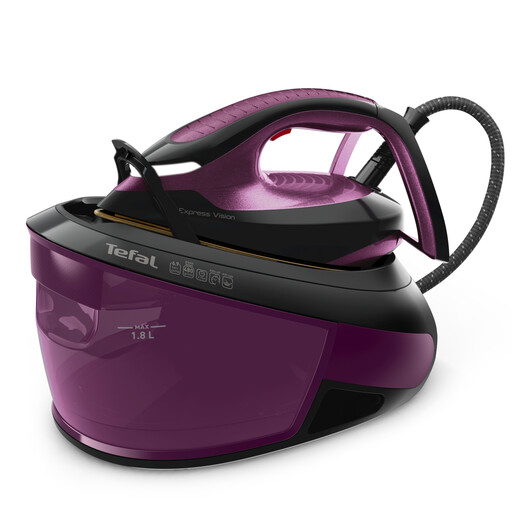
Tefal Express Vision SV8154G0 Steam Generator Iron, Black & Purple
Consider this steam-generator format when collars are part of a larger household ironing session.
The product name specifies 2800 W and a 1.8 L water tank. If button-area precision matters, confirm the soleplate-tip shape and whether it has button grooves; also confirm a standard UK 3-pin plug and fuse before buying.
View on Joybuy
Common questions
What should I look for when pressing shirt collars?
Look for a tapered soleplate tip and, if you press around buttons, a button groove. Russell Hobbs specifies both on its Powersteam Ultra 20630 for reaching fabric around fastenings; check the features on whichever exact model you choose.
Do I need a steam-generator iron just for collars?
A conventional steam iron is a sensible starting point for occasional collar work. Consider a steam generator when collars are part of large, repeated ironing sessions and a larger tank would suit your routine; Russell Hobbs describes larger tanks as a benefit of its steam-generator range.
What plug should I check for on a household iron?
Electrical Safety First advises checking that an iron has a standard UK 3-pin plug and fuse. Confirm these details for the exact product and inspect its plug and cable before use.
How should I descale a steam iron?
Use the water and cleaning procedure specified for your exact model, rather than a generic descaler. Philips advises identifying the model before following its descaling routine, and Tefal warns against certain additives and chemical descalers in its Ultimate Pure guidance.
Is auto-off enough when children are at home?
No. Treat auto-off as an additional feature, while supervising children around a hot iron and unplugging it after use. Tefal’s safety guidance also calls for placing its iron on a stable, suitable surface.


