
24/7 Customer Support

Free returns

Same-day & Next-day Delivery

Quality Guaranteed

Unlock Your Welcome Offers: FREE Delivery | Up to 80% OFF | Free 30-day JoyPlus trial
Download the APP
Choosing a car seat can feel like a significant decision. You're looking for something that keeps your child secure, is simple to install and ideally, won't need replacing every couple of years. A Group 1/2/3 ISOFIX car seat is a popular choice for many UK families for this very reason, offering a long-term solution that adapts as your child grows from a toddler into a young child.
This guide is designed to help you navigate the key features of these versatile seats. We'll break down what to look for and highlight a few standout options to help you find a car seat that fits your family's needs, your vehicle and your budget.
Making an informed choice comes down to understanding a few key aspects. Here are some practical points to keep in mind during your search.
You will often see car seats labelled with safety regulations, primarily ECE R44/04 or the newer R129 standard. An R129 car seat, also known as i-Size, is the latest and most stringent regulation. Key differences include mandatory rear-facing until at least 15 months, improved side-impact protection testing and classification based on a child's height rather than weight, which can provide a more accurate fit. While both standards are legal in the UK, opting for an R129-certified seat means you are choosing a product that has met the most up-to-date testing criteria.
ISOFIX is an international standard for fitting child car seats. It uses two rigid metal anchor points located in the gap between your vehicle's seat cushions. An ISOFIX car seat clicks directly onto these points, often with a colour-coded indicator to confirm a secure connection. This system significantly reduces the risk of incorrect installation compared to using a vehicle's seat belt, providing valuable peace of mind on every journey. Many models also include a top tether or support leg for added stability.
Beyond core safety, certain features can make daily life much easier. A 360 rotating car seat allows you to turn the seat towards the car door, making it far simpler to get your child in and out without straining your back. For families who frequently switch cars or need to save boot space, a foldable car seat can be an incredibly practical solution. As your child grows, the seat will transition from a harnessed seat to a high back booster with ISOFIX, using the car's own seatbelt, so look for models with an easily adjustable headrest and harness system.
Here are a few multi-stage car seats that offer a compelling combination of safety, longevity and practical features.


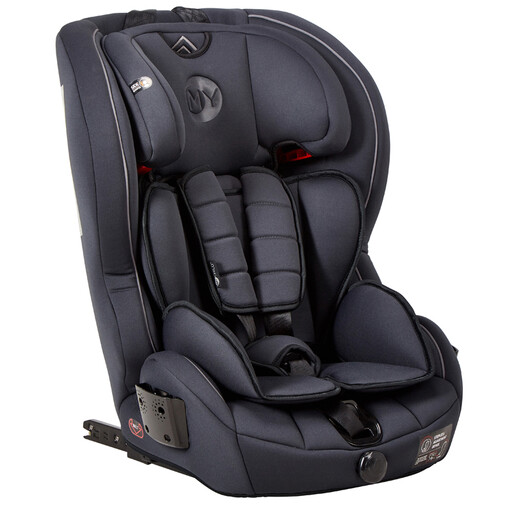
If you haven't found the perfect fit here or want to compare more models, there is a wider selection available. Explore our full range to find a seat that matches your specific requirements.
Discover more in our travel toddler car seat category.
The main difference is the starting stage. A Group 1/2/3 car seat is typically suitable from around 9 months (or 9kg) and is forward-facing. A Group 0/1/2/3 seat, like the Mychild Chadwick, is a car seat from birth to 12 years. It can be used in a rear-facing position for infants and then converted to forward-facing as the child grows, offering an all-in-one solution from day one.
ISOFIX is designed to make correct installation simpler and more reliable. Studies have shown that ISOFIX seats are more likely to be installed correctly than seats fitted with a seatbelt. A correctly installed seatbelt-fitted seat is safe, but ISOFIX provides a more foolproof method, reducing the margin for error and ensuring a rigid connection to the car's chassis.
In a multi stage car seat, you typically transition from the integrated 5-point harness to using the seat as a high back booster when your child reaches the maximum weight or height limit for the harness, which is often around 18kg (or 105cm on R129 seats). At this point, you remove the harness and secure your child with the vehicle's 3-point seatbelt, which is routed through the guides on the booster seat. Always refer to your specific car seat's manual for exact instructions.