Budget shoppers watching sugar
Compare sugars per 100g as well as pack size. A smaller pack or cake does not, by itself, have a lower sugar concentration.


For a budget shop, compare Jaffa cakes by total sugars per 100g, then check the sugar figure for the number of cakes you expect to eat. Sainsbury’s lists 49.6g per 100g for its 150g orange pack, while M&S lists 47.2g per 100g for its 250g dark-chocolate pack; neither figure alone establishes a reduced-sugar claim. Pack size and after-opening instructions also matter if you may not use every cake.
Compare sugars per 100g as well as pack size. A smaller pack or cake does not, by itself, have a lower sugar concentration.
Use the per-cake figure for the number you intend to eat, but return to the per-100g figure when comparing different products. A three-cake snack pack is a different portion.
Start with the per-100g nutrition line to compare products, then check the labelled portion and whether the pack size fits how you will use it.
| Priority | What to check | Your needs |
|---|---|---|
| Sugar comparison | Compare total sugars per 100g on each pack. NHS food-label guidance uses the per-100g figure for comparisons; cake size does not affect that basis. | I want to compare different Jaffa cakes without mistaking a smaller cake for a lower-sugar product. |
| Amount eaten | Check whether the portion figure means one cake or several. Sainsbury’s lists 6.2g sugars per cake for its orange pack; Sainsbury’s lists 5.4g per cake for McVitie’s Original x10. | If I plan to eat one cake, the per-cake figure helps. For a snack pack, I need to check how many cakes make up the stated serving. |
| Pack quantity | Check the pack weight, number of cakes and after-opening instructions. Tesco’s 2 × 150g orange pack says to consume it within two days of opening. | A larger pack only suits my shop if I expect to use it within the instructions on its packaging. |
| Sugar descriptions | Check what a reduced-sugar description compares the product with, then read its sugars per 100g. NHS Scotland’s food-label guidance distinguishes reduced sugar from low sugar. | I do not want a comparison with other biscuits, or a small serving, to stand in for the figures on this particular pack. |
| Ingredients | Read the ingredients and allergy advice on the exact pack. UK government food-labelling guidance says specified allergens must be highlighted in the ingredients list. | When an ingredient or allergen matters in my household, I need to check the pack I am serving. |
A comparison with unspecified other biscuits does not show how a Jaffa cake compares with a standard equivalent. NHS Scotland’s food-label guidance describes reduced sugar as a comparison with a standard equivalent product.
Read the sugars per 100g on the pack and check which standard product any reduced-sugar description uses for comparison.
Sainsbury’s lists 6.2g sugars per cake and 49.6g per 100g for its orange pack. Its listing for McVitie’s Original x10 gives 5.4g per cake but 50g per 100g, so the comparison changes with the portion basis.
Use per 100g to compare the products, then use per cake for the number you plan to eat.
Tesco’s orange twin pack contains 2 × 150g and instructs shoppers to consume the cakes within two days of opening.
Check the after-opening instructions on your pack against how quickly you expect to use it.
These label examples concern the specific packs named below, not every product made or sold by each brand.
Its own-label orange Jaffa cakes come in a 150g pack.
Its own-label orange Jaffa cakes come in a 150g pack.
The Original x10 pack is an example with a stated single-cake sugar figure.
Its Dark Chocolate Jaffa Cakes come in a 250g pack.
Its orange Jaffa cake twin pack contains 2 × 150g.
Its Mini Jaffa Cakes are a different portion format in a 125g pack.
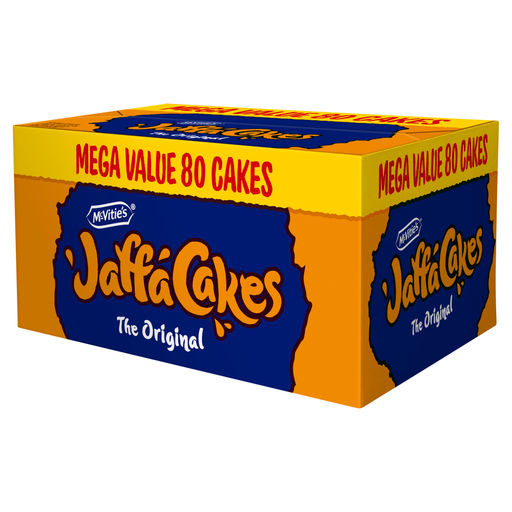
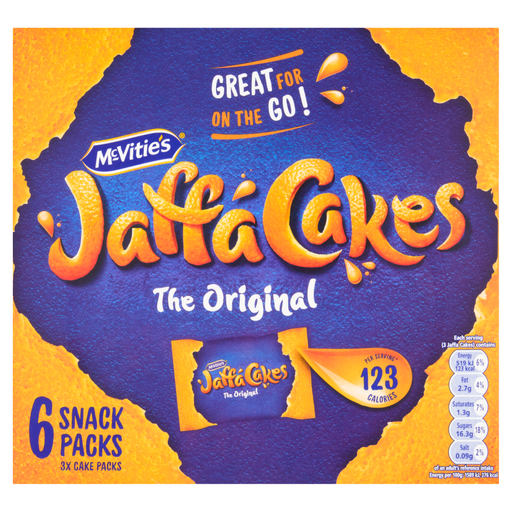
These McVitie’s options offer a large pack and packs divided into three-cake snacks. Compare the nutrition label on the exact pack and choose a quantity that fits how you will use it.
 No image available
This larger pack is worth considering if you expect to use 80 cakes. Check its per-100g sugars and after-opening instructions on the pack when deciding whether the quantity suits you.
 No image available
The six three-cake packs provide a defined pack portion. If you are comparing sugar for one cake rather than three, check which portion the nutrition figure on this pack describes.
No. NHS Scotland’s food-label guidance describes reduced sugar as a comparison with a standard equivalent product, not a guarantee that the product is low in sugar. Compare the sugars per 100g on the exact pack rather than relying on its cake size or a comparison with other biscuits.
Follow the instructions on that pack. Tesco’s orange twin-pack listing says to use an airtight container after opening and consume the cakes within two days.
Read the ingredients and precautionary statements on the exact pack before serving it. UK government food-labelling guidance says specified allergens must be listed and highlighted in the ingredients.