Chocolate-first shoppers
If coverage matters most, compare a traditional dark-chocolate topping with a wrapped bar. Check whether the bar uses milk or dark chocolate rather than relying on its name alone.


For a premium shop, choose the format before the brand: a traditional Jaffa cake has chocolate on top, while a wrapped bar suits a preference for chocolate around the sponge. Minis offer smaller pieces, and larger packs are worth considering for sharing. Compare dark with milk chocolate, check the orange filling and pack size, and read the current allergy information when buying for someone else.
The useful distinction is whether you want chocolate on top, chocolate around a bar, or smaller cakes for serving.
If coverage matters most, compare a traditional dark-chocolate topping with a wrapped bar. Check whether the bar uses milk or dark chocolate rather than relying on its name alone.
A larger pack may suit sharing; minis offer smaller individual pieces. If you are serving someone with an allergy, check the exact product’s current packaging before choosing it.
Look for the familiar sponge, orange centre and dark-chocolate topping. Branded and own-label versions use this format, but the brand alone does not settle which flavour you will prefer.
Decide on the shape and chocolate coverage first, then compare the filling, pack and allergy information for the exact variety.
Choose when: You want sponge, an orange centre and dark chocolate on top, as in McVitie’s Original and the listed supermarket cakes.
Bear in mind: A topping does not wrap the whole cake in chocolate.
Choose when: Chocolate around the sponge matters more than the traditional round-cake shape; M&S lists a milk-chocolate bar and McVitie’s a dark-chocolate bar.
Bear in mind: These are bars, so check the chocolate type and format rather than treating them as standard cakes with a thicker topping.
Choose when: Smaller pieces suit your plans, as with Waitrose minis, or you want a larger pack such as M&S half-coated dark-chocolate cakes.
Bear in mind: Piece size, pack size and chocolate coverage are separate choices; check all three.
| Priority | What to check | Your needs |
|---|---|---|
| Chocolate coverage | Look for “topped”, “half-coated”, “wrapped” or “fully enrobed” in the exact product description. Check whether the chocolate is dark or milk. | I want chocolate around the sponge, not just on top; a bar fits that preference better than a traditional cake. |
| Chocolate composition | Read the ingredient percentage for the particular product. McVitie’s lists 19% dark chocolate for Original cakes and 31% for its bars; M&S lists 46% milk chocolate for its fully enrobed bars. These figures describe different products, not a taste ranking. | Dark or milk chocolate will influence my choice more than choosing whichever pack has the larger percentage. |
| Cake and filling | Check the orange filling and whether the product is a standard cake, mini or bar. Compare pack weights alongside piece size when deciding how to serve them. | For a familiar sponge-and-orange cake, I would keep to a topped variety; for a tray of smaller pieces, I would consider minis. |
| Allergy information | Read the ingredients and product-specific precautionary advice on the current pack. The listed M&S dark-chocolate cakes carry a nut-allergy warning, while the Waitrose mini listing says they may contain milk; neither statement applies automatically to another variety. | When I am buying for a guest with an allergy, the exact pack’s information matters more than whether the chocolate is labelled dark. |
| Pack and storage | Check the pack weight and storage directions before choosing a larger quantity. M&S instructs buyers of its listed dark-chocolate cakes to keep them cool and dry and use an airtight container after opening. | I want enough to share without opening more cakes than I plan to serve or store as directed. |
McVitie’s describes chocolate on top of its Original cakes, while the listed bars are wrapped or fully enrobed. M&S describes its dark-chocolate cakes as half-coated.
If all-round coverage is the deciding feature, look for a wrapped or fully enrobed bar in the exact product description.
A listed percentage is the chocolate ingredient’s share of that product’s weight. The cakes and bars also differ in chocolate type, filling, shape and size.
Use the figure to compare composition, then decide whether you want dark or milk chocolate and a cake or bar.
The listed M&S dark-chocolate cakes contain milk ingredients, and Waitrose’s mini-cake listing says the product may contain milk.
Check the current pack’s ingredients and precautionary allergy statement for the exact variety before serving it to someone with an allergy.
These examples show how the listed products differ in format and ingredients; a brand name is not a substitute for checking the particular pack.
McVitie’s lists both traditional chocolate-topped Jaffa Cakes and a dark-chocolate-wrapped bar.
The listed M&S options include fully enrobed milk-chocolate bars and half-coated dark-chocolate cakes.
Waitrose lists 125g mini Jaffa cakes with orange-flavoured jelly and dark chocolate.
Sainsbury’s lists 150g orange Jaffa cakes with sponge and a dark-chocolate topping.
Asda lists 150g Jaffa cakes with an orange-flavoured filling and dark-chocolate topping.
Tesco lists orange Jaffa cakes in a 2 × 150g twin pack with a dark-chocolate coating.
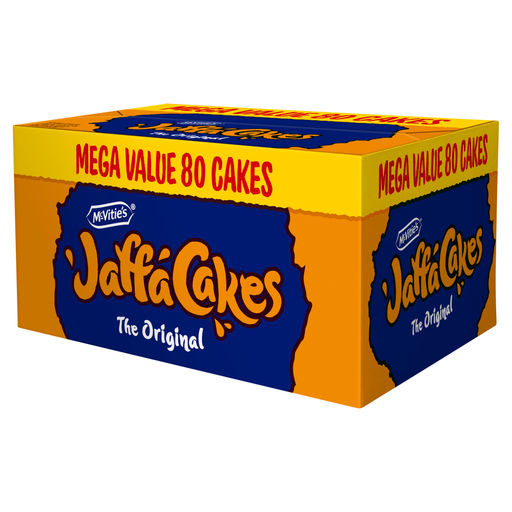
These McVitie’s options are traditional chocolate-topped cakes in different pack formats. Choose among them by the quantity you plan to serve; they are not substitutes for a fully chocolate-wrapped bar.
 No image available
The 80-cake pack is a quantity to consider for a gathering. These are traditional cakes with a dark-chocolate topping, not chocolate-wrapped bars. Check the physical pack’s allergy information before serving.
 No image available
The triple pack offers a sharing format smaller than the 80-cake pack. It contains traditional chocolate-topped cakes rather than fully wrapped bars. Check the current pack’s allergy advice before serving.
 No image available
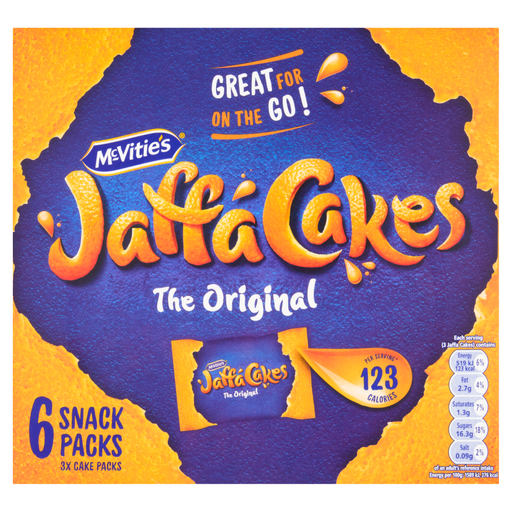
Six individual three-cake packs suit a plan to serve smaller portions at different times. The cakes have the traditional chocolate-topped format, not an all-round coating. Check the physical pack’s ingredients and allergy advice.
The listed packaged varieties are ready to eat; follow the storage instructions on the pack you buy. For its listed dark-chocolate cakes, M&S specifies a cool, dry place away from sunlight and an airtight container after opening.
Check the current physical pack for the exact variety before serving it. GOV.UK says specified allergens present as ingredients in prepacked food must be clearly identified in the ingredients list; product-specific precautionary advice may also matter.
No. GOV.UK explains that a best-before date concerns quality, while a use-by date concerns food safety. Follow the date and storage directions on the pack you receive.