
24/7 Customer Support

Free returns

Same-day & Next-day Delivery

Quality Guaranteed

Unlock Your Welcome Offers: FREE Delivery | Up to 80% OFF | Free 30-day JoyPlus trial
Download the APP
Getting the temperature right is the secret to perfect homemade jam, beautifully set fudge or crispy, golden fried chicken. A reliable jam thermometer is not a luxury; it's an essential tool that separates success from a sticky, disappointing mess. Yet, the market is filled with options that look the part but fail when it matters most.
As the Joybuy Product Recommendation Officer, my role is to help you navigate these choices. We will look at the common pitfalls that lead to wasted money and ingredients and identify the key features that define a truly dependable kitchen thermometer for jam.
Many home cooks invest in a thermometer only to find it lets them down. Before you buy, be aware of these frequent design flaws and marketing traps:
thermometer with pot clip is a major red flag, as it prevents hands-free, stable and accurate temperature monitoring.To avoid these issues, focus on a few non-negotiable specifications. Analysing these details will ensure you select a confectionery thermometer that is both effective and long-lasting.
The first choice you will face is between a traditional analogue thermometer and a modern digital one.
For tasks like making jam or a candy thermometer, where you need to hold a specific temperature for a period, a classic analogue model often provides a more stable and easy-to-monitor experience.
A versatile kitchen thermometer should cover a wide range of temperatures. Look for a model that measures from approximately 40°C to 200°C (100°F to 400°F). This range makes it suitable for everything from delicate custards to a sugar thermometer for hard crack toffee and as a deep frying thermometer for oil.
Equally important are the markings on the scale. A good jam thermometer will have clear, unambiguous labels for key stages, such as:
These guides take the guesswork out of confectionery, allowing you to achieve the perfect texture every time.
Pay close attention to the build quality. The body should be made from food-safe stainless steel, which is durable, easy to clean and does not react with acidic ingredients like fruit. The glass tube should be robust and, crucially, mercury-free.
Finally, inspect the clip. A strong, adjustable thermometer with pot clip is essential. It allows you to secure the thermometer to the side of your pan, ensuring the bulb is submerged to the correct depth without touching the bottom (which would give a false high reading). This keeps your hands free and the thermometer safely in place.
Based on these practical criteria, we have identified products that align with the needs of UK home cooks. Instead of a simple list, we match our recommendations to specific user profiles.
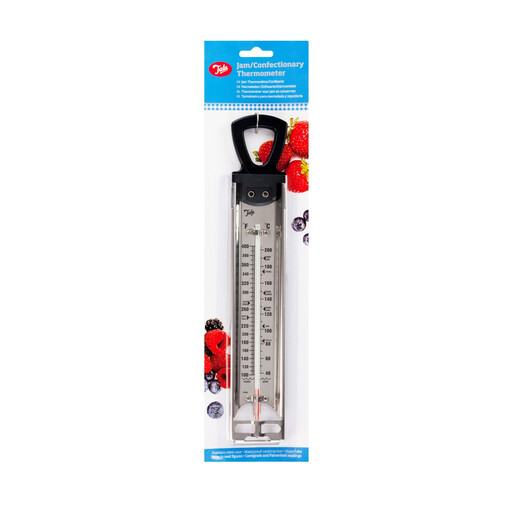
Why This Fits Their Persona: This is an ideal choice for the home cook who appreciates classic, no-fuss kitchen tools that are built to last. The Tala brand has a long heritage in British kitchens, and this thermometer embodies that tradition of reliability. It's perfect for someone who enjoys the process of making preserves, sweets and caramels from scratch.
It directly counters the common pitfalls with its durable stainless steel and glass construction, a large, clear scale with specific markings for jam and sugar and an integrated pot clip for stable, hands-free use.
It is 100% mercury-free for safety and features a comprehensive dual scale (40°C - 200°C and 100°F - 400°F). The clearly marked confectionery stages remove ambiguity from complex recipes.
We have compiled a complete, real-time list of products that fully satisfy these strict selection criteria and UK safety regulations.
Here are answers to a few common questions UK users have about using and maintaining a jam thermometer.
The most reliable method is the boiling water test. Place your thermometer in a pan of boiling water, ensuring the bulb is not touching the bottom or sides. At sea level, water boils at exactly 100°C (212°F). If your thermometer shows this reading, it is accurate. If it is off by a few degrees, you can make a note of the difference and adjust your target temperatures accordingly.
Yes, provided it has the appropriate temperature range. Deep frying typically requires oil temperatures between 160°C and 190°C. A thermometer that goes up to 200°C, like the models discussed, is perfectly suitable for this. Always check the manufacturer's guidelines to confirm it is safe for use with hot oil.
Never plunge a hot thermometer into cold water, as the thermal shock can crack the glass. Allow it to cool down completely first. Then, wash it by hand with warm, soapy water and a soft cloth. Avoid using abrasive scourers that could scratch the glass or markings. Store it in its original packaging or a dedicated drawer where it will be protected from knocks.