45 RPM singles-first listeners
If you mainly play 7-inch jazz singles, check 45 RPM support and whether your records need a compatible centre adaptor. Consider how often you want to handle the tonearm or change speed.


Choose a turntable that plays your 45 RPM singles and connects to the speakers or amplifier you intend to use. A built-in phono preamp helps with a line-level input, while a standard phono output needs an appropriate phono stage or PHONO input. In a small living room, allow space for a firm, level position away from loudspeakers; then decide whether automatic operation, Bluetooth or manual controls suit your listening routine.
If you mainly play 7-inch jazz singles, check 45 RPM support and whether your records need a compatible centre adaptor. Consider how often you want to handle the tonearm or change speed.
Measure the full space available for a firm, level turntable position, including room for cables and an opening dust cover. Keep the deck away from loudspeakers rather than choosing by its dimensions alone.
Start with the inputs on the equipment you own. A line-level connection calls for an appropriate phono preamp, while Bluetooth playback requires compatible speakers or headphones.
For jazz singles, establish playback and connection compatibility before choosing the deck's position and day-to-day controls.
| Concern | What to check | Who this matters to |
|---|---|---|
| 45 RPM singles | Confirm 45 RPM playback on the exact model and check for a compatible centre adaptor if your records need one. | If my jazz singles need 45 RPM and a centre adaptor, I want to know I can play them without another accessory. Roughly 36% of consumers would put singles compatibility first. |
| Audio connections | Match the exact variant's phono preamp or Bluetooth output to your speakers, headphones or amplifier. | I already have listening equipment and want a turntable that connects to it without an unexpected phono stage; around 29% of consumers would make connection simplicity their primary concern. |
| Space and placement | Measure the available surface and clearance, then choose a firm, level position away from loudspeakers. | My living room has limited furniture space, but I still need somewhere stable for the deck. For approximately 21% of consumers, placement would come first. |
| Everyday controls | Check whether start and stop are automatic and whether changing speed uses a control or requires moving the belt. | When I switch between short singles and LPs, the handling routine matters to me; roughly 14% of consumers would prioritise operation. |
The standard Rega Planar 1 needs an appropriate phono stage, whereas the Audio-Technica AT-LP60X has a switchable built-in phono preamp and the Rega Planar 1 Plus has an integrated phono stage for line-level inputs.
Identify your existing input, then check the preamp arrangement on the exact turntable variant.
A phono-output setup may require a separate phono preamp or a compatible amplifier.
Audio-Technica advises placing a turntable on a flat, level surface away from speakers that could cause vibration. A deck's footprint alone does not establish that it has a suitable place in the room.
Measure the surface and allow room for cables and the dust cover before deciding where the turntable will go.
Audio-Technica's AT-LP60X and AT-LP60XBT offer automatic operation, while Rega's Planar 1 instructions describe moving the belt between pulley steps to change speed.
If you alternate regularly between singles and LPs, check the exact model's start, stop and speed-change routine.
Pro-Ject notes that a belt can become slippery as it ages or if it picks up grease from fingers, affecting platter rotation.
Follow the selected model's maintenance instructions and check how to obtain a replacement belt.
Replacing a worn belt adds a maintenance task to ownership.
Its AT-LP60X models offer an automatic route for 45 RPM singles.
The E1.2 is a manual option for listeners comparing deck dimensions and setup requirements.
The Planar 1 models are manual alternatives with different audio-connection requirements.
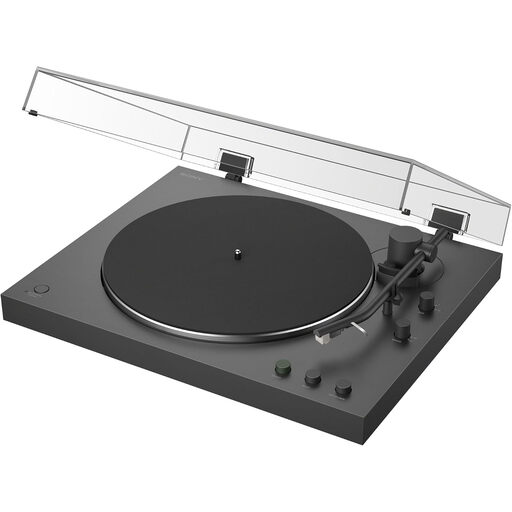
This automatic Bluetooth turntable is an option to consider if you want to play jazz singles using a compatible listening setup. Check your records and the space available before choosing it.
 No image available
For listeners seeking automatic Bluetooth playback of jazz singles, check 45 RPM suitability and centre-adaptor compatibility against your records.
Confirm that your intended speakers or headphones are compatible, and allow a firm, level position away from loudspeakers.
Yes, if the singles you plan to play are cut at 45 RPM. Check the exact turntable's speed specification and whether a centre adaptor is needed for your records; speed-change methods vary between models.
You can if its output and the speakers' input are compatible. Audio-Technica lists a switchable built-in phono preamp on the AT-LP60X, and Rega describes the Planar 1 Plus as suitable for a line-level input; the standard Planar 1 instead needs an appropriate phono stage.
Put it on a firm, flat and level surface away from loudspeakers. Audio-Technica's setup guidance warns that speaker vibration can affect a turntable, so measure for a suitable position rather than relying only on the deck's footprint.
Check the product and seller details and the electrical safety information for the specific turntable. The UK Office for Product Safety and Standards explains that the Electrical Equipment (Safety) Regulations 2016 set requirements for electrical equipment before it is placed on the Great Britain market; the rules alone do not establish whether an individual listing complies.