What should you check before buying?
Start with the claim you intend to make, then check dietary suitability, ingredient information and the quantity needed for the stall. A larger pack or a vegan label does not answer the Fairtrade question.
| Priority | What to check | Your needs |
|---|
| Fairtrade claim |
Read the exact pack for the mark and its wording. The Fairtrade Foundation says the classic mark covers all ingredients that can be Fairtrade-certified; a Fairtrade Sourced Ingredient mark applies to its named ingredient. |
I want to describe what is certified accurately, without treating a familiar brand or a vegan label as proof of Fairtrade sourcing. |
| Vegan suitability |
Check the current suitability statement and ingredients for the exact variety. Tesco’s Jelly Shapes 500 g listing includes pork gelatine; its Rowntree's Jelly Tots 150 g listing states that product is suitable for vegans. |
If I offer a vegan sweet, I need to identify the right product and keep its ingredient information with it at the stall. |
| Allergen information |
Keep current ingredient information with each item. Check whether food packed at the place of sale before selection qualifies as prepacked for direct sale; GOV.UK specifies its name, full ingredients list and emphasised allergens on the label. |
Families need to be able to check ingredients before choosing. I also need a serving arrangement that limits cross-contact. |
| Quantity |
Compare pack masses on the same basis and retain the packaging when dividing sweets for the stall. The reviewed Rowntree's Jelly Tots bag is 150 g; Tesco Jelly Shapes is 500 g, but contains pork gelatine. |
I need enough sweets for the sale without losing track of which ingredients and dietary statements belong to each variety. |
Brand and product-line references
Dietary statements below apply to the named products, not every sweet made or sold by the brand. Check the current pack before using any of them to support a stall sign.
Haribo
HARIBO UK describes its Jelly Beans as suitable for vegans.
- The Jelly Beans product information lists ingredients beginning with sugar, glucose syrup and starch.
- The vegan statement does not establish a Fairtrade claim; check the exact pack before making one.
Rowntree's
Tesco lists a 150 g Jelly Tots sharing bag as suitable for vegans.
- The listing gives an ingredient list and a defined pack size for quantity planning.
- That 150 g listing does not establish the dietary or Fairtrade status of another Jelly Tots variety; check each exact pack.
Tesco
Tesco’s own-label Jelly Shapes is listed as a 500 g fruit-flavour jelly sweet.
- The stated pack mass helps organisers plan quantities.
- Its listed ingredients include pork gelatine. Tesco advises reading the current label because food information can change.
A Joybuy jelly-sweet option
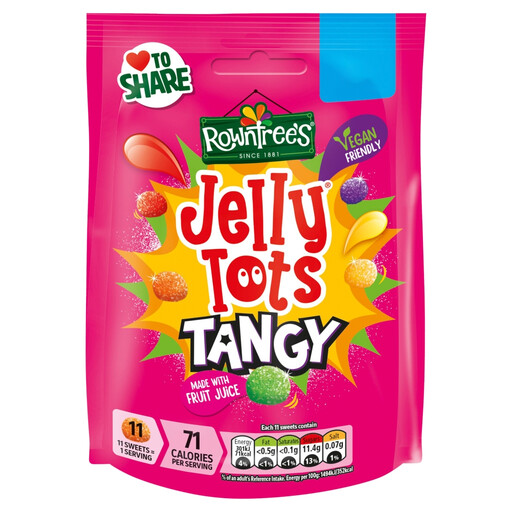
This 140 g Rowntree's Jelly Tots Tangy pack is an option for a packaged-sweets stall. Check its current label before making dietary, allergen or Fairtrade claims about this variety.
 No image available
Rowntree's Jelly Tots Tangy 140 g
The 140 g pack gives organisers a defined quantity for a jelly-sweet stall. Its listing describes this Tangy variety as suitable for vegetarians; that does not establish vegan suitability. Check the current pack for ingredients, allergens and any Fairtrade mark before serving or describing it.
Joybuy
Questions about Fairtrade and serving
Does a vegan jelly sweet count as Fairtrade?
No. Vegan suitability concerns ingredients of animal origin, not Fairtrade sourcing. The Fairtrade Foundation says the classic Fairtrade Mark covers ingredients that can be certified, while a Fairtrade Sourced Ingredient mark applies to the named ingredient; check the exact product’s mark before making a claim.
Can we describe sweets as Fairtrade if the online listing does not say so?
Do not make that claim on the strength of an unmarked listing. Check whether the exact current pack or an applicable official product source substantiates a Fairtrade mark, and describe only the scope that the mark supports.
What if the school packs sweets before customers choose them?
Check whether the food qualifies as prepacked for direct sale: GOV.UK describes this as food packaged at the place it is offered or sold before selection. For food that qualifies, its guidance requires the food name, a full ingredients list and emphasised allergenic ingredients on the label.
How should we handle allergy information at the stall?
Keep the correct ingredient information with each item and check the school’s event arrangements. Anaphylaxis UK recommends clear labelling, separate areas for allergy-friendly items and different serving utensils to limit cross-contact; check any applicable prepacked-for-direct-sale requirements as well.
Are large packs of jelly sweets suitable for vegans?
Pack size cannot tell you that. Tesco’s listing for its 500 g Jelly Shapes includes pork gelatine, whereas the reviewed HARIBO Jelly Beans and Rowntree's Jelly Tots 150 g product information states that those particular products are suitable for vegans. Read the current label of the variety you plan to sell.


