Hosts serving mixed diets
If a guest avoids animal-derived ingredients, look for explicit vegan labelling rather than relying on a fruit flavour or product name. Check the current pack for ingredients and allergens before serving.


For a book club with vegan or vegetarian guests, start with an explicitly vegan-labelled fruit-jelly or jelly-bean bag. If everyone is comfortable with gelatine, jelly babies or a mixed foam-and-jelly bag offer different textures; compare pack weight and any stated servings, then check the current ingredients and allergen information before putting sweets out.
If a guest avoids animal-derived ingredients, look for explicit vegan labelling rather than relying on a fruit flavour or product name. Check the current pack for ingredients and allergens before serving.
Soft jelly babies or mixed sweets may fit the group’s preferences once you have confirmed that gelatine is acceptable. Compare the bag’s weight with the number of people sharing it.
Small jelly beans, soft jelly babies, foam-and-jelly pieces and sour-coated sweets give guests different choices. Pick the format the group actually wants rather than treating all jelly sweets as interchangeable.
Settle dietary requirements first, then compare how much the bag contains and whether its flavour and texture suit the table.
| Priority | What to check | Your needs |
|---|---|---|
| Dietary suitability | Look for an explicit vegan or vegetarian statement; read the current ingredients for gelatine and check allergens separately. Tesco lists Rowntree's Jelly Tots as vegan, while Marks & Spencer lists beef gelatine in its Jelly Babies. | I want everyone to have a suitable option, so I need to know about dietary requirements before opening a communal bag. |
| Amount to share | Compare net weight in grams, any stated serving size and the size of the pieces. Tesco describes its 150g Rowntree's Jelly Tots bag as approximately seven servings of 11 sweets; that serving guidance does not apply to other bags. | There should be enough to pass around, but the words “sharing bag” alone do not tell me how far it will go at this meeting. |
| Flavour and texture | Choose between small beans, soft jelly babies, mixed foam-and-jelly pieces or a sour coating. Check an assortment’s contents if guests have strong preferences. | Our group may enjoy tangy sweets, or prefer a softer, less sour choice that people can pick from easily. |
| Nutrition information | Compare total sugars on the same basis, such as per 100g, and read the stated serving size separately. Total sugars on a product label should not automatically be treated as the NHS measure of free sugars. | I want to understand what a portion represents rather than assume that a sharing bag is a single serving or a nutrition recommendation. |
Some jelly sweets contain gelatine. Marks & Spencer lists beef gelatine in its Jelly Babies, and HARIBO lists gelatine in Supermix.
Ask about dietary requirements before buying. For a mixed group, start with an explicitly vegan-labelled product and read the ingredients on the current pack.
Pack weights, piece sizes and manufacturers’ stated servings vary, so the label does not promise a particular number of portions for your book club.
Compare grams and any serving guidance with the number of guests; account for separate dietary choices if more than one bag is needed.
A vegan statement addresses animal-derived ingredients, not every ingredient or allergen relevant to a guest.
If someone has an allergy, check the full ingredient and allergen information on the actual pack before serving it.
Bag size describes the amount sold, not the sugars in a portion. The NHS distinguishes free sugars in its guidance from the total-sugars figure used on nutrition labels.
Read the current nutrition panel, compare figures on the same basis and decide how much of the bag to put out.
Dietary suitability can differ between products from the same brand, so check the particular bag rather than relying on its maker.
Tesco lists the original Jelly Tots in a 150g sharing bag and the sour-coated Jelly Tots Tangy in a 140g bag.
HARIBO describes its Jelly Beans as vegan and its Supermix as an assortment of foam-and-jelly sweets.
Marks & Spencer lists 180g Jelly Beans and 225g Jelly Babies with different ingredient information.
These bags cover sour vegan-labelled choices, a mixed foam-and-jelly assortment, a fizzy fruit-and-cola mix and soft jelly babies. Choose among them according to the group’s dietary requirements and flavour preferences, then check the current pack.
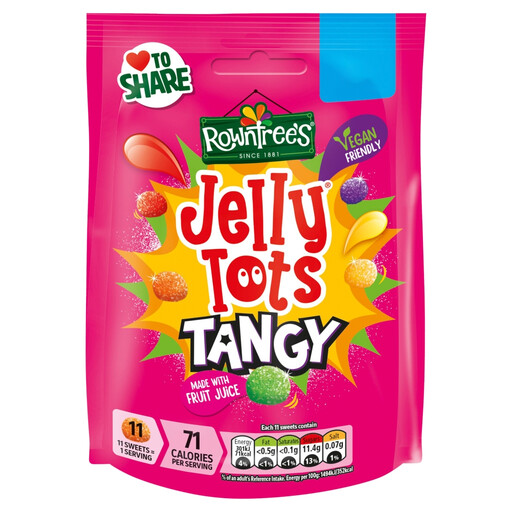 No image available
A sour-coated fruit-jelly choice when the group wants tangy sweets. Tesco lists this 140g variant as vegan; check the current pack’s ingredients and allergens before serving.
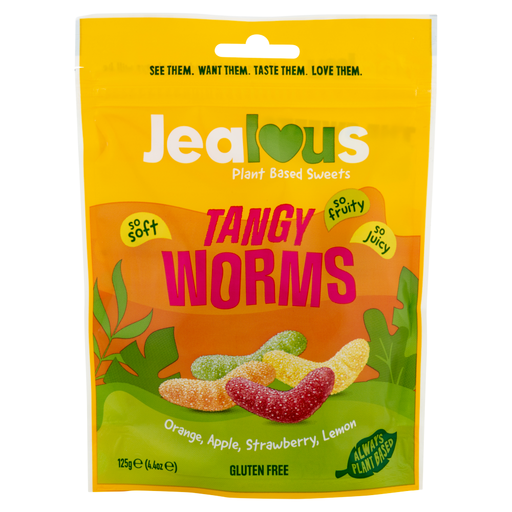 No image available
A 125g sour-sweets bag for a group that likes tangy flavours. Its product description calls it vegan and lists wheat and possible traces of milk, nuts and sulphites; check the current pack against guests’ requirements.
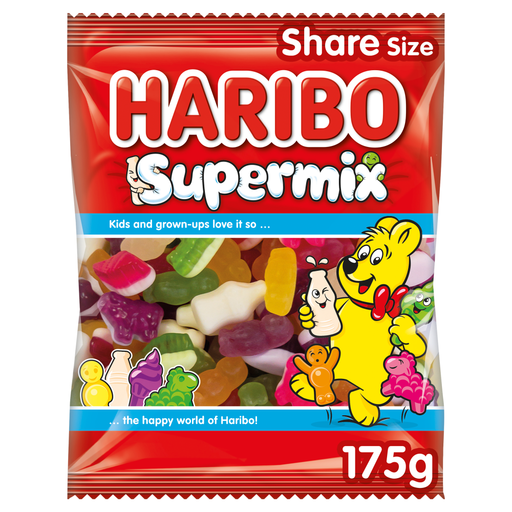 No image available
A mixed foam-and-jelly option for guests who want varied textures. HARIBO lists gelatine in Supermix, so choose it only when that ingredient is acceptable to the group; check the current pack before serving.
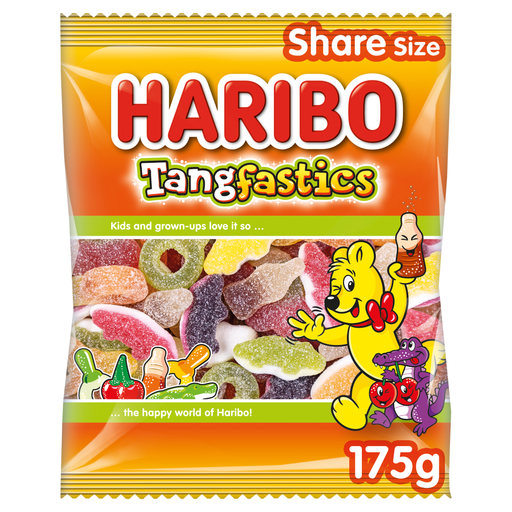 No image available
A 175g sharing bag for a group that wants fizzy, sour-and-sweet flavours. The product details identify gelatine, so it is not a choice for guests avoiding that ingredient; check the current pack’s ingredients and allergens.
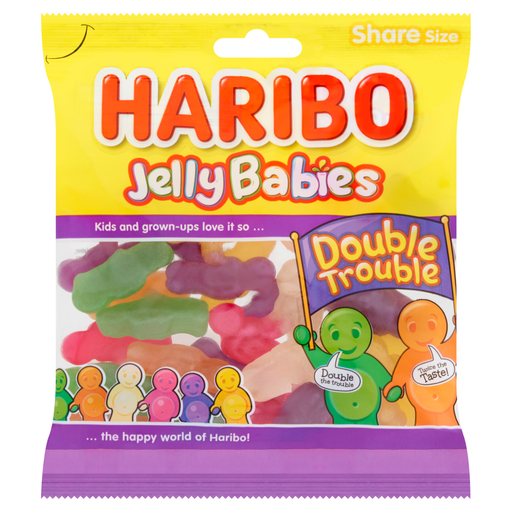 No image available
A 175g jelly-baby bag for guests who prefer soft sweets. Its product details identify gelatine, so confirm that it suits everyone sharing the bag and read the current ingredient and allergen information.
Look for an explicit dietary statement and read the current ingredients. Tesco lists Rowntree's Jelly Tots as vegan and Marks & Spencer lists its Jelly Beans as vegan and vegetarian; M&S Jelly Babies contain beef gelatine, while HARIBO Supermix contains gelatine.
The words “sharing bag” do not establish a number of guests. Compare pack weight, piece format and any stated servings: Tesco describes its 150g Rowntree's Jelly Tots bag as approximately seven servings of 11 sweets, but that guidance is specific to that product.
No: do not use a product’s total-sugars figure as though it measures free sugars directly. The NHS gives guidance in terms of free sugars, including a limit of 30g a day for adults; use the nutrition panel to compare products on the same stated basis.
No. Check the full ingredient and allergen information on the current pack before serving; a vegan statement does not replace an allergy check.
Check the exact product warning. Marks & Spencer says its Jelly Beans are not suitable for children under 36 months because of a potential choking hazard; do not assume the same wording applies to every bag.