People planning a defined treat break
If you would rather not leave an open sharing bag beside your notes, choose an individual mini bag or put a decided amount from a tube into a separate container before you start.


Choose individual mini bags if you want separate portions ready for a study group or several planned breaks. Small sweets in a tube or sharing bag can also work if you portion them before starting; neither format is automatically lower in sugar, so check the serving and ingredient labels. For food supplied by a state-funded school in England, choose something other than confectionery during the school day, in line with Department for Education school-food guidance.
If you would rather not leave an open sharing bag beside your notes, choose an individual mini bag or put a decided amount from a tube into a separate container before you start.
Check the exact sweet, not just its fruit flavour or brand. HARIBO lists gelatine in Starmix, while M&S lists vegan options within its jelly-sweets range; neither detail establishes the suitability of every product in a range.
A privately bought revision treat and food supplied by a school are different decisions. Department for Education guidance restricts confectionery supplied by state-funded schools in England across the whole school day; school-food frameworks differ elsewhere in the UK.
Start with how you will set aside the sweets for a break, then read the label for the exact product and pack size. If the snack will be supplied by a school, check the applicable school-food rules before choosing a product.
| Priority | What to check | Your needs |
|---|---|---|
| Portion format | Check whether the pack contains separate mini bags or loose sweets. HARIBO describes its Starmix Party Box as approximately 50 mini bags; Sainsbury's lists 11 sweets as a serving for the Rowntree's Jelly Tots Giant Tube 115g. | For a group or several planned breaks, I want portions I can set aside in advance. For one break, I can take a decided serving from a tube rather than keep the whole container at my desk. |
| Sugar information | Read the serving size and sugars per serving; use the per 100g figure when comparing products with different serving sizes. Sainsbury's lists 12.1g sugars per 11-sweet serving for the Jelly Tots tube, while HARIBO lists 47g sugars per 100g for Starmix. Those figures use different bases. | I do not want the word “mini” to stand in for a label check. I need to know how much is in the amount I plan to take. |
| Ingredients and allergens | Read the current ingredient list and allergen information for the exact variant. HARIBO Starmix lists gelatine; M&S lists vegan options in its wider jelly-sweets range, not a blanket claim for every sweet. | If vegetarian, vegan or allergen suitability matters to me, I need to check the particular pack rather than rely on a fruit flavour or a retailer's range description. |
| School-day setting | Establish whether the food is being supplied by a state-funded school in England. Department for Education guidance and the Requirements for School Food Regulations 2014 classify non-chocolate sweets as confectionery and restrict school-provided confectionery across the whole school day. Check the relevant framework outside England. | If I am arranging food for an English school to supply during the school day, I need a non-confectionery option. A privately bought treat outside that setting is a separate decision. |
A small bag provides a portion boundary, not a different nutritional profile. HARIBO lists 47g sugars per 100g for Starmix; Sainsbury's lists 12.1g sugars for an 11-sweet serving of the Jelly Tots Giant Tube.
Use the format to plan an amount, then check the serving size and sugars on the product you are buying.
A tube or sharing bag does not separate one break's portion from the rest. Sainsbury's describes the Jelly Tots Giant Tube as containing five servings, while HARIBO describes its Starmix Party Box as approximately 50 mini bags.
Take out one chosen serving or mini bag before revision and put the remainder away.
Ingredients differ between products: HARIBO Starmix lists gelatine, while M&S lists vegan options elsewhere in its jelly-sweets range. Neither a fruit flavour nor real fruit juice establishes vegan or allergen suitability.
Check the current ingredients and allergen information for the exact product and variant.
Department for Education school-food guidance restricts confectionery supplied by state-funded schools in England across the whole school day. That scope is different from choosing a privately bought treat outside the school-provided-food setting.
For food an English school will supply during the school day, choose a non-confectionery option. For a school elsewhere in the UK, check its nation's rules and the school's policy.
These examples show why pack format and the exact label matter; a range-level description does not establish the contents or suitability of every product.
Jelly Tots are small sweets sold in formats including a 115g Giant Tube and a 150g sharing bag. The tube contains loose pieces, not individually wrapped mini portions.
HARIBO describes its Starmix Party Box as containing approximately 50 mini bags, a format suited to setting aside separate portions for several people or breaks.
M&S lists vegetarian and vegan options within its jelly-sweets range for shoppers using dietary filters.
Tesco's jelly-and-chewy-sweets category includes Rowntree's, HARIBO and Tesco own-label products.
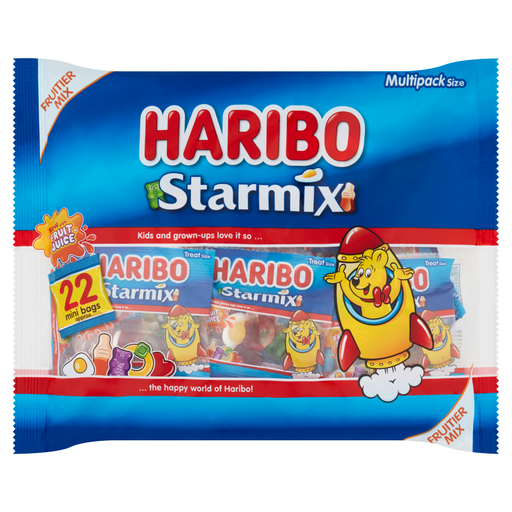
This Joybuy option is an individually bagged Starmix multipack for sharing or setting aside several revision breaks. If you only want sweets for one break, consider how much of the multipack you would use.
 No image available
The 22 separate mini bags let you set aside sweets for a study group or several planned breaks. This is a 352g multipack; check the individual bag label if its weight or sugars per bag matters to your choice. The listed ingredients include gelatine, so it is not suitable for vegetarians or vegans.
No, not as food supplied by a state-funded school in England. The Department for Education school-food practical guide restricts confectionery across the whole school day, and the Requirements for School Food Regulations 2014 include non-chocolate sweets within confectionery. This is not a general ban on privately bought sweets outside that setting; other UK nations have separate school-food frameworks.
No. The bag separates an amount but does not establish its sugar content. Check its weight and sugars per serving on the exact pack; a per 100g figure can help compare products with different serving sizes. For context, HARIBO lists 47g sugars per 100g for Starmix, while Sainsbury's lists 12.1g sugars for 11 sweets in the Rowntree's Jelly Tots Giant Tube.
If you want a defined break, set aside the amount beforehand rather than eating from an open pack throughout the session. The NHS advises reducing foods containing free sugars, including sweets, and limiting them to mealtimes for tooth-decay prevention.
No. HARIBO lists gelatine in Starmix, while M&S lists vegan choices elsewhere in its jelly-sweets range. Read the ingredient list for the exact product and variant before deciding.
Check the current ingredient list and allergen information for the exact product and pack size, including a multipack's mini bags. The Food Standards Agency says food businesses must provide allergen information; a brand name or an older product listing is not a substitute for checking the product being bought.