Older guests who manage regular chewy sweets
For an afternoon tea where guests have no known chewing or swallowing difficulty, compare flavour, portion size, sugars and the ingredients on the pack.


Ordinary fruit jelly sweets are an option for older tea guests who can comfortably chew and swallow them; serve a small portion and check the pack for ingredients that matter to your guests. A dark berry colour does not indicate high cocoa content, so choose a separately labelled chocolate product if cocoa is the aim. If someone coughs or chokes while eating, reports food sticking, or follows a texture-modified diet, follow their individual swallowing advice rather than substituting standard jelly sweets.
For an afternoon tea where guests have no known chewing or swallowing difficulty, compare flavour, portion size, sugars and the ingredients on the pack.
Check the exact sweet rather than assuming all fruit jellies are alike. HARIBO lists gelatine in Jelly Babies, while Nestlé Confectionery describes its core Rowntree’s Jelly Tots range as suitable for vegans and vegetarians.
For someone who coughs or chokes while eating, reports food sticking, or has a texture-modified diet, use their individual swallowing advice to decide what to serve. A sweet described as soft is not thereby suitable for dysphagia.
Start with whether each guest can manage the texture, then check the portion, ingredients and what “dark” means for this tea table.
| Priority | What to check | Your needs |
|---|---|---|
| Chewing and swallowing | Check whether the guest can manage ordinary chewy confectionery and whether they follow an individual texture-modified diet. The NHS identifies coughing or choking while eating and food feeling stuck as signs of swallowing problems; the International Dysphagia Diet Standardisation Initiative cautions that gelatin jelly can break apart as it warms in the mouth. | I need to serve something that follows my guest’s swallowing advice, not rely on a packet’s description of a sweet as soft. |
| Sugars and portion | Compare the same measure on each label and decide how much to put out. HARIBO lists 55g sugars per 100g for Jelly Babies; Nestlé Confectionery lists 59.0g per 100g and 7.6g per seven sweets for its 42g Jelly Tots product. | For an occasional sweet alongside tea, I’d rather set out a small serving than leave a sharing bag open. |
| Ingredients | Read the received pack’s ingredients and allergen information. HARIBO Jelly Babies list gelatine; Nestlé Confectionery says its core Jelly Tots range contains no gelatine and is suitable for vegans and vegetarians. | Someone at my table avoids gelatine, so I need to check the particular product before serving it. |
| Meaning of dark | Check the ingredient list when cocoa content matters. HARIBO Jelly Babies and Nestlé Confectionery’s Jelly Tots are fruit sweets, not products labelled with a cocoa percentage. | A dark fruit flavour may suit the tea table, but if I mean high-cocoa confectionery, I need to check a chocolate product’s own label. |
A product description cannot establish the right texture for a particular swallowing plan. The International Dysphagia Diet Standardisation Initiative notes that gelatin jelly can break apart as it warms in the mouth.
If a guest has swallowing symptoms or a prescribed texture-modified diet, follow their individual advice rather than serving ordinary jelly sweets as a substitute.
A dark-looking fruit sweet does not meet a requirement for high-cocoa confectionery merely because of its colour or berry flavour.
Check whether the product is fruit confectionery or chocolate, and read the cocoa percentage on a chocolate label when that is what you want.
Bag size is not a serving size. HARIBO’s Jelly Babies label lists 55g sugars per 100g, while Nestlé Confectionery’s 42g Jelly Tots listing gives 7.6g sugars per seven sweets.
Put out a small amount and keep the pack available so guests’ ingredient questions can be checked.
Ingredient suitability does not answer questions about chewy texture, sugars or an individual guest’s allergens. Nestlé Confectionery lists 59.0g sugars per 100g for its 42g Jelly Tots product.
Check the exact pack’s ingredients, allergen information and nutrition panel separately, alongside the guest’s ability to manage the sweet.
Haribo Jelly Babies are a fruit-jelly example for guests who can manage ordinary chewy sweets.
Nestlé Confectionery describes its core Rowntree’s Jelly Tots range as containing no gelatine and suitable for vegans and vegetarians.
Tesco’s jelly-and-chewy-sweets category includes products from Haribo and Rowntree’s, allowing shoppers to inspect different packs in one retail category.
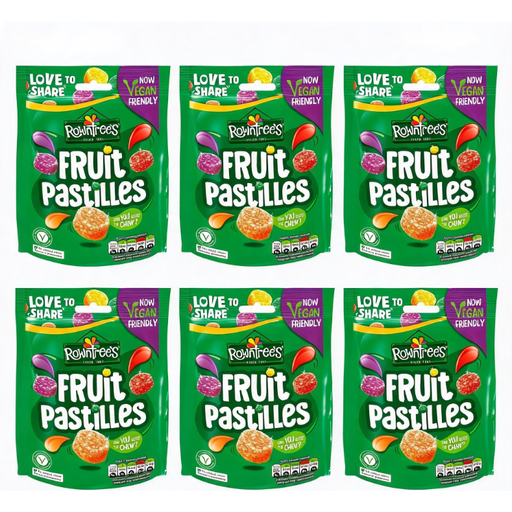
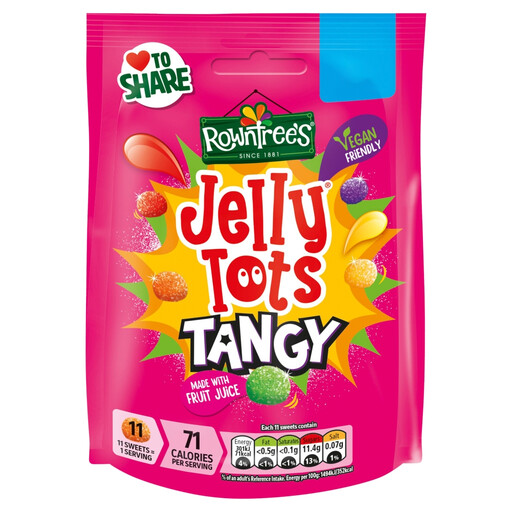
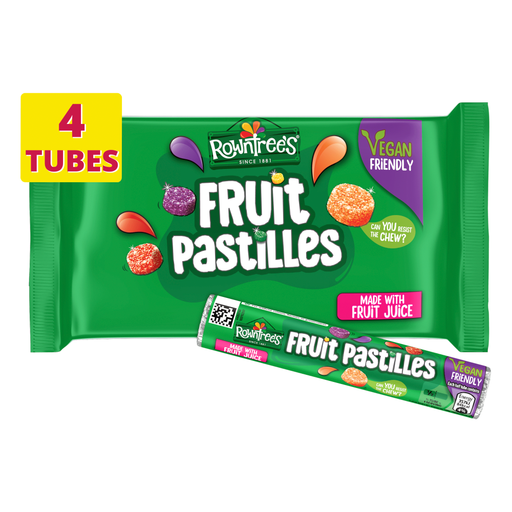
These Rowntree’s fruit-sweet packs are options for an afternoon tea where guests can manage ordinary chewy sweets. Choose between the stated pack formats and check the received pack before serving; none is a substitute for an individual swallowing plan or a labelled high-cocoa chocolate.
 No image available
The vegan-labelled multipack contains six 143g bags. For tea, portion sweets from a bag for guests who can manage chewy confectionery, and check the received pack’s ingredients and allergen information.
 No image available
This 140g bag is a tangy Jelly Tots option for guests who can manage ordinary chewy sweets. Check this variant’s received pack for ingredients and allergens; do not assume a statement about the core Jelly Tots range applies to it.
 No image available
Four separate 41g packs give you a way to open fewer sweets at once, though a pack is not necessarily one serving. Offer them only to guests who can manage chewy sweets, and check the received packs for ingredients and allergens.
Do not use ordinary jelly sweets in place of that person’s individual swallowing advice. The NHS identifies coughing or choking while eating and food feeling stuck as signs of swallowing problems; the International Dysphagia Diet Standardisation Initiative cautions that gelatin jelly can break apart as it warms in the mouth.
Colour alone cannot tell you. HARIBO Jelly Babies and Nestlé Confectionery’s Jelly Tots are fruit sweets rather than high-cocoa chocolate; if cocoa content is the requirement, check the ingredients and stated cocoa percentage of a chocolate product.
Nestlé Confectionery lists 7.6g sugars for seven sweets on its 42g Jelly Tots product. Check the portion and nutrition panel of the exact pack you serve rather than applying that figure to another variant.
No. HARIBO Jelly Babies list gelatine, while Nestlé Confectionery says its core Jelly Tots range contains no gelatine and is suitable for vegans and vegetarians. Check the received pack for the particular product.
Read the received sweet pack’s ingredients and allergen information for that specific product. If sweets are loose, ask the retailer for the relevant information before serving them; do not assume another flavour or pack format has the same ingredients.