Hosts serving guests who eat ordinary sweets
If the guests can chew and swallow ordinary foods, a labelled sharing bag lets you check the ingredients and decide how much to put on the tea table.


For an afternoon tea, choose a sharing bag with a clear serving size and check its current ingredients and allergy advice—but only if every guest can safely manage ordinary chewy sweets. A vegan-labelled bag may suit guests avoiding gelatine, while conventional fruit gums can be an option where gelatine is acceptable. For anyone following a swallowing or texture-modified food plan, that plan takes priority over the sharing bag.
If the guests can chew and swallow ordinary foods, a labelled sharing bag lets you check the ingredients and decide how much to put on the tea table.
A guest avoiding gelatine needs the declaration for the exact bag you buy. Vegan labelling and allergy advice answer different questions, so check both where relevant.
If a guest has difficulty swallowing or follows a prescribed food-texture plan, ordinary chewy sweets should not be treated as an alternative to food permitted by that plan. Kent Community Health NHS Foundation Trust identifies chewy sweets among foods that can be high-risk for people following dysphagia advice.
Establish whether ordinary chewy sweets are appropriate for the guests before comparing portions, ingredients and bag sizes. A sharing label describes the pack, not an amount that everyone should eat.
| Priority | What to check | Your needs |
|---|---|---|
| Swallowing needs | Ask whether a guest follows a swallowing or texture-modified food plan. Follow that plan rather than judging suitability from a sweet’s size or appearance; Kent Community Health NHS Foundation Trust identifies chewy sweets as potentially high-risk in dysphagia guidance. | I need to know whether ordinary chewy sweets are appropriate before putting out a communal bowl. |
| Servings and sugars | Read both the serving measure and the sugars figure, noting whether it is per serving or per 100g. ASDA Groceries lists 11 sweets and 11g sugars per serving for its 150g Rowntree’s Jelly Tots bag; Sainsbury’s lists 46g sugars per 100g for 175g Haribo Goldbears and 55g per 100g for 175g Jelly Babies Double Trouble. | I want to put out a deliberate amount rather than treating the whole sharing bag as one serving. |
| Ingredients and allergies | Check the exact variant’s current ingredient list, dietary declaration and allergy statement. ASDA Groceries labels its 150g Jelly Tots bag vegan; Sainsbury’s lists gelatine in the two Haribo examples. Marks & Spencer labels Percy Pig vegan but says it is not suitable for people with a milk allergy. | Someone at the table may avoid gelatine or need product-specific allergy information; a vegan label alone does not settle both questions. |
| Bag size | Match the bag to the expected guests and planned servings. Tesco Groceries lists a 250g Tesco Jelly Babies bag, while the ASDA Groceries Jelly Tots example is 150g and the Sainsbury’s Haribo examples are 175g. Check the pack’s storage instructions and best-before date. | For a small gathering, I would rather choose an amount we can use as planned than buy a larger bag solely because it is larger. |
Age alone does not tell you whether a guest can manage the texture. NHS guidance lists coughing or choking while eating among signs of swallowing problems, and Kent Community Health NHS Foundation Trust identifies chewy sweets as a potential risk for people following dysphagia advice.
Ask discreetly about any existing swallowing plan before serving. If there is one, follow the person’s clinician-led food guidance instead of offering ordinary jelly sweets by default.
ASDA Groceries describes its 150g Rowntree’s Jelly Tots bag as approximately seven servings; Sainsbury’s also lists seven servings for its 175g Haribo Goldbears and Jelly Babies Double Trouble bags. The bag size and serving measure answer different questions.
Read the serving information and sugars figure on the current pack, then put out the amount you intend to share rather than leaving the bag to define the portion.
A vegan declaration does not replace allergy advice. Marks & Spencer labels Percy Pig vegan while stating that it is not suitable for people with a milk allergy; the Haribo examples listed by Sainsbury’s contain gelatine.
Check the ingredients and allergy statement on the exact pack against each guest’s requirements before serving.
Tesco Groceries lists a 250g Jelly Babies bag, compared with the 150g Rowntree’s and 175g Haribo examples. Extra pack weight does not establish how much the group will use.
Estimate the number of guests and the amount you intend to serve, then check the best-before date and storage instructions if some may be left over.
These examples illustrate different labels and pack formats; check the particular product rather than assuming every item from a brand has the same ingredients or dietary status.
Sainsbury’s lists 175g Goldbears and Jelly Babies Double Trouble sharing bags with serving, ingredient and nutrition information.
ASDA Groceries lists the 150g Jelly Tots sharing bag as suitable for vegans, with 11 sweets per serving and approximately seven servings.
Tesco Groceries lists a 250g Tesco Jelly Babies bag as a larger-pack example.
Its Haribo Goldbears and Jelly Babies Double Trouble pages provide product-specific examples for comparing two 175g bags.
Marks & Spencer’s Percy Pig listing illustrates why a dietary declaration and an allergy statement must be read together.
These bags are options to consider when guests can manage ordinary chewy sweets. The selection includes Haribo 175g bags and a distinct 140g Rowntree’s Jelly Tots Tangy variant; check each exact pack for dietary requirements and serving information.
 No image available
For a tea table where ordinary chewy sweets and gelatine are appropriate, this 175g bag can be compared using the 25g serving stated for the corresponding Goldbears product. Sainsbury’s lists 46g sugars per 100g and gelatine among its ingredients. Check the current pack for allergy advice.
 No image available
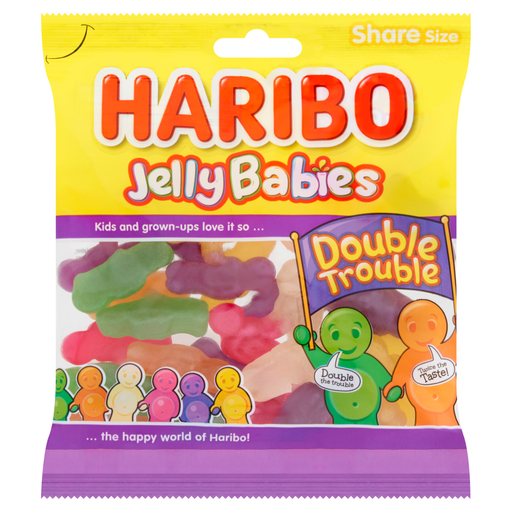
This 175g sharing bag is another option where guests can manage ordinary chewy sweets and do not require a vegan product. Sainsbury’s lists a 25g serving, seven servings per bag, 55g sugars per 100g and gelatine in the ingredients. Check the current pack for individual allergy needs.
 No image available
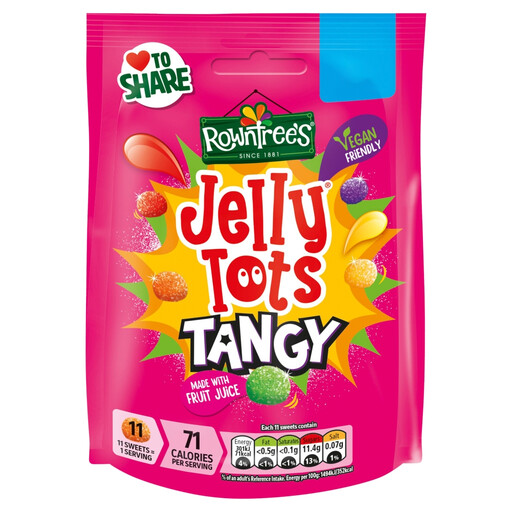
This 140g Tangy variant offers a different bag size to compare for the tea table. If a guest needs a vegan product, check this exact variant’s declaration rather than applying the vegan label from the separate 150g Jelly Tots bag listed by ASDA Groceries. Check its current serving, ingredient and allergy information before sharing.
 No image available
This 175g bag is an option to compare when ordinary chewy sweets are appropriate for the guests. Check the exact pack for its serving measure, ingredients and allergy advice before choosing it for a group with dietary requirements.
 No image available
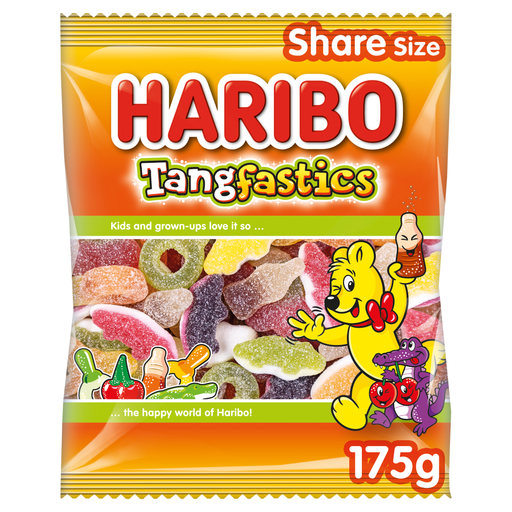
Consider this 175g fruit-and-cola-flavour fizzy bag only for guests who can manage ordinary chewy sweets. Its flavour and format distinguish it from the other Haribo bags here; check the current pack for serving, ingredient and allergy information before putting it out.
Do not assume ordinary jelly sweets are appropriate. NHS guidance identifies coughing or choking while eating as possible signs of swallowing problems, and Kent Community Health NHS Foundation Trust identifies chewy sweets as potentially high-risk for people following dysphagia advice. Follow the person’s existing clinician-led food-texture plan rather than substituting a sharing-bag sweet.
Start with the serving measure on the exact pack, not the full bag. ASDA Groceries lists 11 sweets and 11g sugars per serving for its 150g Rowntree’s Jelly Tots bag, while Sainsbury’s lists 25g servings for its 175g Haribo Goldbears and Jelly Babies Double Trouble bags. Check which measure applies to the product you buy before portioning it.
No. A vegan declaration and an allergy statement provide different information: Marks & Spencer labels Percy Pig vegan but states that it is not suitable for people with a milk allergy. Check the current pack against the guest’s specific requirements.
Use it to compare bags, then read the packaging before serving. Product ingredients and other details can change, so the exact pack is the place to confirm dietary, allergy and serving information for your guests.