What should you check first?
Start with whether this is a routine snack or an occasional treat. If it is a treat, check the child’s age, the sweet’s texture and the current pack before deciding whether to serve it.
| Priority | What to check | Your needs |
|---|
| Routine snack |
Consider NHS snack examples such as fruit, plain unsweetened yoghurt or toast. For packaged sweets, read sugars per serving and per 100g; total sugars on a label are not a direct calculation of free sugars. |
I want something for ordinary between-meal hunger, not a small pack of confectionery mistaken for an everyday snack. NHS guidance says children aged 1 should have no more than 10g free sugars a day, and children aged 2 to 3 no more than 14g. |
| Timing |
Check whether a proposed sweet would be eaten with a meal or between meals. Royal United Hospitals Bath advises serving sugar-containing foods with a meal and offering water or milk between meals. |
If I decide to offer a sweet occasionally, a single pack should not become the usual mid-afternoon snack. |
| Age and texture |
Read the exact product’s age and choking warnings. Department for Education early-years guidance says not to give babies and young children boiled, hard, gooey or sticky sweets. |
I need to check the sweet itself, not assume that every product called a jelly sweet has the same texture or age suitability. |
| Ingredients |
Read the ingredients if vegan or gelatine-free formulation matters. Check nutrition and safety information separately; an ingredient claim does not answer those questions. |
A vegan option may meet my ingredient preference, but I still need to decide whether this particular product is suitable for the child and the occasion. |
Brand and retailer references
These product declarations provide pack sizes, ingredients, sugar figures or warnings to check; they are not endorsements for toddler snack time.
Rowntree’s
Nestlé Confectionery UK lists Jelly Tots in an individual 42g bag as well as larger formats.
- The brand describes Jelly Tots as suitable for vegans and vegetarians.
- Its product declaration gives 7.6g sugars per seven sweets and 59.0g per 100g. Check the current pack’s age and texture information before considering it for a young child.
Haribo
Starmix and Goldbears provide jelly-sweet label examples, rather than an identified toddler-specific single bar.
- HARIBO UK lists Starmix ingredients and nutrition information; Sainsbury’s lists nutrition information for a Goldbears sharing bag.
- The respective listings state 47g and 46g sugars per 100g. Neither figure establishes toddler suitability.
Tesco
Tesco lists own-brand Jelly Babies in a 250g pack, which is not an individual toddler portion.
- The listing gives sugars both per 25g serving and per 100g.
- It states 15.0g sugars per 25g and advises checking the current label because product information can change.
Sainsbury’s
Its own-brand Fruit Jellies are listed in a 200g pack.
- The listing states 15.7g sugars per four sweets.
- It also warns that the product could be a choking hazard to small children; pack convenience should not override that warning.
Asda
Asda lists own-brand Fruit Jellies in a 200g pack.
- The listing describes the product as suitable for vegans.
- It declares 15g sugars per one-eighth pack and 59g per 100g. Vegan suitability does not establish age or texture suitability.
M&S
Its Jelly Babies listing is particularly relevant when checking product-specific age warnings.
- The listing supplies both a nutrition declaration and an explicit age warning.
- It states 60.8g sugars per 100g and says the product is not suitable for children under 36 months due to a potential choking hazard. Check any other M&S jelly product on its own terms.
A Joybuy snack option
This oat-bar option is for considering a routine toddler snack instead of a jelly-sweet treat; it is not a jelly sweet.
 No image available
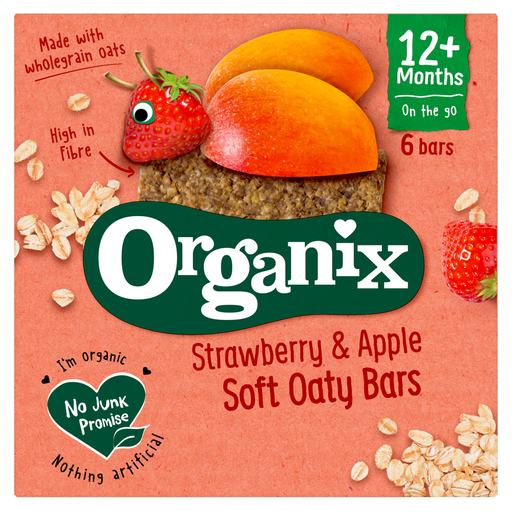
Organix Strawberry & Apple Soft Oaty Bars, 12+ months, 6 x 23g
An oat-bar option for between-meal snack time rather than a jelly-sweet treat. The product name specifies 12+ months and six 23g bars. Check the current pack’s ingredients, allergens and age advice, and supervise the child while eating.
View on Joybuy
Questions about jelly sweets and toddlers
Are jelly sweets suitable as a routine toddler snack?
Choose another food for routine between-meal snack time. The NHS suggests options including fruit, plain unsweetened yoghurt and toast, and advises keeping the amount and frequency of sugary foods low.
Does a single pack make jelly sweets a better between-meal choice?
A single pack makes the quantity more visible, but does not change the guidance on when to serve sugary foods. Royal United Hospitals Bath advises having them with a meal rather than as a between-meal snack, with water or milk between meals.
What age and texture warnings should I check?
Read the warning on the exact pack and consider its texture. Department for Education guidance says not to give babies and young children boiled, hard, gooey or sticky sweets; the M&S Jelly Babies listing specifically says that product is unsuitable for children under 36 months because of a potential choking hazard.
Do vegan ingredients make a jelly sweet suitable for toddlers?
No: vegan status addresses ingredients, not age suitability or sugar content. Nestlé Confectionery UK describes Rowntree’s Jelly Tots as vegan but declares 59.0g sugars per 100g, so check nutrition and warnings separately.
Do England’s school-food rules ban jelly sweets at home?
No home ban follows from the Department for Education guidance on food and drink provided in state-funded schools in England. The guidance describes proposed changes from September 2027 as subject to Parliamentary approval; check an individual nursery or school’s policy for food brought from home.


