Parents handing out one treat at a time
A mini bag provides a separate hand-out without opening a sharing pouch. Check its weight and nutrition information rather than assuming that every individually sold format contains the same amount.


Choose a mini bag when you want to hand out one defined jelly-sweet treat without dividing a pouch. A tube may suit a dietary requirement, but being sold individually does not make it the same size as a mini bag; compare pack weight, sugars per serving and the current ingredients. If the sweets are for a school-organised activity rather than a family half-term snack, check the rules and school policy that apply.
A mini bag provides a separate hand-out without opening a sharing pouch. Check its weight and nutrition information rather than assuming that every individually sold format contains the same amount.
Look for a current product-specific vegan statement and read the ingredients. Nestlé Confectionery describes Rowntree's Fruit Pastilles Tube 48g as vegan, while ASDA lists gelatine among the ingredients of HARIBO Tangfastics.
Food supplied through a school calls for a different check from a family snack at home. Confirm the school's policy and the rules for its UK nation before choosing confectionery for pupils.
Start with how the sweets will be handed out, then check the portion, ingredients and any warnings on the pack you intend to use.
| Priority | What to check | Your needs |
|---|---|---|
| Hand-out format | Compare net weight and pack format. Tesco lists a 16g HARIBO Tangfastics mini bag; Nestlé Confectionery lists a 48g Rowntree's Fruit Pastilles tube. A sharing pouch needs portioning. | I want to give each child one separate treat, rather than decide how much to take from an open bag. |
| Sugars | Read sugars per stated serving and check how many servings the pack contains. ASDA lists 11.4g sugars per serving for Rowntree's Tangy Jelly Tots sharing bag; its stated serving is not necessarily the amount you plan to hand out. | A small-looking pack or fruit flavour should not stand in for the nutrition label when I'm deciding the amount to serve. |
| Dietary suitability | Check the exact product's vegan or vegetarian statement and ingredients. Nestlé Confectionery labels its Fruit Pastilles Tube 48g vegan; ASDA lists gelatine in HARIBO Tangfastics. | Where gelatine is excluded, I need a suitable product-specific label, not an assumption about jelly sweets as a whole. |
| Allergens | Read the physical pack's ingredients, highlighted allergens and precautionary statements. Tesco notes that product information can change with reformulation. | If a child has an allergy, I need to check the pack being served, even if I have bought the same name before. |
| Age warnings | Read warnings for the exact product. M&S Fruit Jellies state that they are not suitable for children under 36 months because of a potential choking hazard. | For a younger child, I need the warning on the chosen pack rather than one borrowed from a different sweet. |
| School setting | Establish whether food is being supplied to pupils through a school. The Department for Education describes requirements for state-funded schools in England; Scotland, Wales and Northern Ireland have separate school-food frameworks. | For a school-organised activity, I need the school to confirm which rules and policy apply. A family half-term treat is a different setting. |
A tube can be bought individually yet contain more than a mini bag; a sharing pouch may list several servings. The format alone does not establish how much one child will receive.
Compare net weight and the stated serving. Choose separate mini bags for fixed hand-outs, or decide in advance how a tube or pouch will be divided.
Fruit-related wording does not tell you the sugars per serving. ASDA lists 11.4g sugars per stated serving for Rowntree's Tangy Jelly Tots.
Use the nutrition panel and serving information for the amount you intend to offer.
Some named products carry vegan statements, while ASDA lists gelatine in HARIBO Tangfastics. Ingredients and allergen information can also change.
Check the current physical pack's dietary statement, ingredients and allergen information before serving.
Retail sale and pack size do not establish whether confectionery can be supplied through a school. England's school-food framework covers food provided in state-funded schools; other UK nations have separate frameworks.
Ask the school or caterer which rules and event policy apply before buying sweets for a school activity.
These examples show formats and label details worth comparing; a brand name alone does not establish portion size or dietary suitability.
Tesco lists HARIBO Tangfastics in a 16g mini bag, a format for handing out separate treats.
Its jelly-sweet formats include Fruit Pastilles tubes and larger Jelly Tots sharing bags.
Tesco lists both a HARIBO Tangfastics 16g mini bag and its own-label Jelly Babies 250g pack.
M&S identifies vegan-friendly options in its jelly-sweets range and labels its Fruit Jellies vegan and vegetarian.
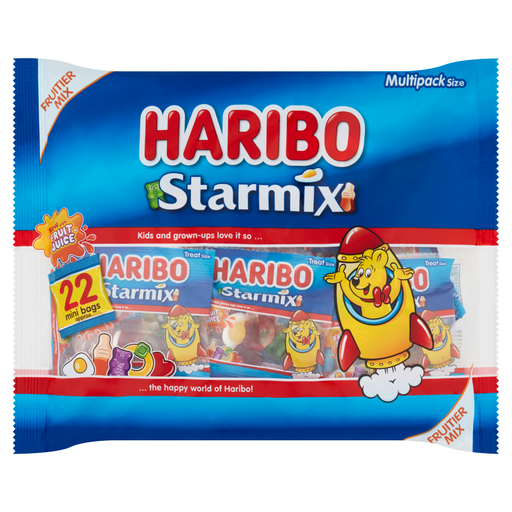
This HARIBO Starmix multipack is an option for handing out separate mini bags during half term. Check the individual bags against your intended portion and dietary requirements.
 No image available
The separate mini bags allow individual hand-outs without opening a shared pouch. The 352g figure is for the multipack; check the pack for the weight and sugars per bag if the amount per treat matters. Ingredients listed for this product include gelatine, so it does not suit gelatine avoidance. Read the current allergen information and age warnings before serving.
No. Tesco lists a 16g HARIBO Tangfastics mini bag, while Nestlé Confectionery lists a 48g Rowntree's Fruit Pastilles tube. Compare the weight and nutrition information for the specific products you are considering; an individual purchase is not necessarily one intended hand-out.
No. Nestlé Confectionery labels Rowntree's Fruit Pastilles Tube 48g vegan, whereas ASDA lists gelatine in HARIBO Tangfastics. Check the current ingredients and dietary statement for the exact product.
Check with the school or caterer before buying for pupils. The Department for Education describes requirements for food provided in state-funded schools in England, and England's school-food regulations define non-chocolate confectionery as confectionery. Scotland, Wales and Northern Ireland have separate frameworks, so an England-specific conclusion should not be applied to every school activity across the UK.
No; check the exact pack. M&S Fruit Jellies state that they are not suitable for children under 36 months because of a potential choking hazard. Do not apply that product's wording, or the absence of a warning on another listing, to every jelly sweet.
Read the physical pack's ingredients, highlighted allergens and any precautionary statement before serving. Tesco notes that product information can change with reformulation; the Food Standards Agency explains that precautionary allergen labelling concerns possible unintended allergen presence.